


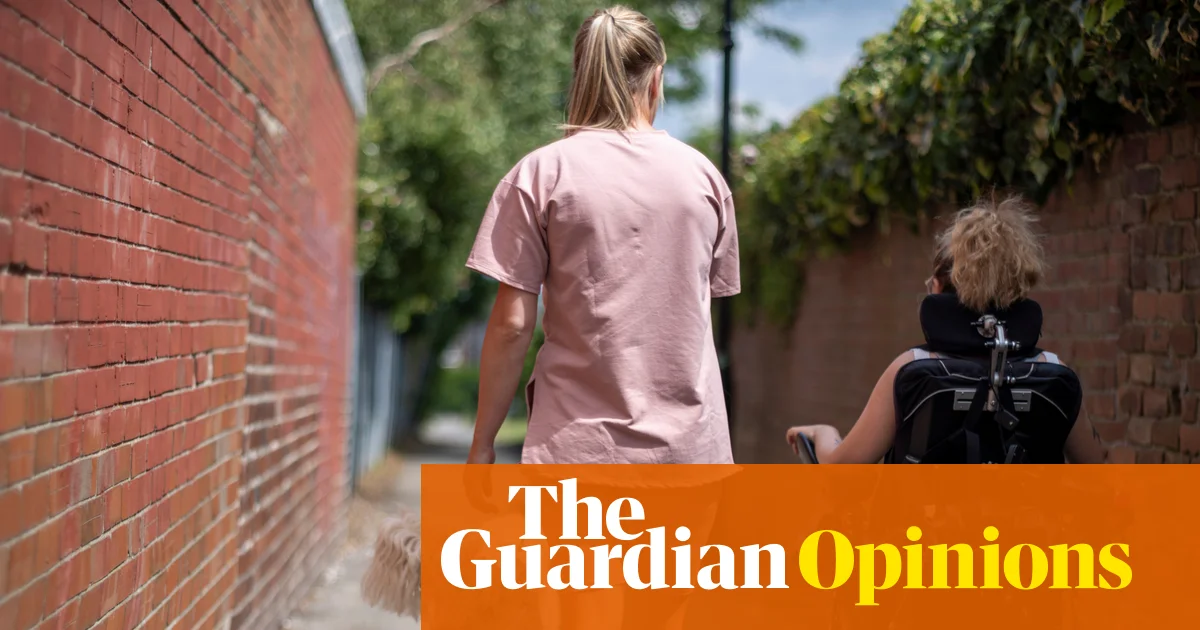
Disabled people are being barred from leaving the country. This isn’t the first line of a dystopian novel but a scandal quietly happening across swathes of England. For the past six months, myself and my colleague Patrick Butler have spoken to disabled people who have effectively been blocked from going abroad on a holiday or to a work event by their local care provider.
There’s 38-year-old Lucy from Oxfordshire who needs to travel internationally as the president of the European Spinal Cord Injury Federation. And Chelsea from Lancashire, a 25-year-old with cerebral palsy who dreams of swimming in Spain again. Then there’s 40-year-old Joel*, who has a muscle weakness and works for a global marketing brand but hasn’t been able to leave the UK for nine years.
Some have live-in personal assistants (PAs) via NHS continuing healthcare, the non-means-tested home support for people with high needs. Others have 24/7 social care through their local authority. But when they try to leave the country, all hit the same wall: they are told they are not allowed to use their care package abroad, sometimes even if they pay any extra costs themselves.
Here’s the plot twist. Some areas of the country are permitting care users to go on holiday or travel for work – while disabled people just a few miles down the road can be stopped. Others are told they can travel but have to pay any extra expenses – effectively still barring them financially from going – while some care boards offer to cover the cost. As there is limited to no national guidance on the issue, disabled people’s right to travel depends on a postcode lottery, with local care officials inspecting their plans for a trip away and having the power to rule “go” or “stay”.
This week, MPs and peers called for national guidelines to end this injustice. Figures such as the work and pensions select committee chair, Debbie Abrahams, the crossbench peer Jane Campbell and the former Labour leader Jeremy Corbyn told the Guardian that the government must guarantee the rights of disabled people to travel and ensure they have the support they need to do so.
You can practically hear the right preparing to oppose the move with a cry of “Free holidays on the NHS!” But care users going abroad doesn’t cost the taxpayer anything extra in care bills. Disabled people who need 24/7 support for everyday activities already have care funding in place, and in many cases use their own money to pay PAs’ travel expenses, such as accommodation and plane tickets (on top of the already extortionate price of accessible travel). When Lucy was told by her care board she couldn’t take her PAs to a spinal cord conference in Germany this spring, her employer had already offered to pay any additional costs.
The question, then, is why would authorities want to stop disabled people going abroad? If it’s not just about tight budgets, why should it matter to them how an adult chooses to use their care package? You could say that it’s about practicalities: it’s easier not to worry about insurance or visas (disabled people largely sort this themselves for their PAs anyway). But it seems naive not to think there’s some prejudice lurking under the bureaucracy. Blocking disabled people from going on holiday or working abroad goes to the heart of cultural assumptions about disability: that we don’t have careers or families or friends like other, “normal” people.
Sixty years after disabled people left institutions and were able to live independently, alongside the vast gains, the stain of paternalistic control still lurks in disability services. It’s the social worker who suggests you get a commode next to your sofa because it’s cheaper than an accessible bathroom. It’s the care worker who speaks very slowly to you and picks your clothes out on your behalf. It’s the occupational therapist who suggests you get a hospital-style bed that your husband can’t fit in (and is visibly surprised you have a husband).
We’re not supposed to talk about this stuff. There’s an unwritten rule that says disabled people should be just grateful for what they’re given by the state, lest we appear to be scroungers or burdens. I say “unwritten”. It’s written in some newspapers most weeks.
It is uncomfortable, I suppose, in part because it is so ordinary. This isn’t the sort of prejudice that comes with an ableist slur or a violent push. It is the gentle, everyday belief that certain kinds of lives – certain kinds of people – come with low expectations.
after newsletter promotion
Just look at the way much of the political and media class discuss social care. In the rare instances that younger disabled people are mentioned alongside elderly people, social care is still solely spoken about in terms of personal care – say, help to wash or prepare a meal. As Andy Burnham has put reform of the care sector on the agenda in recent months, it’s notable there has been little talk of its role in supporting a disabled person’s family role or career: whether that’s help to drop the kids off at school on the way to the office or to get to the pub to celebrate a friend’s birthday.
That’s understandable. Under the current system, as many as 1.5 million disabled people in England are left without access to even the most basic help. If you are suffering the indignity of sitting in soiled clothes because a care worker hasn’t arrived to assist you to the bathroom, it can feel pointless – delusional, even – to mention you’ve not seen the sea in years.
But to settle for this state of affairs forces disabled people to accept a half-life, to be relieved to at least be clean and fed, and to try to forget the colour that defines being human. It diminishes not only our humanity but the principle that disability campaigners fought for decades for and underpins the modern care system: for disabled people to have choice and independence over our lives, just like everyone else.
When I recently spoke to Campbell, who has 24/7 PAs herself, about the care abroad scandal, she said something telling: “It’s as if those controlling [these decisions] believe disabled people don’t deserve the same experiences they enjoy.”
As pressure for national guidelines mounts, I can’t help but think that is a wise litmus test. Would you expect a non-disabled person to live like this? And if not, why do you think it’s OK for disabled people?
*Name has been changed
