


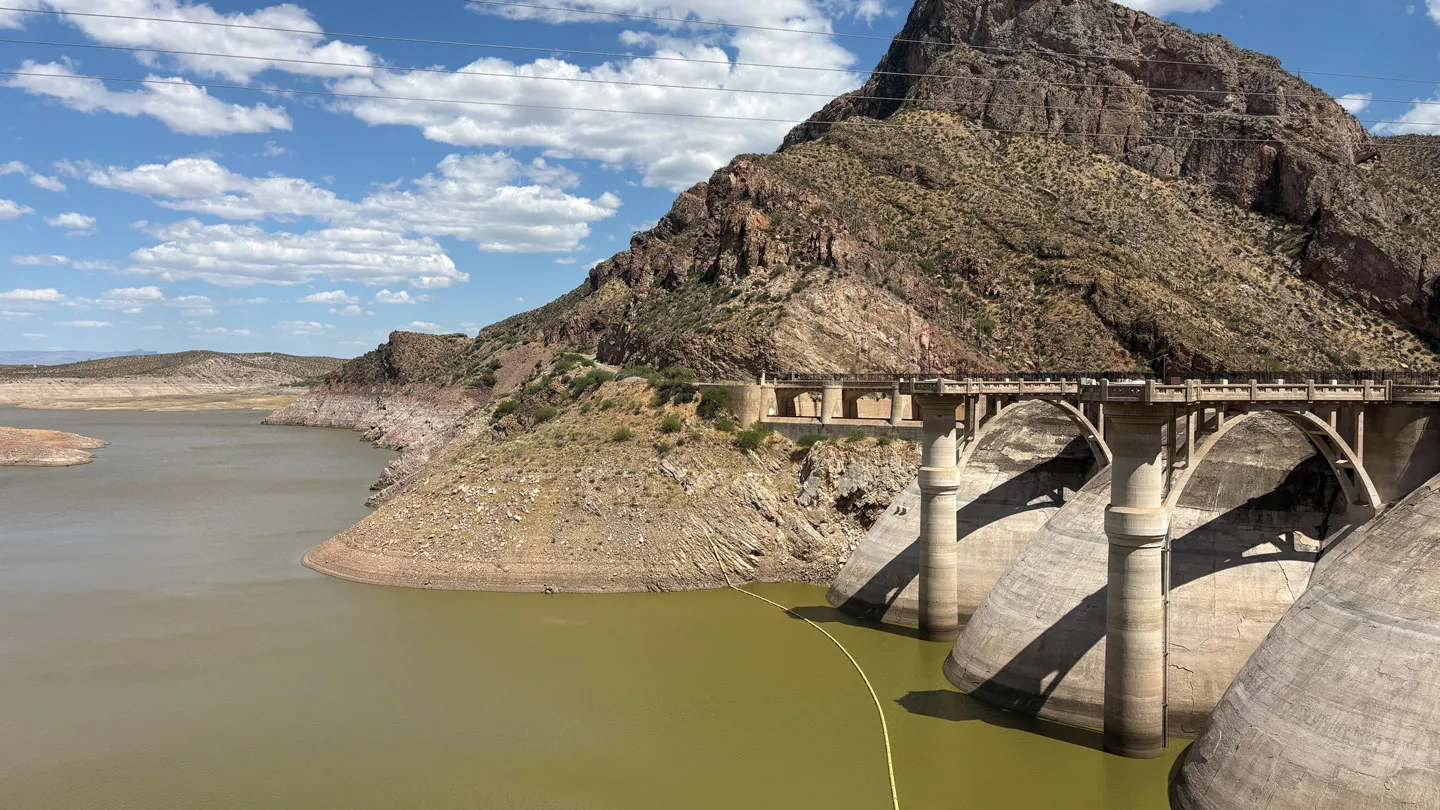
Kearny, Ariz., is a town on the brink. Located at the foot of the Dripping Spring Mountains in eastern Arizona, this small community of 2,000 people sources its water from the Gila River, a verdant waterway that snakes by the southern edge of town.
But in March, the snowpack feeding the river had dropped to precipitous levels: It was just 1 percent of its historic norm for that time of year. The Gila River water commissioner slashed Kearny’s allotment of river water by some 85 percent. And in April, town officials announced that “Zero Day” was approaching, at which point the taps would run dry.
“We need rain,” says Norm Warren, a lifelong Kearny resident. He owns the only large grocery store within a 45-minute drive of the town. Without tap water for refrigerator cooling systems, Warren says he won’t be able to store perishable products like meats and fresh produce.
Kearny’s dilemma foreshadows a crisis building across the American Southwest. Since 2000, the region — which includes Arizona, New Mexico, California, Utah, Colorado and parts of northern Mexico — has endured a historic “megadrought,” or a period of severe dryness that persists for decades. Scientists say it’s the driest this region has been in 1,200 years.
“We’re 27 years into it, and it shows no signs of letting up,” says Brad Udall, a water and climate researcher at Colorado State University in Fort Collins.
Scientists point to two factors causing the drought — rising temperatures and declining precipitation. Heat from human-caused climate change creates a thirsty atmosphere that is more effective at drying out the landscape, says Kevin Anchukaitis, a dendrochronologist who runs the University of Arizona Laboratory for Tree-Ring Research in Tucson. As for the lack of rain, many researchers wonder if it is simply a stroke of bad luck.
But a controversial study published in Nature in 2025 suggests something far more ominous: Humankind has disrupted a naturally occurring climate cycle in the Pacific Ocean that historically ushered episodes of wet weather into the Southwest. If that’s true, Udall says, things are not looking good for places like Kearny. Other researchers worry that the megadrought may be locked in place for the foreseeable future.
A thirstier atmosphere
The drought is transforming the American Southwest slowly but inexorably. Since 2000, the region’s most vital waterway, the Colorado River, has seen its flow decrease by roughly 20 percent. Lakes Powell and Mead, the river’s largest reservoirs, fell to historic lows in August — about a quarter of their combined capacity. That’s a hard blow for the roughly 40 million people who depend upon the Colorado for their daily needs.
In August, the federal government cut the amount of river water allocated to Arizona, California and Nevada by roughly 20 percent over the next two years. If conditions don’t improve, those states could see future reductions of up to 40 percent.
Although agriculture is likely to bear the brunt of the reductions, residential users in many cities may see their water bills increase dramatically as a result, according to municipal officials from Phoenix and Tucson.
“We feel the urgency of it,” says Warren, who — along with other residents of Kearny — has cut back on his laundry and showers. He has let his lawn die and now waters his other plants with used dishwater. “The town is really trying.”

Nature, however, isn’t getting on board. As temperatures across the Southwest climb, rainfall is dropping. From 2000 to 2021, annual precipitation in the Southwest was 8.3 percent lower than the average of the previous 50 years. That’s helped create a drought of historic magnitude.
An analysis of regional soil moisture and tree ring data backs that up: The drought is the most severe the Southwest has endured in more than a millennium, scientists reported in 2022 in Nature Climate Change. An updated dataset provided to Science News shows that the megadrought, now 27 years long, remains the driest such period since the year 800.
Those numbers don’t particularly shock Margaret Evans, an ecologist at the tree ring lab.
Evans and her colleagues study the 1,000-year-old rings of ancient trees across the Southwest to measure past droughts. Like the stratigraphic layers of the Grand Canyon, these rings serve as natural records of the settings in which they formed. Thicker ones indicate years of greater growth, which generally correspond to wetter conditions.
By examining the tree rings from roughly a dozen sites in the Upper Colorado Basin, researchers from her lab and others have found evidence of at least two other megadroughts: one in the 12th century and another that spanned almost the entire second century. Scientists used computer models to reconstruct how much water would have flowed through the Colorado River at the time. During the 12th century drought, the river fell to roughly 80 percent of its 20th- and early 21st-century average. During the second century drought, the river fell to 68 percent of that average.
A Modern Megadrought
The current megadrought in the American Southwest is the driest 27-year period in the past 1,200 years, according to soil moisture anomalies derived from tree ring data and modern observations.

That suggests our modern megadrought falls within the realm of natural variability, Evans says. What’s different, she adds, is that it’s a “warm drought.”
Temperature plays a key role in how much moisture remains on the ground as rain or snow. The hot conditions brought on by climate change, Anchukaitis says, have made the sponge of the atmosphere better at sucking up moisture. A 192-year-old thermodynamic formula called the Clausius-Clapeyron equation explains how: For each degree Celsius of warming, a parcel of air can hold 7 percent more water. “A thirsty atmosphere will take that water that does fall from the sky away from the surface,” Anchukaitis says.
Those effects — and the uncertainty over how long they will continue — has caused some researchers to stop using the word “drought” altogether. Instead, they favor the term “aridification,” which describes a progressive drying process. Wet weather can come and go, Anchukaitis says, but if the temperature keeps rising, it’s the perfect recipe for aridification.
A Pacific influence
An arid atmosphere isn’t all that’s driving the megadrought. The other piece of the puzzle lies in the vast waters of the Pacific Ocean.
At its heart is a phenomenon known as the Pacific Decadal Oscillation, or PDO. It’s an alternating climate pattern in which areas of warmer and cooler than normal surface waters switch their positions every 20 years or so, says climate scientist Richard Seager of Columbia University. Unlike some shorter-term climate patterns, the PDO “goes back and forth with timescales of many decades,” Seager says.
Scientists had long assumed that the PDO obeyed a regular rhythm dictated by the complex interactions between the land, sea and atmosphere. Understanding that cadence has always been of vital interest, Anchukaitis says, because of the PDO’s powerful influence on the North American climate.
When the PDO shifts, it diverts the path of the Pacific jet stream, a band of high-flying winds that steers weather patterns around the world. During the PDO’s warm phase, a horseshoe of cooler water covers the northern, western and southern Pacific, while a warmer tongue occupies the eastern Pacific. That pushes the Pacific jet stream south over North America, shepherding wet weather patterns into the Southwest.
But when the PDO switches to its cool phase, the locations of those warm and cool surface waters flip, and the jet stream moves north, diverting wet weather patterns out of the Southwest and making drought more likely.
The PDO’s last warm phase ran from 1977 to 1998, causing the wettest period the Southwest had seen in a millennium, Seager and colleagues reported in 2025 in AGU Advances. But sometime around 1999, the needle swung in the other direction, moving the region from an extremely wet period to an exceptionally dry one, Seager says.

Given the PDO’s presumed cyclical nature, many scientists thought that the switch was only temporary. “The conventional wisdom suggested that the PDO could shift any given year, and we [wouldn’t] have to worry about drought [after that],” says climate scientist Jeremy Klavans of the University of Miami.
But he and colleagues weren’t so sure. They dug into that assumption, analyzing more than 500 simulations of the PDO from a dozen major climate models. They examined how the PDO shifted — and stabilized — in the presence of outside forces such as volcanic eruptions, solar variation and levels of greenhouse gases and aerosols.
Their finding: Greenhouse gas and aerosol emissions had effectively hijacked the behavior of the PDO over the last 50 years by altering atmospheric temperatures, the team reported in 2025 in Nature.
Ballooning concentrations of industrial aerosols — which can have an atmospheric cooling effect — probably pushed the PDO to increasingly favor its warm phase starting in the 1950s, the researchers say. But in the 1980s, clean air legislation decreased aerosol emissions even as greenhouse gas levels continued to rise and warm the atmosphere. That combination drove the PDO toward its cool phase, making drought conditions more likely in the Southwest. Instead of being a rare event, drought “becomes kind of commonplace,” Klavans says.
To see if such events had historic precedent, another group of researchers looked to a period of warming that took place during the mid-Holocene Epoch, some 6,000 years ago. At the time, changes to Earth’s orbit around the sun and the spread of vegetation caused less sunlight to be reflected away from the planet, heating up the Northern Hemisphere. The researchers reasoned such warming should have pushed the PDO into a prolonged cool phase.
After scouring data from bog and lake sediment cores and analyzing dozens of climate simulations re-creating the period, they found that something resembling a cool phase of the PDO did in fact take place. It lasted several thousand years, during which time drought became widespread across the Southwest, they reported in 2025 in Nature Geoscience.
And the current climate models may actually be underestimating the potential duration of the ongoing megadrought, based on those findings, says study coauthor Victoria Todd, a climate scientist at the National Center for Atmospheric Research in Boulder, Colo.
That could be bad news for the American Southwest, Udall says. Even if people stopped emitting greenhouse gases today, planet-warming carbon dioxide will continue to accumulate in the atmosphere, locking the PDO and megadrought into place, potentially for decades. If the emerging science is right, then the Southwest is going to keep getting drier and drier, Udall says. “No question about it.”
Trading Places
The Pacific Decadal Oscillation, or PDO, is a climate pattern in which areas of warmer- and cooler-than-normal surface waters in the Pacific Ocean switch their locations every couple of decades. This affects climate on the surrounding continents.
Warm phase (1977–1998)

During the PDO’s warm phase, the Pacific jet stream (red arrow) moves south over North America, drawing wet weather patterns into the Southwest.
Cool phase (1999–now)

When the PDO switches to its cool phase, the Pacific jet stream (blue arrow) moves north, diverting wet weather patterns out of the Southwest and making drought more likely.
What’s to come
The hypothesis that human emissions have disrupted the PDO could be put to the test this year. That’s because scientists are predicting a historically strong El Niño, a Pacific climate pattern characterized by months of warmer than normal sea surface temperatures in the eastern equatorial Pacific. El Niños often bring wet conditions to the Southwest — and they have been known to force the PDO into a different phase. For example, the 1976–1977 El Niño helped push the PDO into a warm phase for nearly a quarter of a century.
But a powerful El Niño in 2015 wasn’t able to force the switch for more than a few years. That suggests the PDO may be slowly changing, Klavans says. “Something’s different here.”
Even if the current El Niño is strong enough to force the PDO into a warm phase, no one should expect the megadrought to go away any time soon, Seager says. “We’re talking about something that’s been going on for a few decades now. Even one very wet winter is not going to be enough to restore Colorado River reservoirs to where they would preferably be.”
To find out what would happen if the PDO switched to a warm phase in the near future, Seager and colleagues simulated multiple scenarios in which the PDO either stayed in the warm phase or flipped back into a cool phase, all the while monitoring potential impacts on the megadrought.
Even in the best-case scenarios, the Southwest never returns to the wet years of the 1980s and ’90s, when lakes Powell and Mead reached maximum capacity numerous times, the researchers reported in 2023 in npj Climate and Atmospheric Science. The findings instead suggest that, regardless of what the PDO does, the region will face a far drier climate than it did in its recent past. In other words, even if the megadrought were to end, the Southwest faces an uncertain future when it comes to water, according to the study.
Communities need to prepare for the future by improving their water conservation efforts and infrastructure, Anchukaitis says. Those practices will grow only more crucial as the Southwest’s population continues to balloon: Utah, Texas, Nevada, Colorado and Arizona are among the 10 fastest growing states by population this decade, according to a 2024 report by the University of Virginia’s Weldon Cooper Center for Public Service.
Even if wet weather returns, Anchukaitis says, the cities of the Southwest shouldn’t fall into complacency. “[More rain] doesn’t mean that … megadroughts aren’t going to come back,” he says. “Maybe it buys us some time to ease systems into a new way of thinking.”
In Kearny, the town’s residents have made some impactful changes. Though officials first warned Zero Day could occur in July, they now estimate that water restrictions and conservation efforts — as well as canceled water requests by other communities — have helped extend the town’s water supply until at least the end of the year.

But such measures can do only so much. The upstream flow of the Gila River is controlled by the Coolidge Dam, and the reservoir behind the dam is currently less than 1 percent full. If nothing changes before next year, Kearny’s annual allotment of river water could fall to zero.
Back in his store, Warren contemplates the town’s future. “This is going to hurt us if we have to shut off our livelihood,” he says, glancing around at his stocked shelves. “We can’t walk away from it.”
