


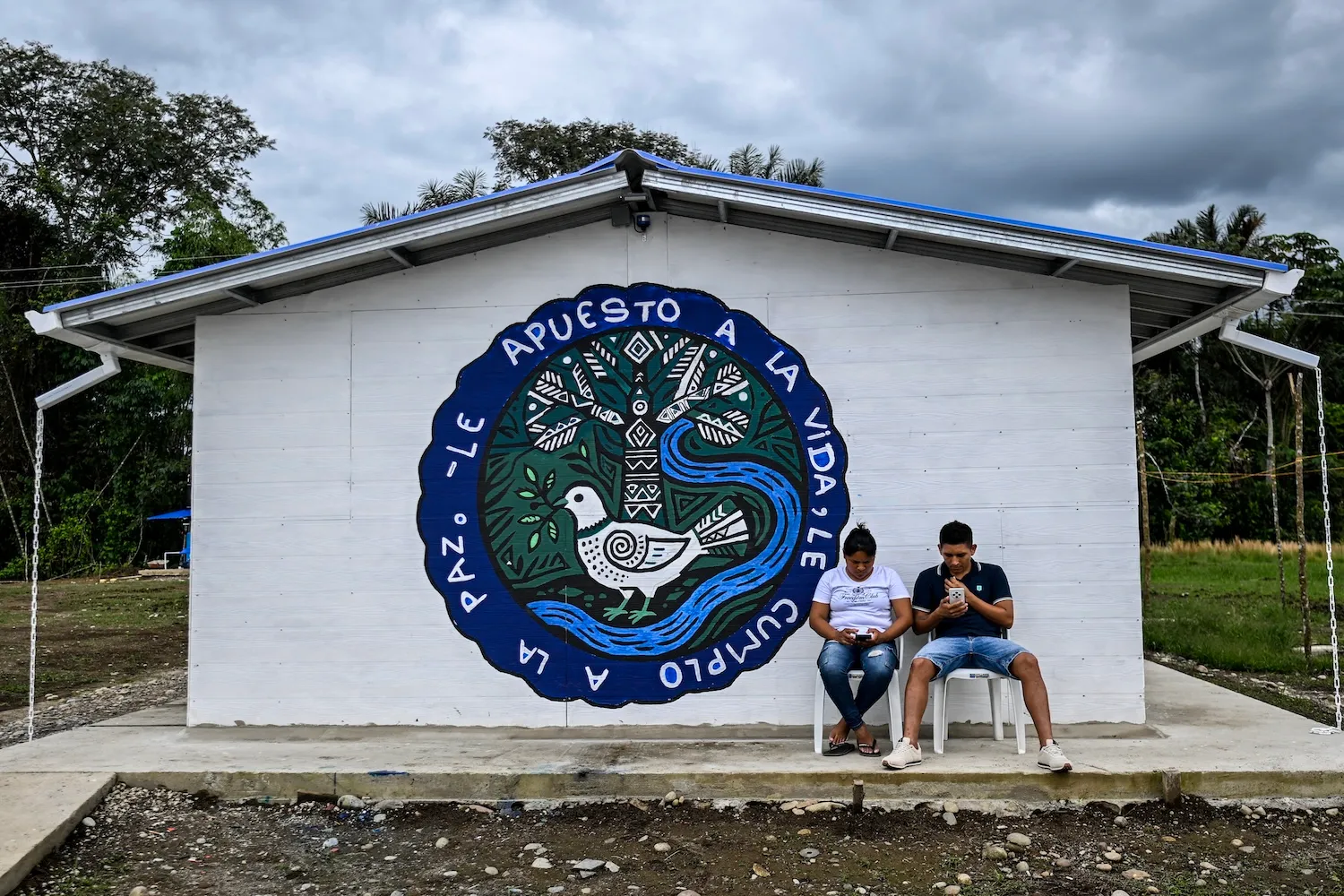
PUTUMAYO, Colombia—As the afternoon heat set in on La Granja de Paz in July, cooperative members returned from their shifts at the fishponds, taking a break before preparing their catches for the next day’s market. They trickled into a communal gathering space, where they shared their anxieties around what the country’s new government could mean for their way of life.
The Cooperativa Multiactiva Comunitaria del Común, or Comuccom, comprises nearly 100 former Revolutionary Armed Forces of Colombia (FARC) fighters and their families. They have established their lives on this farmland in southern Colombia: building homes, digging fishponds, setting up a plant nursery and an apiary, and founding a daycare for nearby rural communities.
The local municipality, Puerto Guzmán, loaned the land to the collective’s founders in 2019 through a reincorporation program established under the 2016 peace agreement between the Colombian government and the FARC, once Latin America’s largest left-wing guerrilla group. The accord ended more than five decades of fighting and created an extensive transitional justice framework to facilitate demobilization and the reintegration of former combatants.
A member of the Carlos Patino Front, a FARC dissident group, patrols next to coca crops in Micay Canyon in southwestern Colombia on March 24, 2024.Raul arboleda/AFP via getty images
A decade on, however, the peace agreement has failed to meet expectations, and armed groups are expanding again in Colombia. New armed factions, some led by former FARC members, have capitalized on the power vacuum left by demobilization in strategic areas—particularly in Putumayo, a coca production enclave with access to drug trafficking routes to Brazil and Ecuador.
With new Colombian President Abelardo de la Espriella implementing an increasingly militarized security approach, members of Comuccom—along with thousands of other former FARC fighters—fear that the peace agreement will be undermined, leaving them in limbo and endangering the lives that they have built over the last decade.
After the FARC demobilized in 2017, Comuccom members resided alongside a few hundred other former fighters in La Carmelita, a stretch of land designated by the government for their transition into civilian life. But many ex-combatants left La Carmelita over the years, returning to their old homes, pursuing other opportunities, or fleeing threats from dissident groups or other rivals.
Seeking somewhere with a greater capacity for large-scale agriculture, the cooperative’s founders found an ally in the then-mayor of Puerto Guzmán, Rodrigo Rivera Ramírez, who helped get the land loan for La Granja approved by the municipal council. At the time, the plot was abandoned save for “scorpions, snakes, and wasps,” said José Montiel, a member of Comuccom.

Colombian President Juan Manuel Santos (left) and FARC leader Timoleón Jiménez shake hands during the second signing of the peace agreement between the Colombian government and the FARC at the Colón Theater in Bogotá on Nov. 24, 2016.Luis Robayo/AFP via getty images
Cooperative members relied on their years of training as insurgents to make the land livable, sleeping in tents while they built more permanent shelter. They pooled the money they received as part of the reincorporation process—around $2,400 for each ex-combatant—and sought more funds from local and international organizations, including the United Nations and the European Union. Over time, more families moved in.
Though life on La Granja is mostly peaceful, residents haven’t fully escaped political violence. Dissident groups often attempt to recruit ex-combatants to bolster their numbers; those who refuse find themselves in danger. In 2022, Jorge Santofimio Yepes, one of the cooperative’s founders, was killed, presumably by members of a FARC dissident faction. Four others were injured in the attack, including children.
In response, Comuccom requested security from the Colombian government, which now deploys soldiers to the area for daily patrols. Many residents work as bodyguards on the farm and the broader region in a specialized unit for former FARC fighters established by the peace agreement. Despite these additional protections, Comuccom members still receive death threats from dissident factions fighting for control over Putumayo.
José Arroyo, a Comuccom member, said the collective is determined to stay. “One of our members was murdered here, others have been threatened and have had to leave, but despite all that, we’ve managed to hold our ground,” he said. Still, many residents fear escalation—and that Colombia’s new leadership will weaken the few protections they have gained.

A man throws a tire into a fire during unrest following the preliminary results of the presidential runoff election in Bogotá on June 21. Diego Cuevas/AFP via getty images
De la Espriella, who replaced President Gustavo Petro on Aug. 7, has been an outspoken critic of the 2016 peace agreement. On Sept. 7, the government shut down remaining negotiations with criminal groups that have been ongoing since 2022. These talks, part of Petro’s Total Peace initiative, found little success: Of nine attempted negotiations, only those with the Border Commandos, a Putumayo-based armed faction, had tangible results.
De la Espriella also plans to reinstate programs to eradicate Colombia’s coca plantations, which produce an estimated 70 percent of the world’s cocaine supply. (Petro’s government moved away from similar policies to focus on interdiction efforts.) There were more than 44,000 hectares of coca in Putumayo as of 2024, and many farmers, including ex-combatants, are dependent on the cash crop. Without a plan to transition those workers to other means of income, forced eradication could lead to confrontations between eradicators and armed forces.
De la Espriella has already intensified military operations against various guerrilla groups, launching an offensive remarkable for its speed, scale, and mounting civilian casualties. At least 84 people died in confrontations between security forces and armed groups in August, according to ACLED—the highest monthly toll since the global monitor began collecting data on Colombia in 2018. Another 24 people, including three minors, died during an operation in Guaviare this month, prompting a judge to order the government to suspend bombings if there is any indication that minors are present.
This harsher approach recalls that of former Colombian President Álvaro Uribe, who oversaw a military offensive against the FARC in the early 2000s. Although Uribe was praised for security accomplishments during his presidency, he was also accused of overseeing war crimes and crimes against humanity and of sponsoring the militias responsible for the largest share of civilian deaths during Colombia’s decades-long conflict.
In Putumayo, which was particularly hard-hit by violence, many remember the Uribe years as a dark time—such as María A., a former FARC combatant who requested to go by her first name out of fear for her safety. Wary of de la Espriella’s rhetoric, she said she was ready to move at a moment’s notice to protect her children. “I’m not going to wait for paramilitaries to come in and recruit [my son], like when Uribe was in power,” she said.

Colombian farmers and police officers work to uproot coca plants during an eradication operation in Putumayo’s Villagarzón municipality on June 11. Raul Arboleda/AFP via getty images
In 2021, attackers stormed into María A.’s home and shot her husband. He was one of almost 500 former FARC members killed since 2016, including 46 in Putumayo alone. “Sometimes I think it would have been better if we had stayed [in the guerrillas],” she said.
Lucía Pianda, a former FARC fighter who lives in La Carmelita, shares that sentiment. She said violence against ex-combatants and the difficulty of finding stable employment have made her question the decision to accept the peace agreement. “Sometimes I even look around, and I feel like going [back to the armed groups] because I don’t see anything here—I don’t see any future for myself,” she said.
Ultimately, Pianda said she won’t join another armed group to protect her children.
For others, the political massacres of members of the left-wing Patriotic Union (UP)—a party that emerged from peace negotiations between the FARC and the Colombian government in the early 1980s—feel like a warning. After the UP’s strong showing in regional and local elections between 1986 and 1990, the government allied with paramilitary forces to target and kill more than 6,000 UP members, supporters, and accused left-wing sympathizers.
“We think: ‘Are they going to kill all of us?’” said Mileidy Martínez, a Comuccom member. “Because look at what happened with the other people that demobilized all those years ago.”

Colombian President Abelardo de la Espriella speaks during his inauguration in Cali, Colombia, on Aug. 7. Leonardo Castañeda/Getty Images
The current Colombian government is legally obligated to carry out the peace agreement until 2030. Nevertheless, a month before taking office, de la Espriella announced plans to eliminate several key institutions and more than 200 positions—including the Unit for the Implementation of the Final Agreement, the Presidential Advisory Office for National Reconciliation, and the high commissioner for peace—as part of his promise to reduce state spending by as much as 40 percent.
In August, the Colombian government released its 2027 budget proposal, which was approved by Congress on Sept. 14. The Agency for Reincorporation and Normalization (ARN), which monitors more than 10,000 ex-combatants in their transition to civilian life, faces a 37 percent budget cut. The government has already frozen the agency’s funding for the remainder of 2026.
Some ex-combatants are concerned that the government will stop paying their monthly stipend of approximately $600, which is tied to individual progress on reincorporation and administered by the ARN. This money is essential, especially since many former fighters’ businesses and projects have struggled to break even or been shut down due to violence and threats.
De la Espriella has also threatened to slash funding for the justice tribunal established by the 2016 peace agreement, saying the court has let war crimes committed by FARC leaders to go unpunished. So far, the budget does not include such cuts. Hundreds of ex-combatants still await final legal decisions before the court’s mandate expires in 2033.
Anxieties around the health of the transitional process are not new; the implementation of the peace agreement slowed down considerably during former President Iván Duque’s rule from 2018 to 2022. Some Comuccom members, such as Duberney López, believe that de la Espriella could “walk back everything that’s been built.”
Meanwhile, Comuccom and other associations of former FARC fighters have been working for years to purchase plots of land, including La Granja, as part of the agrarian reform included in the peace agreement. Though there have been considerable steps toward land access and restitution, barriers remain.
Despite the uncertainty, life in Comuccom continues. As de la Espriella’s government settles in, former combatants and their families tend to their fish and bees, gather for soccer games, and lobby the mayor’s office for help in improving the daycare’s facilities. “We want to work this land with everyone, no matter who they are, so that we can embrace each other one day and see that we built this together,” Arroyo said.
