


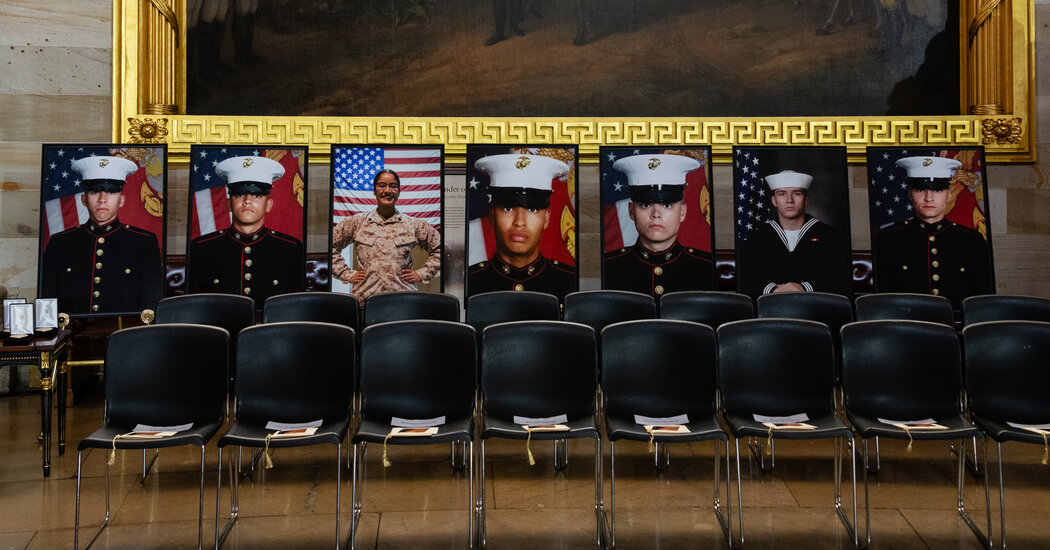
An Afghan man was sentenced in Virginia on Wednesday to 20 years in prison in a case where prosecutors had sought to tie him to a suicide bombing outside the Kabul airport in 2021 but the jury delivered a mixed verdict.
The man, Mohammad Sharifullah, was found guilty in April of aiding the Islamic State Khorasan, or ISIS-K, the terrorist group that claimed responsibility for the bombing. The attack at Afghanistan’s main airport killed 13 American troops and more than 150 Afghans, and became a symbol of the chaotic U.S. withdrawal from the country during the opening months of the Biden administration.
But jurors could not decide whether Mr. Sharifullah should be held directly responsible for the airport attack.
The bombing took place at what was known as Abbey Gate, the entry point to Hamid Karzai International Airport in Kabul, the capital. It had become a gathering point for thousands of civilians who were seeking to flee Afghanistan as the Taliban took hold of the country.
Mr. Sharifullah, who was arrested in Pakistan last year, was accused of helping a suicide bomber reach the airport without being detected. The bomber walked into a crowd of civilians at Abbey Gate and detonated an explosive hidden under his clothing.
“Mohammad Sharifullah has dedicated his life to violence and murder for the sake of hatred,” Theophani K. Stamos, a deputy to the U.S. attorney for the Eastern District of Virginia, said in a statement on Wednesday. “We cannot restore the lives he has taken, but we can bring a measure of justice to the families who lost so much on that day.”
Mr. Sharifullah faced the possibility of life in prison. The jury in his trial unanimously agreed that he was a member of ISIS-K and convicted him of conspiracy to provide material support to a designated foreign terrorist organization. They split on whether there was enough evidence to blame him for the Abbey Gate attack.
Lawyers for Mr. Sharifullah argued during his trial that he was not responsible for the attack.
Geremy Kamens, a lawyer for Mr. Sharifullah, said in an email on Thursday that hearing from families of some of the service members during Mr. Sharifullah’s sentencing on Wednesday was “heartbreaking.”
“Those families deserve to see the people responsible for that attack brought to justice,” he wrote. “But the jury heard the evidence and did not find that Mr. Sharifullah was among them.”
After Mr. Sharifullah was transferred to U.S. custody, the F.B.I. said he told agents that he was a member of ISIS-K and that he knew the operative who blew himself up at Abbey Gate. He also admitted to scouting the attacker’s route to the airport, the agency said.
Mr. Sharifullah’s defense lawyer, however, disavowed his confession, saying it was false and coerced.
The prosecution’s case relied heavily on the confession. During the trial, the judge instructed the jury that they could not convict based on a confession if it was not corroborated by other evidence.
The F.B.I. said Mr. Sharifullah had admitted to having played a part in other ISIS-K terrorist attacks: He provided transportation for the bomber accused of a 2016 suicide attack on the Canadian Embassy in Kabul, which killed at least 10 people. The bureau also linked him to an attack on a music venue in Moscow in 2024 that killed about 130 people. He also admitted to sharing instructions on how to use assault rifles with two of the four gunman who were charged in the Moscow attack, the F.B.I. said.
Overall, prosecutors said, Mr. Sharifullah participated in more than a dozen attacks over nearly a decade.
