


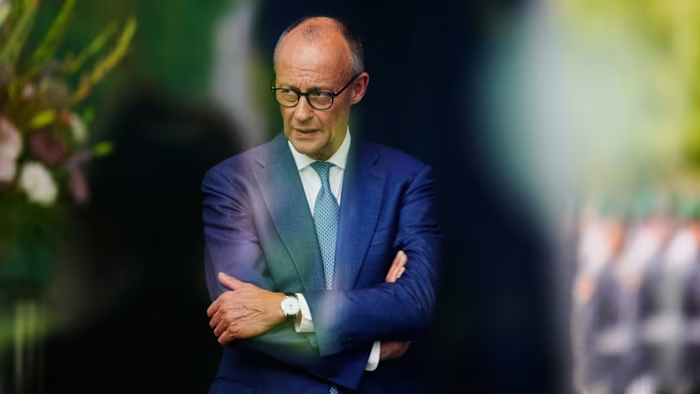
German Chancellor Friedrich Merz is facing mounting unrest within his party ahead of two regional elections on Sunday, with some insiders warning that more poor results could hasten his departure from office.
Merz has decided to skip next week’s UN General Assembly in New York and hold an emergency party meeting on Sunday evening as he seeks to contain the fallout from expected losses for the Christian Democratic Union in Berlin and the north-eastern state of Mecklenburg-Vorpommern.
Two weeks after the far-right Alternative for Germany won a shock victory in the eastern state of Saxony-Anhalt, where the CDU recorded its worst-ever result, Merz is confronted with a growing belief within his party that he has to go in order to stop the bleeding.
A change in chancellor only 16 months into his four-year term would send shockwaves across the EU, Nato and all the way to Ukraine, given that Merz’s government has been a steadfast ally for Kyiv and its biggest military aid donor in Europe.
A transitional period in Berlin would also come just months ahead of presidential elections in France at the end of Emmanuel Macron’s 10-year presidency and as EU governments are locked in financial negotiations over the bloc’s next seven-year budget in Brussels.
While Merz has so far held firm and given no indications he is willing to leave, a CDU insider told the FT there was now “broad consensus” that a poor result leading to ejection from the regional parliament in Mecklenburg-Vorpommern would “completely change the dynamic”.
Failing to meet the 5 per cent threshold required to be represented in the legislature would be a historic low for the party of Konrad Adenauer, said CDU insiders. Such a loss would be particularly stinging for Merz and crystallise his existential fears, insiders said, as Mecklenburg-Vorpommern is the home state of former chancellor Angela Merkel — his longtime nemesis who remains far more popular than him.
Once part of communist East Germany, Mecklenburg-Vorpommern is Germany’s third-smallest state with just 1.5mn inhabitants and holds, because of its past behind the Iron Curtain, very specific grievances linked to the upheavals of reunification.
With just days to go before the elections, the CDU has slipped below 7 per cent in surveys, leaving it within the margin of error of the threshold for entering the regional parliament. The local campaign has become a two-way race between the AfD, polling at 37 per cent, and the ruling Social Democrats, on 35 per cent.
The political atmosphere was “febrile”, said political scientist Andreas Busch. The country had become accustomed to the Social Democrats’ internal troubles as the centre-left faced gradual electoral decline in recent years, he said. Now, it was also affecting the CDU, which “used to be the party of stability and common sense”.
“Isn’t the tail wagging the dog if 1.5mn inhabitants can determine the chancellor’s fate in a country of over 80mn?” he said.
Despite the growing discontent within the CDU, replacing a chancellor before the end of his term is rare and politically difficult.
The constitution allows for a change in chancellor without fresh elections as long as the newcomer can rely on an existing majority in the Bundestag. If Merz does not want to step down, MPs could launch a so-called constructive vote of no confidence to remove him. But that has happened successfully only once in the country’s postwar history.
Merz has shown no inclination to relinquish his post.
“We are an elected government,” he said on Tuesday. “I have been elected for four years.”
Some European diplomats, worried about the abrupt departure of a leader they regard as Ukraine’s staunchest ally in Europe, recently broke with their usual reserve to urge senior CDU figures against ousting the chancellor, according to one person with direct knowledge of the discussions. “The message was: ‘This would be a triumph for Putin,’” the person said.
A central question is whether any credible successor would be willing to move against Merz. Speculation has centred on Hendrik Wüst, the 51-year-old premier of North Rhine-Westphalia, who has long been viewed as a chancellor-in-waiting.
But two CDU insiders questioned whether Wüst would act before contesting elections in his own state in April. On Wednesday, he co-signed a letter with the seven other CDU state premiers urging the party to end its “personnel debate” and pledging support for the current chancellor.
The premiers have been invited by Merz to Sunday’s party crisis meeting, where the chancellor intends to confront critics and demand their loyalty.
Another contender for the job is Markus Söder, the 59-year-old premier of Bavaria and chief of the CDU’s Bavarian sister party CSU. He has also recently expressed his backing for Merz.
Both Wüst and Söder would have to win broad support in the Bundestag — no small feat given the coalition’s narrow 12-seat majority.
Some believe that Merz will survive because of the lack of clear alternatives and the destabilisation risks that a change would pose.
“Merz has become unpopular,” said Holger Schmieding, chief economist at Berenberg. “However, any attempt to replace him would be a high-risk manoeuvre as his coalition has only a small majority.”
Even if Merz survived, he “will be too distracted and constrained by domestic politics to provide European leadership”, warned Jeremy Cliffe and Jana Puglierin of the European Council on Foreign Relations. “A Germany riven by internal drama cannot be the anchor that Europe needs.”
