


Zurab Chitaia, a Georgian business owner, appeared before a judge in Tbilisi over a post on his personal Facebook page on Sept. 7. The post is a stream-of-consciousness complaint about domestic politics, mostly aimed at Georgia’s opposition, accusing its leaders of weak planning and ineffectual action. A brief postscript directed “fuck their lot” at the ruling Georgian Dream party, collectively.
Investigators from the interior ministry stepped in, despite the lack of a complaint from any injured party. Police monitors read his posts, wrote up charges, and decided that public order had been violated. The judge quickly found Chitaia guilty and fined him 3,000 Georgian lari, roughly $1,100, and warned Chitaia that a repeat offense could bring 20 days in administrative detention.
Zurab Chitaia, a Georgian business owner, appeared before a judge in Tbilisi over a post on his personal Facebook page on Sept. 7. The post is a stream-of-consciousness complaint about domestic politics, mostly aimed at Georgia’s opposition, accusing its leaders of weak planning and ineffectual action. A brief postscript directed “fuck their lot” at the ruling Georgian Dream party, collectively.
Investigators from the interior ministry stepped in, despite the lack of a complaint from any injured party. Police monitors read his posts, wrote up charges, and decided that public order had been violated. The judge quickly found Chitaia guilty and fined him 3,000 Georgian lari, roughly $1,100, and warned Chitaia that a repeat offense could bring 20 days in administrative detention.
“The entire process is pure bureaucratic theater,” Chitaia said. “Is it simply not allowed to use curse words on Facebook? Did I insult anyone in particular, or what?”
His summons is part of a national campaign that has turned Georgia’s courts into enforcers of speech control. In February, the Georgian parliament adopted amendments to Georgia’s Soviet-era Code of Administrative Offenses and added provisions punishing verbal insults, swearing, taunting, and other offensive acts directed at political officeholders, civil servants, and public employees. A first offense carries a fine of between 1,500 and 4,000 lari or up to 45 days in administrative detention. A repeat offense can bring a fine of up to 6,000 lari or between five and 60 days behind bars.
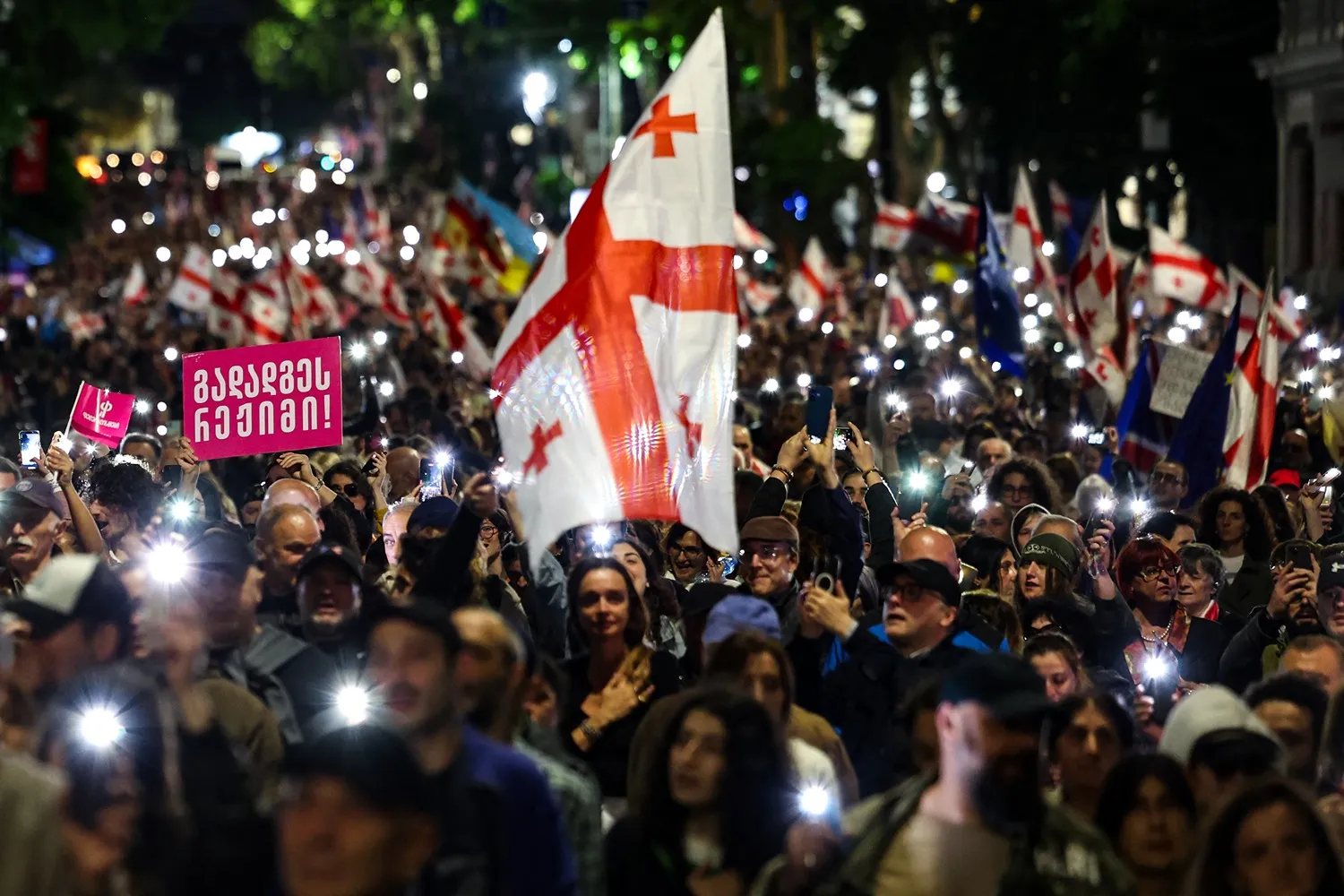
In Georgia, the state-led campaign against insults and social media speech forms one layer of a larger democratic collapse. Since the disputed October 2024 parliamentary election and the government’s suspension of its drive toward European Union accession talks, tens of thousands of protesters have taken to the streets, and activists, journalists, and politicians have faced detention, fines, or prosecution.
Dozens of protest participants have received prison sentences. Masked groups have attacked opposition politicians, activists, and journalists near homes and offices. Investigations have yielded little accountability. Major opposition leaders have been jailed, pushed into exile, or placed under criminal investigation. Georgian Dream has also moved toward banning its principal rival parties.
The government’s attempts to police online speech have occasionally produced the opposite effect. This month, the interior ministry brought an administrative case against blogger Tornike Razmadze after he swore at Kremlin propagandists Margarita Simonyan and Vladimir Solovyov. Razmadze faces a fine of up to 3,000 lari or 20 days in detention. In response, Georgians began posting insults against Simonyan across social media, daring the authorities to prosecute them all.
The new policy is another part of an increasingly comprehensive authoritarian state, albeit one that still tries to maintain the appearance of democracy. Vulgarity alone can place a citizen before a judge. In June, the interior ministry added a new enforcement arm, a 10-person Division for Combating Hate Speech. Its mandate includes monitoring public statements and proactively identifying language that “insult[s] human dignity” or shows signs of an administrative offense.
During its first month, the unit identified 170 alleged violations and sent 150 cases to court. Judges had issued decisions in 33 cases by July 1, producing 31 fines and two warnings. Officers now read social media accounts, collect screenshots, and bring citizens to court over heated language.
Government officials justify the crackdown as an essential moral campaign to cleanse Georgia’s political environment of what they describe as toxic hostility. Prime Minister Irakli Kobakhidze has framed verbal abuse not as protected expression, but as a deliberate weapon used by political enemies to destabilize the country. He maintained that the state has an obligation to act “without double standards” and penalize all sides equally in order to “completely eradicate hate speech” from Georgian society.
The strange logic resulted in one case in Zestaponi, a city in western Georgia, where a court held a hearing over an insult directed at Tamar Chergoleishvili, a leader of the opposition Federalists party. A local resident, Avtandil Chulukhadze, had posted a rude comment about her online.
Chergoleishvili said she had no idea the comment existed and learned of the case when reporters sought her reaction. Regional authorities nevertheless brought Chulukhadze before a judge. He apologized and received an official warning.
“We are living in an Orwellian dystopia,” Chergoleishvili said. “People unknown to me gathered in a regional court and were made to apologize to one another for insulting me, something I had never even heard about, much less complained about. It is good that the poor person was spared a fine and that repentance alone was deemed enough,” Chergoleishvili added. “But taxpayers’ money was still spent on this farce. Most importantly, this is fundamentally absurd and is being done solely to silence critics of the regime. That person, unknown to me, is merely collateral damage.”
Chergoleishvili has experienced the same machinery as a defendant. Courts have fined Chergoleishvili a total of 11,500 lari, about $4,400, for posts insulting Georgian Dream officials and, in one case, a private citizen she said she did not know.
Cases involving opposition figures allow Georgian Dream to claim evenhanded enforcement. Mikheil Zakareishvili, a lawyer representing eight defendants, said courts routinely ignore legal thresholds. Public-swearing charges require evidence that public order was disturbed, while insults against police or officials must relate to their official duties. “In none of the hearings were those elements established. They were not even discussed,” Zakareishvili said. He said the authorities pursuing people who insult opposition figures creates an appearance of balance. “Those defendants receive mild penalties, while our side, with very rare exceptions, receives the maximum fine or imprisonment,” he noted.
In some cases, profane comments on social media have resulted in jail time. Giorgi Akhobadze received both a fine and a prison sentence within the same month. In early July, a court fined the physician and anti-government activist 3,000 lari for a profane Facebook comment aimed at members of a pro-government group advocating Georgian neutrality. Weeks later, authorities combined social media posts insulting the prime minister and other Georgian Dream officials with insults Akhobadze directed at police employees during telephone calls. On July 24, Judge Manuchar Tsatsua sentenced him to 25 days in administrative detention.
“I expressed my anger verbally. That was it,” Akhobadze explained. “They watch my profile, but when people curse at me from their side, they have no reaction to that.”
The government recently received unexpected help from an institution that many Georgians regard as their final protection against state abuse, the European Court of Human Rights. In December 2022, delivery courier Irakli Miladze posted a TikTok video about Tbilisi’s transport policy and the privileges enjoyed by government vehicles. Miladze cursed Tbilisi Mayor Kakha Kaladze, city hall employees, and police who failed to enforce traffic rules. The video attracted more than 100,000 views. Georgian courts fined Miladze 500 lari for disorderly conduct and claimed it constituted personal abuse.
With support from the Georgian Young Lawyers’ Association, Miladze appealed to the European Court of Human Rights. He argued that the fine violated Article 10 of the European Convention, which protects freedom of expression. In May of this year, the court unanimously ruled in Miladze v. Georgia that the fine complied with the convention. The judges accepted the Georgian courts’ distinction between forceful political criticism and hostile personal denigration. They emphasized Miladze’s sexually explicit language, the video’s reach, and TikTok’s young audience. The minimum fine, they concluded, was proportionate. Government outlets presented the Strasbourg ruling as a victory and proof that the new restrictions were legitimate safeguards against abuse rather than political repression.
“The government propaganda seized on the Strasbourg decision right away,” Miladze said. “It indeed restricts freedom of expression. I was talking about the systemic injustice that exists in the country, about how high-ranking officials use privileges, break the law, and face no enforcement. … But what can be done here when a criminal syndicate is basically running the country?”
Across the post-Soviet space, Strasbourg has long served as a court of last resort for people seeking justice after domestic courts failed them. The Miladze ruling now offers other authoritarian governments policing speech a Strasbourg judgment they can cite to defend penalties for offensive political expression. By U.S. constitutional standards, most of these cases would struggle to survive First Amendment scrutiny. Vulgar criticism of government officials generally remains protected unless it amounts to a true threat or incitement. But the European Court thought otherwise.
A decade ago, Georgia ranked as the democratic leader of the South Caucasus, with competitive elections, media, and a national consensus around integration with the West. Today, the country is moving through the familiar stages of authoritarian consolidation at remarkable speed.
Yet despite the pervasive legal threats, heavy penalties, and state watching, public resistance endures. “I hold the same view: fuck them,” Miladze said with laughter, risking yet another fine.
