


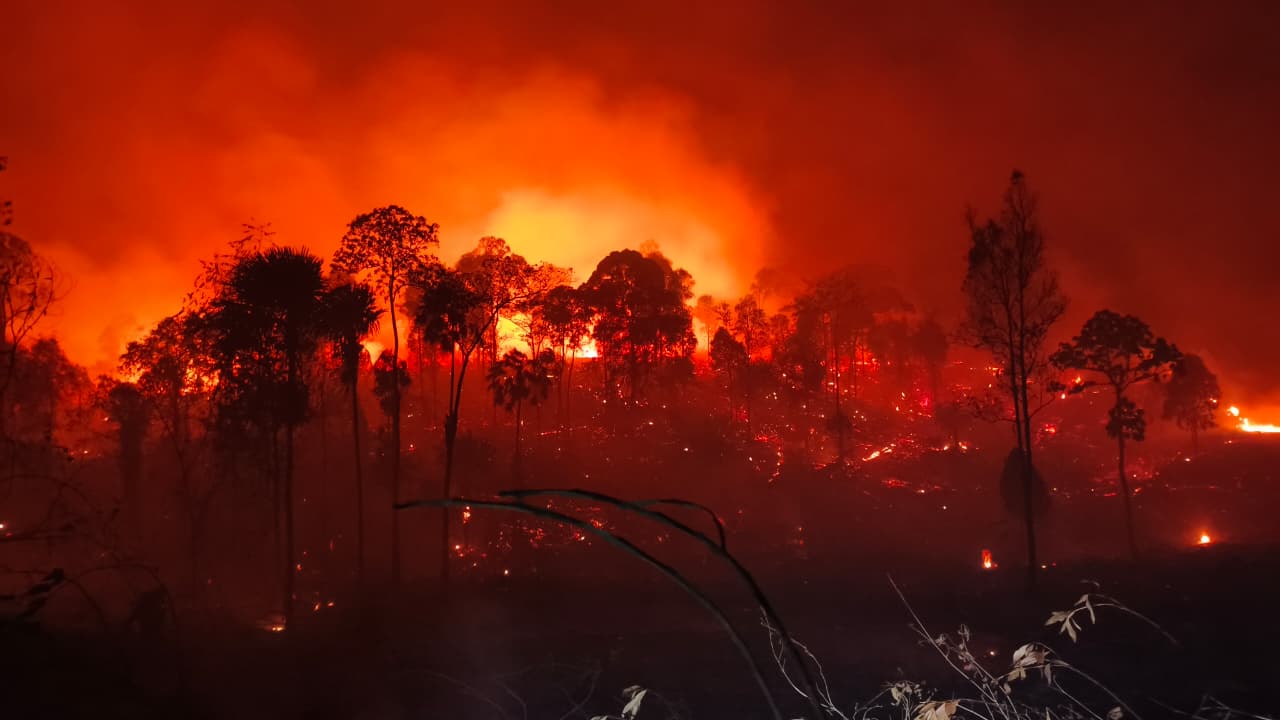
- The authority overseeing Indonesia’s new capital city, Nusantara, confirmed on Sept. 9 that fires had broken out within the new capital city administrative area; although, the fires were around 30 kilometers (18.6 miles) from the core government buildings.
- Five days later senior government officials including Indonesia’s forestry minister visited the site of the fires on the outskirts of the area designated for the government buildings.
- A satellite-monitoring platform FireWatch, recorded more possible fires, known as hotspots, through Sept. 8 than during the same period in 2019, one of Indonesia’s most severe wildfire years.
- Across the country, fires have been accompanied by reports of wildlife deaths and rising respiratory illness, as community and state firefighters scramble to contain blazes intensified by El Niño.
PENAJAM PASER, Indonesia — Indonesia’s escalating wildfire crisis has reached the outskirts of Nusantara, the new capital city under construction as the world’s fourth-most-populous country seeks to transplant its political heartland from a flood plain in Java to the island of Borneo.
Fires in mid-September burned 30 to 40 kilometers (19 to 25 miles) from the perimeter of government buildings. The fires were reported at Wonotirto, near the main toll road, and at Bukit Tengkorak in the Bukit Soeharto protected forest.
These wildfires were in the outer zone designated for Nusantara, authorities in the new capital said, but had stopped short of the construction site of the government complex.
“Hopefully, it won’t reoccur,” Danis H. Sumadilaga, Nusantara authority spokesperson, said in a Sept. 9 statement. “We will have to conduct monitoring and patrols to ensure this fire doesn’t happen again.”
On Sept. 14, forestry minister Raja Juli Antoni traveled to inspect the fires, along with the head of Indonesia’s disaster management agency and the lead of Ibu Kota Nusantara (IKN), the agency overseeing the new city, one of the world’s largest construction sites.
Helicopters carrying giant buckets of water buzzed overhead as the officials surveyed the fragile landscape skirting the city.
“It’s there again — where’s Manggala Agni?” the minister said, referring to the state fire brigade after spotting a suspected fire burning in the hills. “They need to get there, along with colleagues — there’s smoke again.
“Please coordinate with the firefighters, army, police,” Raja Juli Antoni said on Sept. 14. “Find the quickest route.”
Tale of two cities
Plans to build Nusantara and move Indonesia’s capital from Jakarta were unveiled by then-president Joko Widodo in 2019. The project was estimated to cost 466 trillion rupiah, which was around $32.7 billion at the time.
The government initially earmarked only a fifth of that cost from the state budget, with the remainder expected to come from public-private partnerships and private investment.
Jokowi, as the former president is known, presented the new capital in 2019 as a way to overcome some of Jakarta’s structural limitations, including severe congestion and rapid land subsidence caused by extraction of groundwater from the aquifer.
The radical plan also carried symbolic weight: by shifting political capital away from Java, Indonesia’s most populous island, where more than half the country’s population lives, to the Indonesian archipelago’s less-developed east.
However, much of the private investment has yet to materialize, while concerns remain the project has slipped down the list of national priorities with the 2024 election of Prabowo Subianto as president of Indonesia.

Right to clean air
Firefighters have been battling fires across Indonesia since the main dry season began in July. In recent decades, much of Borneo’s peatlands have been drained and converted to oil palm plantations.
Indonesia’s fire season is already showing signs of becoming one of the country’s most severe in years, with remote-sensing platforms showing fire activity surging.
At one air pollution detector operated by Indonesia’s environment ministry, very fine particle, PM2.5 concentrations, in South Barito district in neighboring Central Kalimantan province barely dropped below 600 micrograms per cubic meter (µg/m³) for 24 hours on Sept. 14— which was more than 40 times the World Health Organization’s recommended 24-hour guideline of just 15 µg/m³.
Sri Murlianti, social development lecturer at Mulawarman University, in the nearby city of Samarinda, said the fires showed the challenges associated with paving a futuristic new city on land shaped by decades of ecological damage.
“The measure of development success should not be just how many buildings are built, or how much investment is made,” Sri told Mongabay Indonesia. “But whether the people living nearby have the most basic right — to breathe safe air.”
Fire is often used to clear land quickly, but drained peat can burn uncontrollably, particularly during El Niño-fuelled heat and drought. In East Kalimantan, the center of Indonesia’s coal industry, more than a quarter of the province’s GDP in 2025 came from coal mining.
Refinaya Jamiilfitriani, a young environmental advocate and coordinator of Mahardhika Samarinda Women’s group, pointed to the heightened domestic burden shouldered by women in the home amid increased air pollution.
“Children cannot play freely outside, vulnerable members of the family require more attention, the house needs to be cleaned more frequently, and health needs monitoring,” Refinaya said.
Communities around Nusantara, meanwhile, report anxieties over air pollution, from the city of Balikpapan through surrounding districts Kutai Kartanegara, North Penajam Paser, Paser and Samarinda.
Deden Wahyudi, who lives in Sepaku Lama village within the grounds of the new capital, said the village was enveloped by smoke in late August, risking the health of his mother Jakiyah, who was diagnosed with pneumonia.

In Balikpapan, a city of almost 800,000, local residents said they were worried about the pollution.
“I thought it was fog,” Balikpapan resident Emi said. “But it smelled like smoke from something burning, like something had burned.”
Emi, who is pregnant and has a 3-year-old child, said she was worried about the effects of the smoke on her family.
“There have been cases here, but they’re not as numerous and severe as elsewhere,” she said. “If this is actually smoke carried [from wildfires] and reaching here, it’s already really bad.”
Data from the Balikpapan city health department showed diagnoses of respiratory disease increased by almost 20% in August over July to 1,361 cases in the city. Health officials have cautioned, however, that the data do not yet establish a link between the increase in illness and the wildfires.
Meanwhile, disaster management officials in North Penajam Paser — the district that originally contained the land for Indonesia’s new capital — said they were braced for more fires to come.
“Our focus is on stockpiling masks, distributing these to the public, and providing education and outreach to reduce outdoor activities,” said Nurlaila, who leads the disaster management office of the district.
For many workers, there is no choice but to continue working outdoors despite the heightened health risks.
“What about daily laborers, small traders, motorcycle taxi drivers, farmers?” Refinaya said. “So if they’re not able to leave the house, that just means they’ll go hungry tomorrow because they won’t earn any income — why are people continually being asked to adapt to damage they didn’t create?”
Banner image: A forest and land fire burning in the Bukit Soeharto protected forest area in Sepaku, North Penajam Paser regency, Sept. 1, 2026. The fire is located within the IKN delineation area. Image courtesy of BPBD PPU.
This story was first published here in Indonesian on Sept. 9.
Children’s health at risk in south Borneo as El Niño intensifies Indonesia wildfires
Rescuers scramble to save orangutans as El Niño-boosted fires spread across Borneo
Cite this article
Niken D. Sitoningrum (2026). Wildfires on doorstep of Indonesia’s new capital as environmental and health crisis flares. Mongabay Conservation news. DOI: https://doi.org/10.66709/news-329765

