


MOGADISHU, Somalia—In July, the U.S. Mission to the African Union announced that it would be cutting support for the United Nations Support Office in Somalia (UNSOS). This unit provides logistical support, food rations, fuel, and medical supplies for the African Union peacekeeping mission in Somalia.
The cut, which takes effect on Dec. 31, marks the end of U.S. support for the peacekeeping mission, known as the African Union Support and Stabilization Mission. After two decades of military intervention in the anarchic war-torn Horn of Africa nation—intervention overwhelmingly paid for by the U.S. government—the al Qaeda-affiliated Islamist group al-Shabab is arguably stronger than ever.
MOGADISHU, Somalia—In July, the U.S. Mission to the African Union announced that it would be cutting support for the United Nations Support Office in Somalia (UNSOS). This unit provides logistical support, food rations, fuel, and medical supplies for the African Union peacekeeping mission in Somalia.
The cut, which takes effect on Dec. 31, marks the end of U.S. support for the peacekeeping mission, known as the African Union Support and Stabilization Mission. After two decades of military intervention in the anarchic war-torn Horn of Africa nation—intervention overwhelmingly paid for by the U.S. government—the al Qaeda-affiliated Islamist group al-Shabab is arguably stronger than ever.
Analysts who spoke with Foreign Policy said the decision by the Trump administration to cut support for UNSOS and the African Union peacekeeping mission is partly due to this questionable result.
“Despite the savior rhetoric of the past two decades, the international community has neither developed a strategy to defeat al-Shabaab,” wrote Abukar Arman, a political analyst and former Somali diplomat to the United States, in an email. “Nor have they ever executed anything in a coordinated way.”
Ugandan AU peacekeepers examine an unexploded artillery round, which was found and surrendered to them by Somalian army members, in Mogadishu on May 14, 2007.AFP via Getty Images
In March 2007, African Union (AU) peacekeepers from Uganda were deployed to the Somali capital, Mogadishu, to prop up a fragile transitional government battling armed Islamist rebels—most notably, al-Shabab.
In the years that have followed, the AU peacekeeping force has managed to push al-Shabab out of major cities and urban areas across south-central Somalia, including Mogadishu. But despite these successes, the militant group still dominates most of rural south and central Somalia. In these areas, it has morphed from a guerilla movement into something akin to a shadow state.
Since 2007, the United States has provided an estimated $3.6 billion to sustain consecutive African Union peacekeeping missions in Somalia, which includes nearly $2 billion sent through U.N. support offices and close to $1.6 billion in bilateral assistance to African countries contributing troops to Somalia, according to a recent U.S. congressional research assessment from July.
But “the international community has focused on propping up a mission, while al-Shabab has focused on building a state,” according to Jethro Norman, a senior researcher with the Danish Institute for International Studies.
Al-Shabab has formed a parallel government in the areas that it rules, with its own judiciary courts and tax system. Within this system, al-Shabab can raise somewhere between $100 million and $150 million a year from taxation, Norman said, while the Somali government’s own tax revenue runs at a little more than $250 million, most of it from Mogadishu port customs and donor transfers.
“You have an insurgency that funds itself and a government that does not,” Norman said.

Al-Shabab militiamen fire on Somali government troops in the streets of Mogadishu on May 22, 2009. Mohamed Dahir/AFP via Getty Images
With its revenue, al-Shabab has prioritized providing services to civilians. One result has been the near-total eradication of drugs and crime in areas that al-Shabab governs.
Since the insurgency’s inception, its leaders have understood the importance of securing grassroots legitimacy while also adroitly navigating Somalia’s often-complex clan-based society. They have garnered support from local communities, especially in rural areas, while the Somali government has been ranked the country’s most corrupt government since 2006, according to Transparency International. Even in government-controlled areas such as Mogadishu, civilians flock to the sharia courts run by al-Shabab.
Norman said that for many members of Somalia’s political class, defeating al-Shabab was not obviously in their interest. Regional leaders’ cooperation with the campaign “was shallow even at its high points,” he said, because they worried that a government victory against al-Shabab would confer a legitimacy needed to remove them from office.

Ethiopian troops at the international airport in Mogadishu on Dec. 29, 2006. Peter Delarue/AFP via Getty Images)
The presence of foreign forces on Somali soil has been controversial throughout history. The AU deployment was predated by an Ethiopian military intervention in December 2006. This intervention saw thousands of Ethiopian troops invade Somalia, eventually operating under the cover of U.S. drones. The George W. Bush administration aimed to overthrow the Islamic Courts Union (ICU), a coalition of sharia courts that had seized power in Somalia and which marked the first instance in the post-9/11 era of political Islam gaining a foothold on the African continent.
Members of the current AU peacekeeping force, and the two against al-Shabab that preceded it, have been implicated in allegations of widespread human rights abuses and atrocities ranging from extrajudicial killings, enforced disappearances, massacres of civilians, and even using rape as a weapon of war.
These allegations span decades, and without any justice or accountability, the public has turned against the AU peacekeepers. The Somali government, too, is seen as turning a blind eye.
A textbook example was the 2024 Bulo-Mareer killings, in which African Union peacekeeping troops from Uganda brutally decapitated two local farmers in the agricultural town of Bulo-Mareer. The deaths sparked protests in the town, and local residents called on AU troops to leave. Al-Shabab responded by releasing a statement condemning the attack and vowing retaliation and vengeance for the killing of the civilians; the federal government has not yet addressed the situation two years on.
Al-Shabab, meanwhile, is viewed by many Somalis as defending the country from foreign subjugation and occupation, and it follows in a nationalist tradition of armed religious resistance to foreign encroachment from colonial times. The group uses that history to incentivize young men to take up arms and join the insurgency.
But it’s not just nostalgia tied to the 19th century that Al-Shabab utilizes, but also the more recent memory of the “global war on terror.”
“Before December 2006, al-Shabab was a small and radical component of the Islamic Courts Union,” Norman said. Then the Ethiopian intervention came, with U.S. diplomatic and intelligence backing, followed by the American airstrikes. “Al-Shabab expanded by presenting itself as the resistance, and many who joined appear to have been moved by Ethiopian conduct rather than by commitment to al Qaeda’s broader ideological project,” he said.
Another burning issue is that al-Shabab has retaken nearly all the territory that it lost in a 2022-2023 Somali army campaign. During a 2025 counter-offensive, insurgents came as close as 45 kilometers to the Somali capital, Mogadishu.Their blitzkrieg-style offensive forced one of Mogadishu’s key allies, Turkey, to deploy 500 extra troops to Somalia, including drone operators. That al-Shabab has since recovered that ground underscores that after two decades of combat and consecutive interventions, the group remains a factor and a potent threat.

A woman salvages iron sheets where her home was destroyed, allegedly by retreating insurgents, at Awdheegle, one of several towns liberated from al-Shabab militants in Somalia’s Lower Shabelle region on Nov. 11, 2025. Tony Karumba/AFP via Getty Images
Following the U.S. announcement of ending support for the AU peacekeeping mission in Somalia, troops have begun the process of withdrawing.
Burhakaba, located in the Bay region of Somalia, was the first town to see a troop withdrawal. It has been encircled and isolated by al-Shabab since 2014. Many more towns are expected to go through similar phases of withdrawal before the Trump administration’s Dec. 31 deadline.
The uncertainty is made worse by the fact that there is no one other nation that can fill the United States’ void. Turkey can only provide air support, and it doesn’t have the capacity to replace the AU peacekeepers. Al-Shabab will wait patiently until the last foreign boots leave Somali soil, said Arman, the political analyst.

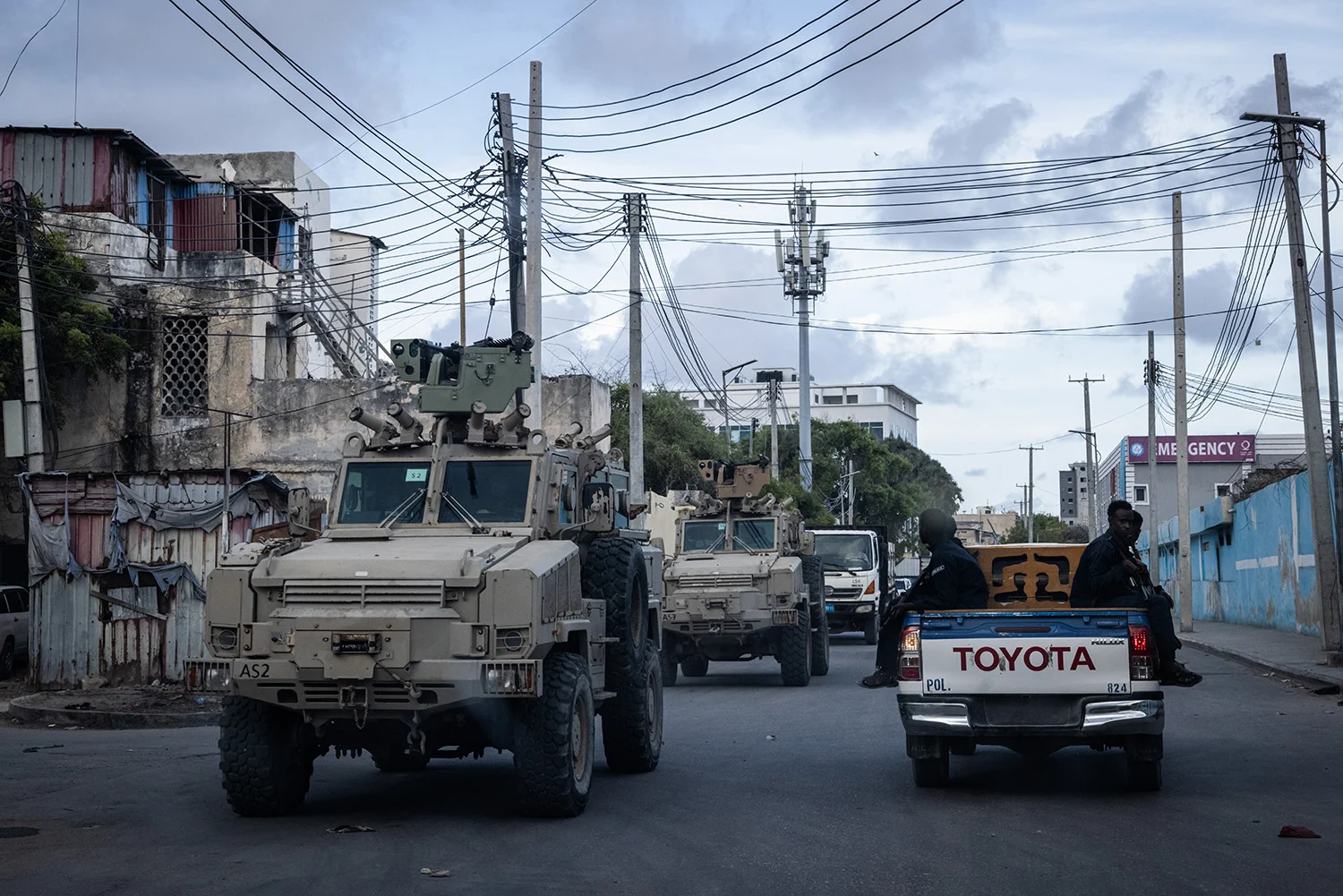
Soldiers from the Somali National Army ride in a convoy as part of a security escort in Mogadishu on April 21, 2025.Ed Ram/Getty Images
A recent summit held by countries currently contributing troops to the African Union peacekeeping mission in Somalia saw several governments request an 18 month to 24 month extension—signaling uncertainty around whether Somali forces will be ready to take responsibility for the country’s security when the AU troops leave.
“The one thing Al-Shabaab does well is filling vacuums when they present themselves,” Arman wrote.
