


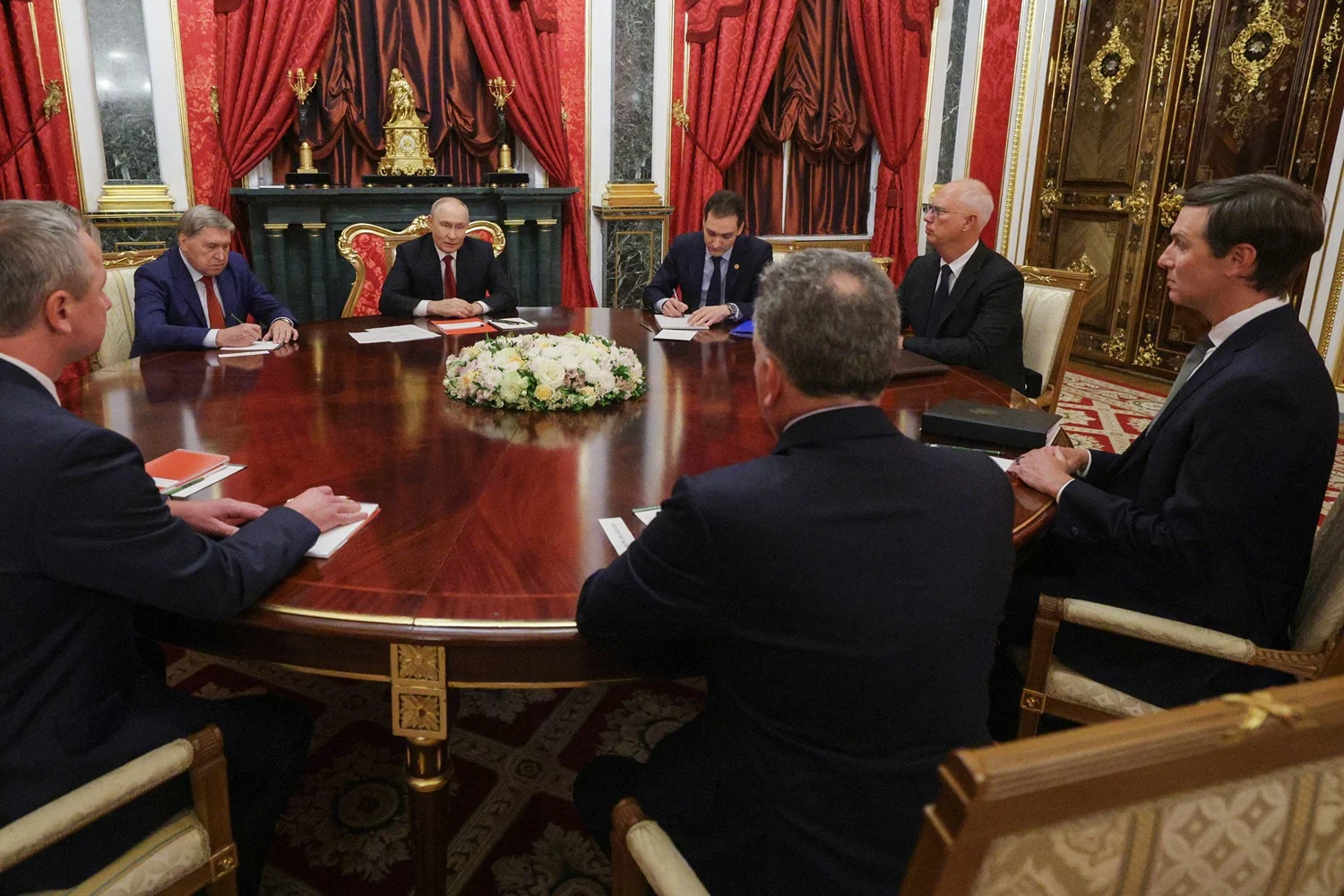
After more than half a year of drift in U.S.-brokered talks, Washington recently sent envoys Steve Witkoff and Jared Kushner to Moscow and Kyiv to meet Russian President Vladimir Putin and Ukrainian President Volodymyr Zelensky.
Washington is right to resume talks, but U.S. diplomacy toward Russia remains too episodic. Witkoff and Kushner’s meetings in Moscow and Kyiv produced no breakthrough, and there is little sign that either side has moved appreciably on the core issues. High-level shuttle diplomacy can reopen doors, but it cannot substitute for sustained official channels and the institutional capacity to use them.
Still, whether or not this latest push leads to anything, the war in Ukraine will eventually end at a negotiating table. What happens on the battlefield will shape the terms of any cease-fire or settlement, but it will not substitute for one. Russians and Ukrainians will ultimately have to reach terms that each can live with, and any durable agreement will almost certainly require deep and sustained U.S. involvement.
Vital as it is, managing the Ukraine conflict will be the beginning, not the end of U.S.-Russia negotiations. Moscow and Washington will also have to deal with each other on nuclear risk and strategic stability, outer space, the Arctic, pandemics, and responding to disasters, among many other issues. None of this requires a return to “normal” relations, much less trust or friendship. It requires something more basic: the ability to conduct difficult business with a difficult counterpart when important U.S. interests demand it.
The problem is that after more than a decade of increasing pressure and isolation, especially since 2014, the United States has lost much of that ability.
There are good reasons for imposing costs on Russia. Moscow’s aggression against Ukraine, interference in Western political systems, repression at home, and increasingly hostile posture abroad demanded consequences. But policies have second-order effects. One of them has been the hollowing out of the human and institutional infrastructure by which the United States once managed sustained engagement with Moscow.
This matters because the Russians are tough negotiators. Generations of U.S. officials and experts who have sat across the table from Russian counterparts came away impressed by their discipline and preparation. Ambassador Rose Gottemoeller, who negotiated the New START treaty, described her Russian counterparts in an interview with me as “crack negotiators,” extremely well trained, fluent in the negotiating process, technically capable, and often possessing an advantage in language skills.
Russian negotiators also tend to pay very close attention to Americans. That reflects a persistent asymmetry in the relationship. For Moscow, Washington has often been among the very highest foreign-policy priorities. For Washington, Russia has had to compete with China, the Middle East, Europe, terrorism, trade, domestic politics, and everything else occupying a superpower’s attention. In the post-Soviet period, veteran U.S. officials recalled Russian counterparts studying U.S. politics, personalities, and institutional dynamics in extraordinary detail, while Americans sometimes arrived with less experienced teams and far less bandwidth.
That does not mean that Russians possess some secret national negotiating code. They make mistakes, misread opponents, overreach, and frequently fail to achieve their goals. And of course, individuals vary as much as Americans or anyone else. But they almost always come to the table with a strong sense of representing a great power, deep institutional memory, careful preparation, and acute sensitivity to questions of status and respect. At the same time, the decision-making process to which they are subject can be rigid and highly centralized.
An experienced American negotiator learns to distinguish between an opponent who will not move and a counterpart who simply cannot. That kind of judgment is learned through experience, not briefing books.
The United States has had to learn this lesson before. Direct U.S.-Soviet engagement began expanding even during some of the hardest years of the Cold War. The 1958 Lacy-Zarubin agreement opened exchanges in science, medicine, education, culture, and other fields. By the 1970s, Washington and Moscow had built formal channels not only for arms control but also for cooperation on health, agriculture, environmental protection, science, and technology. These programs existed even amid the depths of the Cold War precisely because they were seen by both sides as important tools for managing conflict.
By the late 1980s, the dialogue led by U.S. Secretary of State George Shultz and Soviet Foreign Minister Eduard Shevardnadze had become even more structured. Its famous “four-part” agenda covered nuclear arms control, regional conflicts from Afghanistan to Central America, bilateral issues such as trade and energy, and human rights questions including Soviet Jewish emigration. The point was not necessarily to seek agreement on this wide array of topics. Rather, it was to ensure that there was a process capable of carrying disagreement without risking potentially dangerous showdowns or requiring every issue to be elevated to the presidential level.
Post-Cold War administrations kept relearning the same lesson. The bilateral commission led by U.S. Vice President Al Gore and Russian Prime Minister Viktor Chernomyrdin created cabinet-level working relationships across space, energy, health, science, and other fields. The George W. Bush administration tried a smaller strategic dialogue intended to identify problems, clear bureaucratic logjams, and elevate issues requiring presidential attention. Finally, a commission created by U.S. President Barack Obama and Russian President Dmitry Medvedev combined senior political oversight with more than a dozen working groups.
Each model had flaws. Some became too bureaucratic. Others depended too heavily on personalities. But the fact that Washington and Moscow kept constructing this kind of institutional machinery for negotiations shows that sooner or later, they found that they needed it.
Washington has now spent years dismantling that machinery and, even more consequentially, losing the experience required to use it. The generation of U.S. officials formed by repeated negotiations with Soviet and Russian counterparts is leaving government. Behind them is a cohort of highly capable U.S. experts, but many have spent the most important years of their careers in an environment defined by sanctions, diplomatic expulsions, and mutual isolation.
Knowing Russia through study, even having spent time in countries bordering Russia, is not the same thing as knowing Russians and how to negotiate with them across a table, repeatedly, over months or years. American diplomat George F. Kennan himself made this leap in 1933. After two years studying Russian language, history, and culture in Berlin and another two at the U.S. diplomatic listening post in Riga, Latvia, Kennan joined Ambassador William Bullitt’s small team charged with establishing the first U.S. embassy in Moscow since the Bolshevik Revolution. For all that preparation, Kennan later recalled in his memoirs that he had never actually been to Moscow and that it was only then that his education as a Russia expert became an education in dealing with Russians.
None of this requires waiting for a political thaw. There are practical steps that the United States can take now, even in the midst of a deep freeze in official relations.
First, the United States should capture the knowledge that remains. Veteran diplomats, arms control negotiators, military officers, and other officials who spent years dealing directly with Soviet and Russian counterparts should be systematically debriefed, through oral histories, case studies, and after-action reviews focused not only on what was negotiated, but also how.
Second, Washington should train for negotiations before it needs them. The State Department, Defense Department, and National Security Council can conduct realistic simulations involving Russian institutions, personalities, negotiating practices, and chains of authority, drawing heavily on officials with Russian language and regional expertise.
Third, U.S. officials should rebuild their map of the other side. Allied governments, track 1.5 dialogues, academic exchanges, and the limited contacts that remain can help identify the next generation of Russian officials, understand how Russian institutions have changed during the war years, and distinguish formal titles from actual influence and authority.
Finally, Washington should determine which official channels must remain functional even if the confrontation were to get worse. Crisis communications, nuclear risk reduction, and military deconfliction cannot be improvised after something has gone wrong. Those channels should be maintained and, where possible, exercised. Nor should U.S. officials wait for a sudden political opening in Moscow to discover who can pick up the phone, who has authority on the other side, or which parts of the U.S. government know how to turn a presidential directive into sustained negotiations.
Washington should prepare for more than one Russian future. Putin could remain in power, and confrontation with the West could persist or intensify. A settlement in Ukraine could create only a narrow opening for limited engagement. Or a leadership transition, internal upheaval, or other black swan event could produce a much larger and less predictable opportunity. These scenarios would demand very different policies. All would demand negotiating capacity.
Preparing for that day now is no concession. Diplomacy is never a reward for good behavior, and negotiation is not normalization. It is an instrument of national power.
For the past decade, the United States and its allies have invested heavily in their ability to impose costs on Russia, constrain its options, and deter further aggression. Those capabilities remain necessary. But leverage has value only if the United States also knows how to turn it into outcomes. Sooner or later, U.S. officials will again sit across the table from Russian counterparts. Preparing them to succeed should begin now.
