


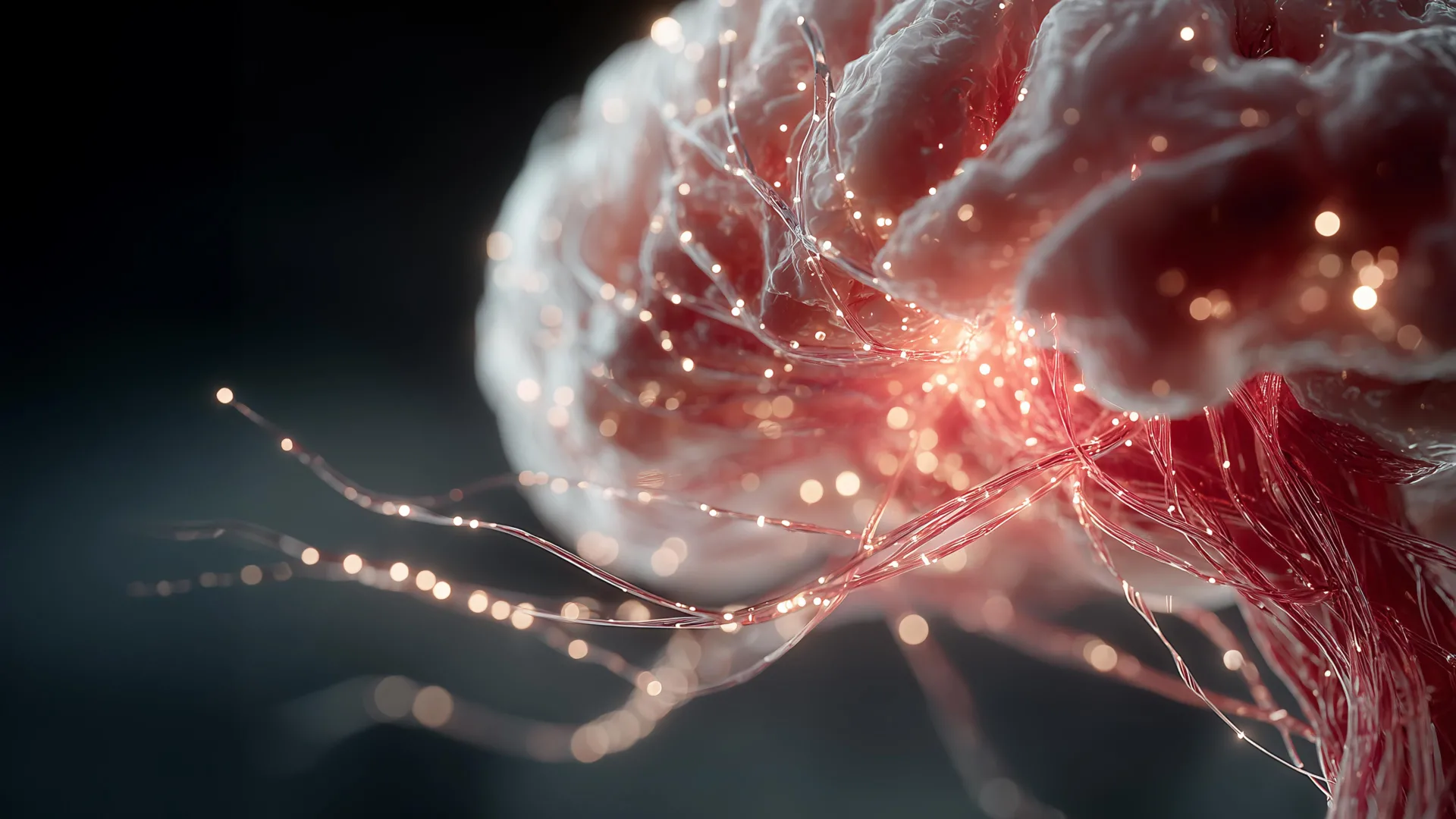
Scientists at the Mark and Mary Stevens Neuroimaging and Informatics Institute (Stevens INI) at the Keck School of Medicine of USC have uncovered evidence that two neighboring types of brain tissue may work together to support thinking abilities later in life. Their findings suggest that the condition of the brain’s local communication pathways could influence how strongly gray matter loss affects cognition.
The study, published in Alzheimer’s & Dementia: The Journal of the Alzheimer’s Association, included brain imaging and cognitive testing from 459 adults aged 60 and older living in communities across India. The research is among the first to investigate superficial white matter in a community-based population from a low- and middle-income country.
The Brain’s Local Communication Network
Superficial white matter forms a thin layer of nerve fibers directly beneath the gray matter covering the outside of the brain. These short, curved fibers connect nearby regions of the cerebral cortex, allowing them to exchange information. They can be thought of as local roads linking neighboring areas of the brain.
Gray matter serves a different role. It contains many of the nerve cells responsible for processing information. Together, gray matter and the white matter directly beneath it form closely connected systems that may both contribute to cognitive health.
“Gray matter and superficial white matter are physically close and may play different roles: gray matter processes information, while superficial white matter helps nearby brain regions communicate,” said Yingxu Liu, PhD, a postdoctoral scholar at the Stevens INI and first author of the study. “Our findings suggest that cognitive health depends not only on how much gray matter is preserved, but also on the condition of the wiring that connects it.”
Measuring the Brain’s Hidden Wiring
To investigate these local connections, the researchers used an advanced type of diffusion MRI. This imaging technique tracks the movement of water through brain tissue, allowing scientists to examine microscopic features that conventional brain scans may not reveal.
The researchers focused on measurements related to neurite density and the amount of freely moving water surrounding these structures. Neurites are the small projections through which nerve cells send and receive signals. A lower density of neurites or an increase in free water can indicate damage or disruption in tissue associated with processes including loss of myelin, inflammation, or swelling.
Participants also underwent assessments covering several areas of cognition, including language, memory, executive function, and visuospatial ability.
The most consistent connection between superficial white matter health and cognitive performance involved language. People with healthier superficial white matter tended to perform better on language tests. The strongest associations appeared in frontotemporal regions of the brain involved in recognizing words, speaking fluently, and temporarily holding language information in mind.
Healthy Wiring May Cushion Gray Matter Loss
Measures of gray matter atrophy were still the strongest overall predictors of cognitive ability. However, the researchers found that the impact of gray matter loss appeared to vary depending on the health of nearby superficial white matter.
When these local connections showed poorer integrity, gray matter loss was more strongly associated with impaired language performance and broader cognitive difficulties. When superficial white matter was healthier, the link between gray matter loss and poorer cognition was weaker.
This raises the possibility that the condition of the brain’s local wiring could help explain why two people with similar amounts of gray matter loss do not necessarily experience the same degree of cognitive decline.
“The findings point to superficial white matter as a possible source of resilience,” said Leon Aksman, PhD, assistant professor of research neurology at the Stevens INI and senior author of the study. “Two people with a similar degree of gray matter loss may not experience the same cognitive effects if the local connections surrounding that gray matter differ in health. Following participants over time will be essential to test whether preserving these connections can help maintain cognition.”
Expanding Brain Aging Research Beyond Typical Populations
The researchers drew their data from the Harmonized Diagnostic Assessment of Dementia for the Longitudinal Aging Study in India, known as LASI-DAD. More than half of the larger LASI-DAD population has low literacy, while about 60% lives in rural communities.
Populations with these characteristics have historically been underrepresented in brain imaging studies, making the research an opportunity to examine cognitive aging across a broader range of social, educational, and geographic backgrounds.
In this analysis, the association between superficial white matter and language ability was stronger among people who were unable to read or who read incorrectly, those who had received no formal education, and participants living in rural areas.
The researchers emphasize that the results do not establish that these social factors caused changes in brain tissue. Instead, they suggest that brain aging may be shaped by a complex combination of experiences throughout life, including education, social circumstances, health, and environmental exposures.
What Scientists Still Need to Learn
Because participants were examined at only one point in time, the study cannot establish which brain changes occurred first. Researchers do not yet know whether deterioration of superficial white matter begins before gray matter loss, develops alongside it, or precedes measurable cognitive decline.
Long-term research that follows people as they age will be needed to clarify these relationships. Future studies will also investigate how vascular health, inflammation, Alzheimer’s related proteins, and other biological factors interact with changes in gray and white matter.
“A fuller understanding of brain aging requires research that reflects the world’s social, cultural, and geographic diversity,” said Arthur W. Toga, PhD, director of the Stevens INI and Provost Professor at USC. “By studying an underrepresented population and looking beyond gray matter alone, this work brings us closer to identifying the biological and social factors that may protect cognition across the lifespan.”
In addition to Liu and Aksman, the study’s authors include Kirsten M. Lynch, Miguel Arce Rentería, Emma Nichols, Alden L. Gross, Lindsay C. Kobayashi, Neda Jahanshad, John P. John, Harshita V. Vishwakarma, Pranali Khobragade, Joyita Banerjee, Niranjan Khandelwal, Jyoti Dangwal, Sudhir Saxena, Nirod Medhi, Soumik Das, Prudhvinath Reddy, Pratyaksha Rana, Arjun Narula, Saravanan Kannan, Dinesh Patel, A. B. Dey, Sharmistha Dey, and Jinkook Lee.
The research was supported by the National Institute on Aging (R01AG080473, RF1AG087965, RF1AG088003, R01AG087513), the National Institute of Mental Health (R01MH134004), the National Institute of Neurological Disorders and Stroke (RF1NS136995), and the Office of the Director of the National Institutes of Health (S10OD032285).
