


Americans live in a perpetual state of war. Although Congress has not formally declared war since 1942, U.S. presidents have repeatedly deployed troops overseas based on United Nations resolutions, congressional authorizations, or their own executive power—as President Donald Trump has in Iran.
But the power that presidents possess in matters of national security is not the product of an inevitable expansion of the executive authority. Congress builds the imperial presidency one step at a time. At key moments in U.S. history and in response to international threats, Congress has made deliberate decisions that have resulted in presidents being allowed to deploy troops and assert executive power over civil liberties.
Americans live in a perpetual state of war. Although Congress has not formally declared war since 1942, U.S. presidents have repeatedly deployed troops overseas based on United Nations resolutions, congressional authorizations, or their own executive power—as President Donald Trump has in Iran.
But the power that presidents possess in matters of national security is not the product of an inevitable expansion of the executive authority. Congress builds the imperial presidency one step at a time. At key moments in U.S. history and in response to international threats, Congress has made deliberate decisions that have resulted in presidents being allowed to deploy troops and assert executive power over civil liberties.
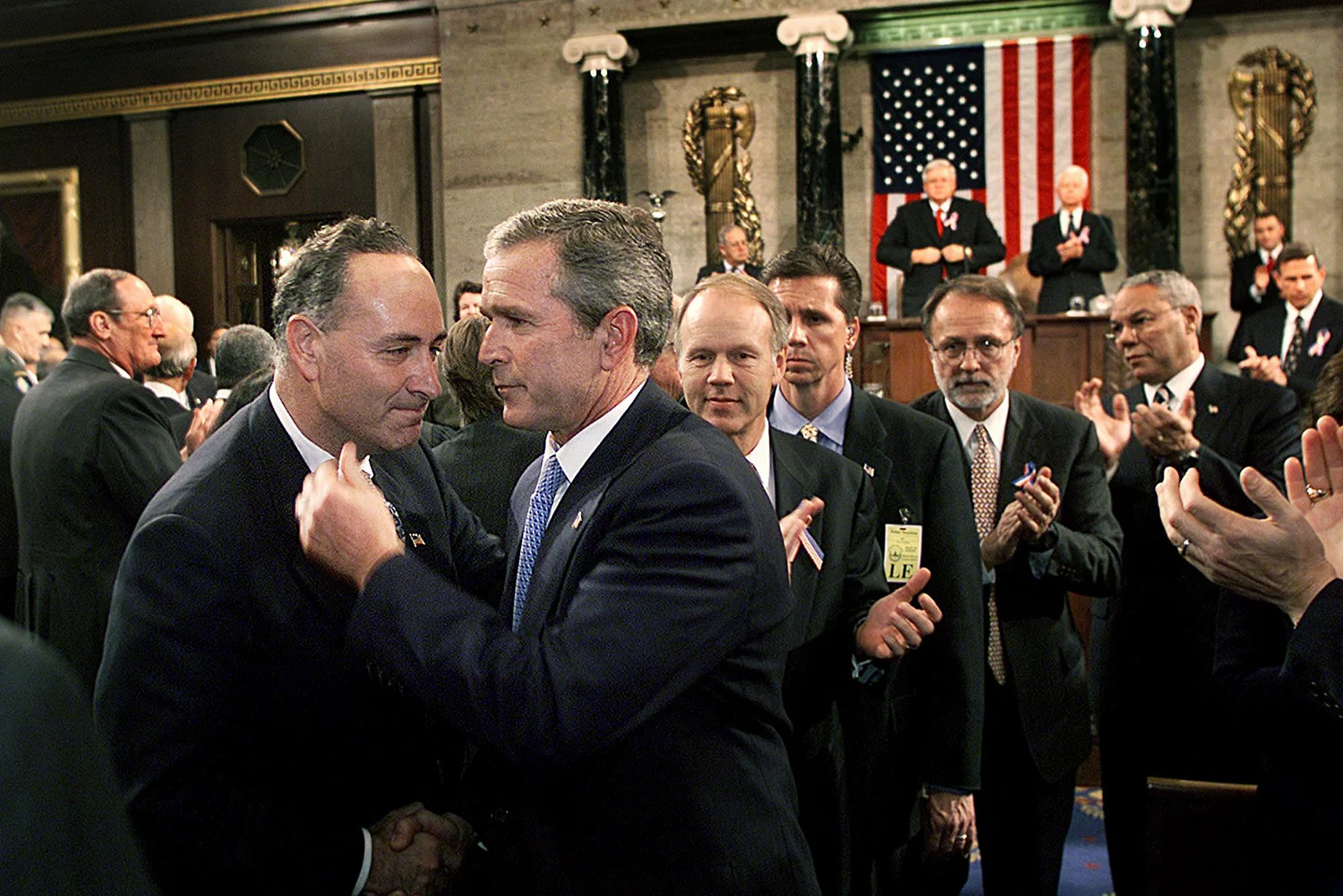
One of the most consequential moments came in the aftermath of the horrific attacks of 9/11. Just days after Americans suffered the deadliest-ever attack on U.S. soil, Congress passed the Authorization for Use of Military Force (AUMF) with bipartisan support. The measure placed the nation on a permanent wartime footing, greatly expanding the range of actions a president could take without seeking additional congressional approval. Although some skeptics succeeded in narrowing the scope of the authority granted by the legislation, it remained so broad that its effects continued to shape national security policy today.
Understanding the decisions Congress made in the weeks following 9/11 is as important as commemorating the tragedy itself. Those decisions shaped how the nation would respond to terrorist threats, the constitutional safeguards Congress was willing to sacrifice in the name of security, and the damaging consequences for the balance of power that resulted from elected officials’ efforts to protect the country.
The 9/11 attacks devasted the nation. The destruction wrought by al Qaeda killed Americans, destroyed the World Trade Center and portions of the Pentagon, and left the country deeply traumatized. Americans had grown accustomed to the protections afforded by two vast oceans. Although it had been a long time since the nation could consider itself truly insulated from global affairs—and although the advent of nuclear weapons during World War II meant that everyone, everywhere, was potentially vulnerable to attack—a devastating strike against the homeland on the scale of 9/11 was profoundly shocking.
Bush responded aggressively. In contrast to President Bill Clinton, whose administration had addressed the 1993 World Trade Center bombing primarily through domestic law enforcement and the criminal justice system, the Bush administration treated the events of 9/11 as an act of war.
Of all the decisions made in the weeks following 9/11, few were as consequential as the passage of the AUMF. Determined not to waste time, Bush worked with congressional leaders to draft legislation authorizing the administration to respond to the attacks with military force. Bush sought the broadest possible language, language that would make President Lyndon Johnson’s 1964 Gulf of Tonkin Resolution—which granted him authority to use force in Vietnam—seem modest by comparison. The president wanted a bill that would empower him not only to pursue those responsible for the attacks but also to “deter and pre-empt any future acts of terrorism or aggression against the United States,” as his administration’s draft text put it. That would’ be roughly the equivalent of Congress granting him a blank check for war.
In the aftermath of 9/11, Democrats were fearful of looking weak on national security (a charge that the GOP had used effectively since the 1960s) and Republicans were eager to support their president; even so, they pressed the administration to accept slightly narrower language. The final legislation authorized the use of force against those who “planned, authorized, committed, or aided” these specific attacks, as well as any country that had given refuge to terrorists.
Despite the slightly narrower language, the authority Congress granted was sweeping. The limits were largely illusory, as the legislation did not specify against whom force could be used, where the force could be employed, and when the authorization would end. The structure of the legislation also freed the president from the constraints that Congress had imposed with the War Powers Resolution of 1973, which had sought to limit presidential power to use military force after the quagmire in Vietnam. Although the War Powers Resolution had always been flawed, the AUMF rendered it nearly irrelevant in matters that could be justified as part of the response to 9/11.
On Sept. 14, the day that Bush made a historic visit to Ground Zero with first responders, the Senate passed the AUMF by a vote of 98-0. The sole dissent in the House of Representatives was California Democrat Barbara Lee. (Ten other representatives abstained from voting.) In a blistering speech, she warned that her colleagues were repeating the mistakes of earlier wars—no matter how just—by expanding government power in the name of national security; she said that they were creating a dangerous precedent that would allow future presidents to act overseas with little regard for Congress. Lee pleaded that as the nation was in a “state of mourning,” Congress should “pause, just for a minute and think through the implications of our actions today.” Arizona Republican Sen. John McCain, who helped narrow the language with Massachusetts Democrat John Kerry, acknowledged that he still had concerns given the Gulf of Tonkin precedent.
On Sept. 18, Bush signed the bill into law. His Office of Legal Counsel promptly claimed that the president’s power was even more sweeping than the law proclaimed: John Yoo wrote a memo stating that the president still had the power to launch preemptive attacks against potential threats.
The congressional authors of the bill were proud of what they had done. Then-Sen. Joe Biden, who helped craft the measure, boasted: “We gave the president all the authority he needed without giving up our constitutional right to decide whether force should be used.” Defending the law, Arizona Republican Sen. Jon Kyl explained, “I’m not for putting a lot of strings on it. Are we going to be able to give the president enough flexibility to act if we put a lot of restrictions in legislation?”
The first major use of the law came in October 2001, when the administration started bombing Afghanistan to bring down the Taliban regime that had harbored al Qaeda. Bush also relied on the AUMF to justify the detention of suspected terrorists at Guantánamo Bay, the detention facility in Cuba that administration officials argued lay outside sovereign U.S. territory and was therefore beyond the reach of certain constitutional protections, including the writ of habeas corpus. The administration invoked the AUMF when it established military commissions to try terrorism suspects, rather than go through the legal system. It also authorized expansive and sweeping surveillance programs conducted by the National Security Agency.
While Congress voted for a separate authorization to use force in Iraq, Bush cited the 2001 law to justify why troops should be sent to topple Saddam Hussein: “The use of armed force against Iraq is consistent with the United states … continuing to take the necessary actions” against “those nations, organization, or persons who planned, authorized, committed, or aided the terrorist attacks that occurred on September 11, 2001.”
Congress never rescinded the 2001 AUMF. Presidents of both parties have relied on it to conduct military operations. President Barack Obama, who campaigned against many aspects of the Bush administration’s war on terrorism and criticized the expansive use of executive power, nevertheless depended on the law to authorize drone strikes and special operations in numerous countries, including Yemen and Somalia. He also initially invoked the AUMF to support military action against the Islamic State in 2014, arguing that the group was a successor to al Qaeda. The “existing statutes,” he said, “provide me with the authority” he needed to wage war. Trump and Biden likewise relied on the legislation to support military operations and counterterrorism activities.
Attempts to repeal the AUMF have failed. Over time, Lee was no longer alone in her opposition, but Congress nevertheless refused to repeal or significantly curtail the authority it had granted. As a result, even in 2026, presidents continue to wield far broader military powers than they did before 9/11, including in military operations that are only tenuously, if at all, connected to the attacks that the nation suffered 25 years ago.
If either party is serious about reining in presidential power, addressing the AUMF would be an important place to start. Repealing or substantially reforming the measure would be a vital step toward restoring some of the authority Congress has ceded and require the current president (and future presidents) to obtain legislative approval before using military force abroad. Although doing so would not fully reverse the erosion of congressional authority that has occurred in recent decades, it would represent a significant step by eliminating a clear and tangible source of power that presidents have long had at their disposal.
But Congress will need to restore its own power. In Washington, former Speaker Nancy Pelosi was known to say, nobody gives you power; you have to take it. For too long, Congress has been willing to cede war-making power to the president for a variety of reasons, from partisan loyalty to a desire to avoid blame when military operations go poorly. Whatever the rationale, the imbalance has reached dangerous levels, as became clear when Trump unilaterally committed the country to a costly, months-long operation that has further destabilized the Middle East and potentially strengthened Iran’s economic leverage.
