


Unlock the Editor’s Digest for free
Roula Khalaf, Editor of the FT, selects her favourite stories in this weekly newsletter.
The European Central Bank said it was bracing for “longer-lasting” inflation that will drag on well into 2027 as it raised interest rates by a quarter point to 2.5 per cent on Thursday, the second increase this year.
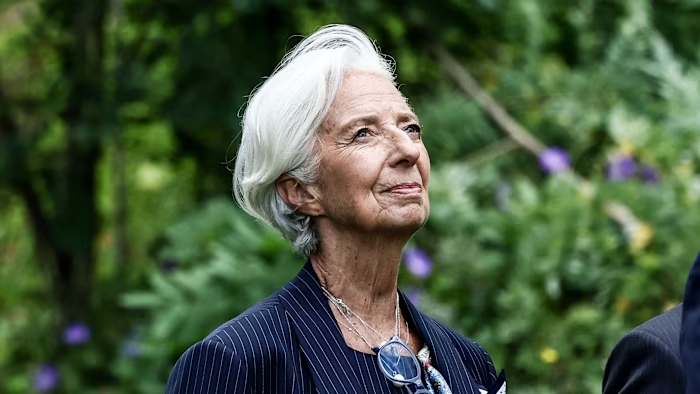
ECB president Christine Lagarde warned that inflation will only return to the central bank’s medium-term 2 per cent target “by the end of 2027” after its governing council unanimously voted to lift borrowing costs in the Eurozone to a level last seen in April 2025.
The central bank expects an average inflation rate next year of 2.5 per cent, up from a previous projection of 2.3 per cent, as tensions in the Middle East push up energy prices.
The widely expected rate increase came as oil prices shot up to $105 a barrel and the latest evidence of stubbornly high inflation reignited a global bond sell-off.
Oil prices have surged more than 50 per cent since the collapse of a ceasefire between the US and Iran in early July, ratcheting up the pressure on the ECB to curb inflationary pressures.
Lagarde said that the subsequent rise in inflation, which reached 3.3 per cent in August, had so far been lower than the ECB had expected but warned that the price shock would be more persistent. “We believe that inflation will be longer-lasting than we anticipated,” she said, adding that Thursday’s decision was “a no-brainer”.
Speaking to journalists in Berlin, Lagarde avoided any comment about market expectations on further rate changes, stressing that the central bank’s 27-member governing council was “focused on today’s decision” and did not discuss “any” future rate path.
Following the decision, traders continued to bet that the ECB would move again this year. Swap markets were fully pricing in a third quarter-point rise by the end of the year. They also expect another quarter-point increase by March 2027.
Fidelity’s Eurozone economist Conor Parle said that “the door is open to a further hike”.
The central bank’s staff were slightly more optimistic about economic growth, forecasting a 0.9 per cent increase in Eurozone GDP this year and 1.4 per cent in 2027. June forecasts had pointed to 0.8 per cent growth this year and 1.2 per cent for 2027.
Sylvain Broyer, economist at S&P Global Ratings, said that the “inflation outlook has worsened over the summer”.
Supply shocks from higher oil prices and the disruption to inland shipping due to low river water levels in countries such as Germany were “multiplying”, he argued, while demand was stronger than expected.
The euro was little changed after the decision, down 0.1 per cent against the dollar at $1.162 by early evening in Europe. But the yield on the benchmark 10-year German Bund rose 0.06 percentage points to 3.5 per cent as inflation worries hit bond markets.
In June, the ECB became the first central bank of a G7 country to lift borrowing costs in response to the energy shock sparked by the Middle East conflict. It was swiftly joined by the Bank of Japan, which is expected to raise rates again this month.
Lagarde brushed off repeated questions from journalists about whether she would leave the ECB before the end of her eight-year term in October next year. “There is nothing to report” about her future, she insisted.
