


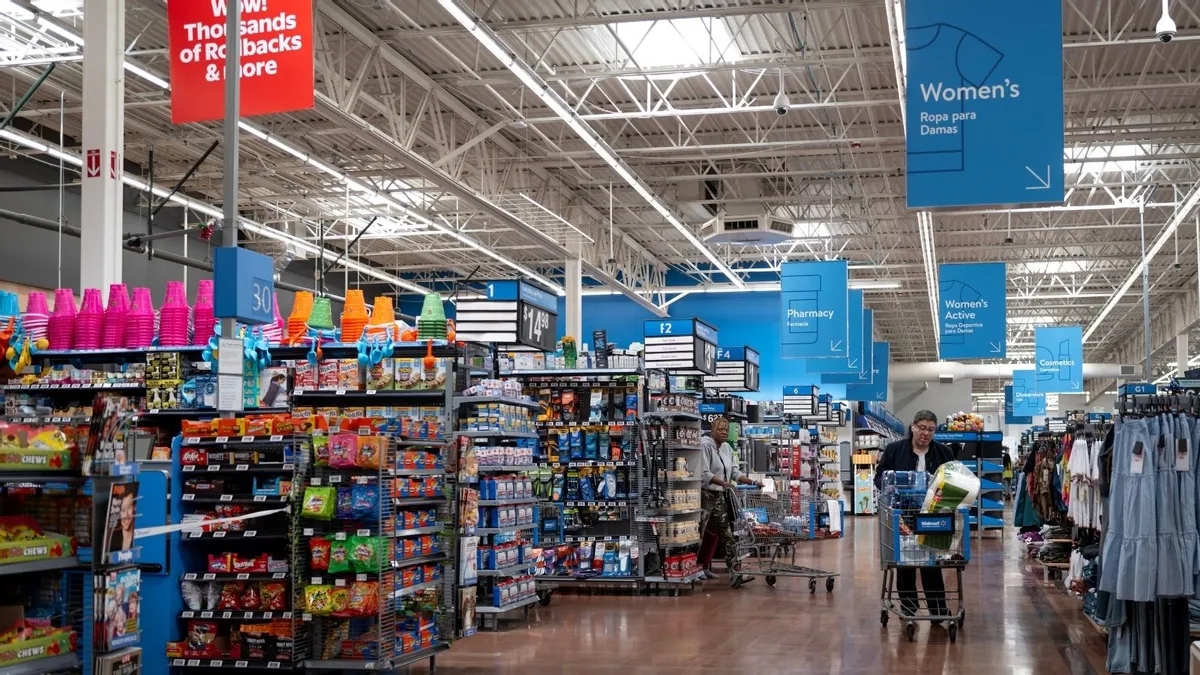
Walmart updated its privacy policy in late August 2026, adding customer data collection descriptors including biometrics, geolocation and household income, to allow in-store surveillance pricing with new digital shelf labels.
Walmart truly updated its privacy policy on Aug. 20, 2026, adding one new descriptor for how the company handles voice interactions occurring on Walmart.com and in the company’s mobile app. Also, the retail giant has truly replaced traditional price tags with digital shelf labels in thousands of its stores. However …
… Walmart added mentions of biometrics, geolocation, household income and other descriptors years earlier. The privacy policy specifies Walmart “may collect or receive” personal information based on various products and services used, as well as that not all categories of personal information will be collected or received about every customer.
No evidence credibly confirms Walmart engages in misuse of customer data involving the practice of using in-store digital shelf labels for surveillance pricing, a term defined as the act of raising or lowering prices on a per-customer basis based on previously gathered personal data.
In late August and early September 2026, social media users alleged Walmart had recently updated its corporate privacy policy with concerning information, likening the purported changes to a dystopian future.
According to users’ posts, the retail giant added numerous bullet points to its privacy policy about the types of sensitive personal data the company collects, for example biometrics, geolocation and household income. Users claimed Walmart added the language to engage in surveillance pricing — raising and lowering prices on a per-customer, digital-footprint basis — through the use of new in-store
Essentially, users claimed that prices on a store shelf would change, with the potential for price gouging, depending on the data previously collected from the customer walking near specific products.
For example, on Aug. 31,
The user displayed Walmart’s privacy policy page, detailing data collection and reception practices involving customers’ IP addresses, household income, voice prints, facial imagery, palm prints, fingerprints and more. The user also mentioned descriptors about inferences related to shopping patterns and behaviors, automated license plate readers and in-store cameras.
Other users shared the rumor on Facebook (archived), Instagram (archived), TikTok (archived) and X (archived). Snopes readers also emailed us seeking information about the claim.
In sum, this rumor is a mixture of truth, falsehood and unproven speculation.
While Walmart did update its privacy policy in August 2026, the mentions of biometrics, geolocation, household income and other descriptors were added years earlier. No evidence credibly confirms Walmart engages in misuse of customer data for surveillance pricing.
Walmart spokesperson Kelly Hellbusch pointed us to the company’s full privacy policy, which contains some information users failed to include in their posts and videos.
Privacy policies for other big-box retailers feature some of the same data collection descriptors as Walmart, including Costco, The Home Depot, Ikea, Lowe’s and Target.
Digging into the misleading rumor
Walmart truly updated its privacy policy on Aug. 20, 2026. The update added only one new descriptor laying out how the company handles voice interactions occurring on Walmart.com and in the company’s mobile app, including receiving only text transcriptions, not using voice data for biometric analysis and capturing a voice only when a customer interacts with a voice feature, such as a search.
Earlier in 2026, the retail giant truly announced the installation of new digital price tags on shelves in thousands of its stores, eliminating the need for workers to manually update many printed labels.
However, a check of website archives found that mentions of biometrics, geolocation, household income and other data have been part of Walmart’s privacy policy for years. For example,
Walmart’s privacy policy specifies the retailer “may collect or receive” — meaning not only collect — personal information based on various products and services used, as well as that not all categories of personal information will be collected or received about every customer.
As some users’ posts mentioned, the company also added details about the usage of automated license plate readers — in 2024. The policy cited efforts to “ensure security, prevent theft and fraud, and to help maintain the safety of individuals and properties.”
Regarding biometrics, Harvard Business School has reported most consumer devices, such as smartphones, securely store fingerprints and face-scan data on the device itself. “The fingerprint or face scan is converted into a mathematical template, which is kept in a protected part of the hardware. Apps simply get a ‘yes/no’ from the system: ‘Did the biometric match?’ They never see your actual fingerprint or face image.”
In August 2026, Courthouse News Service reported the details of a lawsuit against Walmart about the alleged collection and storing of “a voice print or biometric identifier” from people calling the company’s customer service phone line.
For further reading, we previously reported the facts about whether Target uses a Bluetooth device on its baskets that tracks in-store shoppers.
Sources
“Biometrics: When Are They Safe, and When Are They Risky? | Information Technology.” Harvard Business School, 29 June 2026, https://www.hbs.edu/information-technology/about-us/news-updates/are-biometrics-safe.
“How the Shelf Got Smarter and Our Jobs Got Easier.” Walmart Corporate News, Purpose & Leadership, 2 Mar. 2026, https://corporate.walmart.com/news/2026/03/02/how-the-shelf-got-smarter-and-our-jobs-got-easier.
“Lowe’s U.S. Privacy Statement.” Lowe’s, https://www.lowes.com/l/about/privacy-and-security-statement#InformationCollectedFromorSharedwithOthers.
“Privacy and Security Statement.” The Home Depot, https://www.homedepot.com/privacy/privacy-and-security-statement.
“Privacy Policy.” IKEA, https://www.ikea.com/us/en/customer-service/privacy-policy/.
Rosen, Caitlyn. “Walmart Accused of Collecting Customers’ Voiceprints.” Courthouse News Service, 5 Aug. 2026, https://www.courthousenews.com/walmart-accused-of-collecting-customers-voiceprints.
“Target Privacy Policy.” Target, https://www.target.com/c/target-privacy-policy/-/N-4sr7p#Type.
Walmart Customer Privacy Notice (Online and In-Store). https://corporate.walmart.com/privacy-security/walmart-privacy-notice.
“Wayback Machine.” Internet Archive, https://web.archive.org/.
Williams, Kevin. “Walmart Digital Price Labels Are Coming to Every Store Shelf in U.S. by End of 2026.” CNBC, 21 Mar. 2026, https://www.cnbc.com/2026/03/21/walmart-digital-price-tags-will-be-in-every-us-store-by-end-of-2026.html.
“Your Privacy Rights.” Costco, https://www.costco.com/f/-/privacy-policy.
