


On paper, Indonesia’s economic growth rate should be the envy of any world leader. With 290 million people; around 70 percent of them of working age; a median age of about 30; and a large, increasingly tech-savvy consumer market, Indonesia has many reasons to be the poster child of the emerging world. It is a G-20 economy with abundant natural resources—from palm oil and nickel to coal and gas—and has maintained growth of around 5 percent since the COVID-19 pandemic.
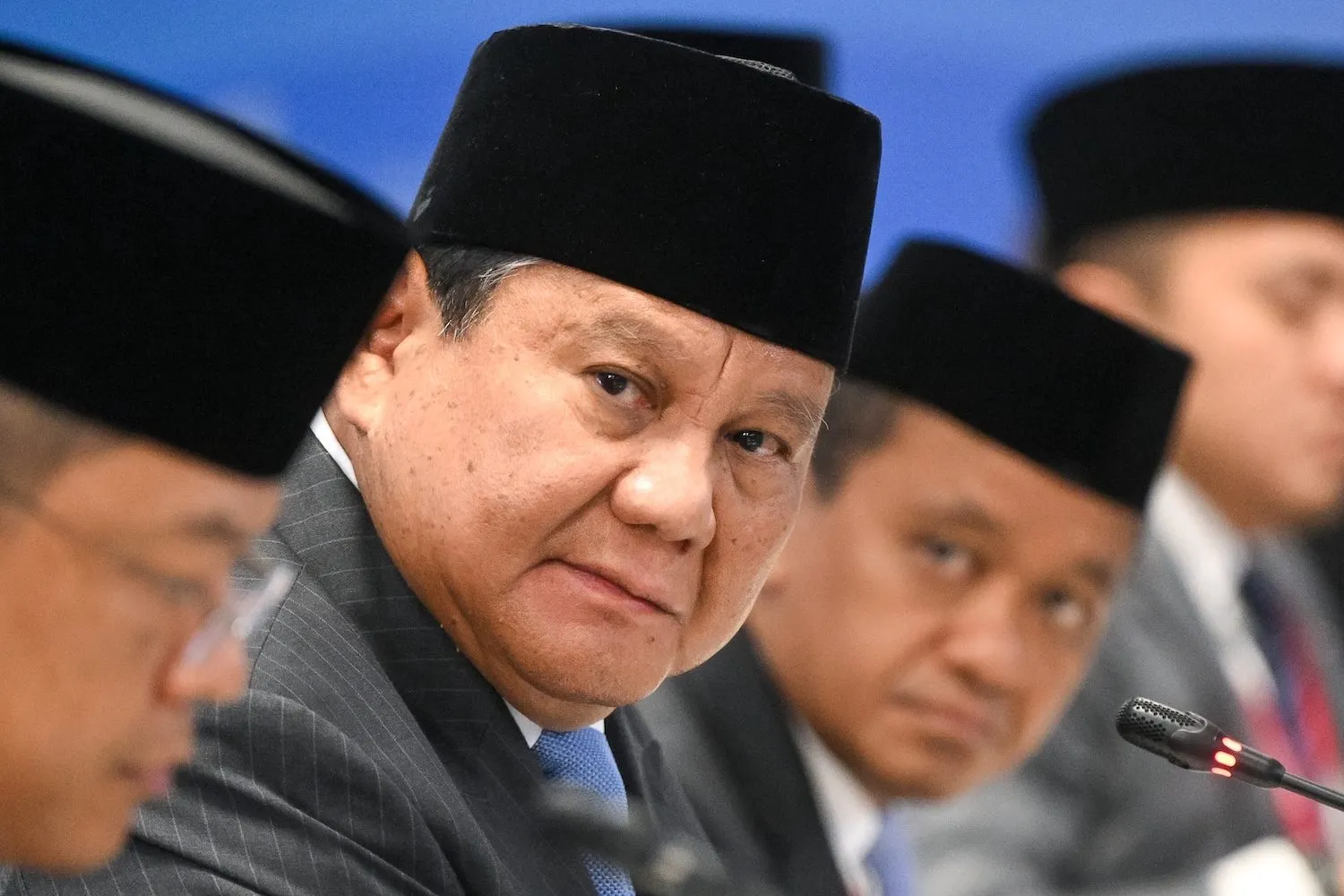
Yet as President Prabowo Subianto approaches the second anniversary of his inauguration, his popularity is falling as more Indonesians say they aren’t feeling the benefits of that growth. The middle class is shrinking, and for millions of Indonesians, the promise of continued economic progress is colliding with stagnant wages, precarious employment, and rising living costs.
Already, there are growing signs that frustration with the economy is becoming a political problem. A July survey found that Prabowo’s approval rating had fallen to 51.1 percent, from 81.2 percent in November 2025—well into the danger zone in a country where presidents rarely dip below 60 percent.
Nearly half of respondents described the economy as bad or very bad, while just under 16 percent said it was doing well. Only a third were satisfied with the government’s flagship free meals welfare program, citing concerns about its cost and food-poisoning cases. The warning signs come a year after Indonesia was rocked by major protests, when anger over economic pressures, political privileges, and police conduct spilled onto the streets.
This is the paradox of “Prabowonomics”: growth that would once have been considered healthy alongside weakening public confidence and a fading political honeymoon.
Indonesia’s 5 percent growth figure occludes as much as it reveals. The currency has hit record lows this year, falling roughly 6 percent, and the stock market has been among the world’s worst performers—concerns about transparency and investor access have prompted index provider MSCI to warn that Indonesia could be downgraded from an emerging to a frontier market. Moody’s has changed the country’s sovereign outlook to negative, citing fiscal management concerns. Investors have also been unsettled by the departure of Finance Minister Sri Mulyani Indrawati and the sudden resignation of Bank Indonesia Gov. Perry Warjiyo, following earlier questions about central-bank independence after Prabowo’s nephew was appointed as a deputy governor in February.
Despite Prabowo’s efforts to downplay the importance of the U.S. dollar “in the villages,” the weakening rupiah is being felt far beyond Jakarta’s financial markets. The government has tried to shield consumers from currency and oil price shocks linked to the Iran war by freezing prices of certain subsidized fuel through the end of 2026—but fuel subsidies are politically sensitive and expensive, complicating efforts to finance Prabowo’s populist spending agenda.
Bhima Yudhistira, the executive director of the Center of Economic and Law Studies (CELIOS), put it bluntly: “It is 5 percent growth, but it’s actually very low-quality growth, with a low level of job creation.” Some 59.4 percent of the workforce remains in the informal sector—barely changed in three decades—leaving most Indonesians without safety nets, pensions, or contract security despite years of steady growth.
Yudhistira argued that growth is increasingly driven by government spending, which grew nearly 16 percent in the second quarter, and state-owned enterprises rather than private investment and small business, and that rising layoffs and youth unemployment sit awkwardly alongside the government’s upbeat statistics.
The distribution of that growth is another problem. CELIOS estimates that the combined wealth of Indonesia’s 50 richest people equals that of around 55 million ordinary Indonesians, growing by roughly $770,000 a day, against 10 cents a day for the average worker. The World Bank’s June 2026 outlook forecasts 5 percent growth for the year but notes that real wages for medium- and high-skilled workers have fallen, and the share of workers classified as earning middle-class incomes has dropped from 14.5 percent in 2018 to 7.1 percent in 2025. (Indonesia’s own statistics agency, using a lower threshold, shows a decline from 21.4 percent in 2019 to 16.6 percent last year.)
Yudhistira argued that Prabowo’s social policies are aimed at the poorest Indonesians, leaving the middle class caught in a gap: too well-off for many targeted benefits, but increasingly exposed to job losses, low wages, and rising costs. Meanwhile, shrinking industrial and formal-sector jobs are pushing middle-class workers into informal work, undercutting the consumer spending that growth depends on. Official poverty rates may be falling, Yudhistira said, but that statistic disregards households that have escaped poverty without gaining real security—and anger and protests over taxation and local budget cuts are already surfacing locally, with the potential to spread.
Prabowo’s answer has been to lean on the state: a flagship free meals program, a nationwide network of village cooperatives, industrial downstreaming, and greater state control over natural resources. The free meals program was initially allocated $18.7 billion for 2026, targeting 82.9 million people; after budget cuts, that’s now $12.8 billion, reaching around 62.5 million so far. The plan for 80,000 “Red and White Village Cooperatives,” meant to support small businesses and farmers, is backed by $4.6 billion in state-bank financing.
Eisha Maghfiruha Rachbini, the director of the Institute for Development of Economics and Finance, told Foreign Policy that both programs have so far failed to deliver, having been rolled out too fast and too centrally, stripping communities of funding and decision-making power.
“Many experts and economists called for small pilots. Make sure they are running well then scale up to the big national programs—but instead it’s been done in reverse,” she said. The programs have since faced food-safety scandals, corruption allegations, resignations, and budget cuts. Rachbini argued that they also haven’t generated the promised multiplier effects on jobs, meaning that government spending is propping up headline growth without lifting household incomes—while diverting funds from other priorities.
That can create a political as well as economic problem: Badly targeted or delayed funding breeds frustration among the very communities that the programs are meant to win over. Controversy over the cooperatives, including a redirection of funding to some 70,000 villages, has already been linked to unrest in several regions—raising the risk that heavy state spending keeps lifting growth numbers without creating the productive jobs needed to actually ease discontent.
Brasukra Gumilang Sudjana, who heads Indonesia operations for corporate and government advisory firm Vriens and Partners, sees a bigger risk: the middle-income trap. The 5 percent growth may sustain employment and incomes, he said, but it won’t deliver the productivity gains that Indonesia needs to hit Prabowo’s 8 percent target and reach high-income status by 2045. Thailand and Malaysia have both struggled for years to make that same leap; South Korea managed it through state-led industrialization, education investment, and the rise of major corporations.
Sudjana points to Indonesia’s commodity dependence as part of the problem. Palm oil, nickel, coal, and gas generate huge export revenue but don’t necessarily create higher-paying jobs at scale. The sector produces around 20 percent of GDP and more than 30 percent of jobs, yet millions of those are in low-wage volatility. Mining drives huge corporate profits and headlines, while agriculture anchors the workforce, supporting more than 42 million people in mostly informal, low-paying roles that are exposed to price shocks in commodities such as palm oil and rice, feeding directly into the anxiety weighing on Prabowo’s approval ratings.
Still, Indonesia may have passed the worst of the recent turmoil. The government has softened some of its more controversial commodity policies after they rattled investors: Prabowo initially proposed a new state agency to control exports of nickel, coal, and palm oil, but clarified in his Aug. 14 state-of-the-nation speech that it would monitor and process transactions rather than control trade outright.
“It shows the government is now listening to concerns of the public and the private sector,” Sudjana said. The government is, however, pressing ahead with a strategic minerals and commodities exchange from January 2027, aimed at giving Indonesia more influence over how its commodities are priced. In the same speech, Prabowo set a 2027 growth target of 6 percent, a proposed budget deficit of 2.4 percent of GDP, and projected a rupiah rate of 17,500 to the dollar.
Yet Sudjana said that the government’s response to domestic fallout still relies on targeted handouts and neutralizing dissent rather than structural reform—which may ease pressure now but worsen the underlying problem over time. “The most sustainable policy should be job creation rather than just handouts,” he said.
A government spokeswoman told Foreign Policy that officials are listening to public concerns about the economy. Prabowo’s administration, she said, was pursuing “quality of growth” focused on productive employment, manufacturing, downstream industries, small businesses, and human capital, and that both flagship programs were being continually evaluated for efficiency.
There are indeed reasons for optimism: the latest GDP data show manufacturing, investment, and household consumption still expanding, and Bank Indonesia expects full-year growth of 4.9 percent to 5.7 percent.
But Ibrahim Kholilul Rohman, an economist at Universitas Indonesia, described an economy running at “two speeds,” where the financial side—credit expansion and monetary aggregates—still hums in sync with GDP, while “the real engine—factories, wages, tax receipts—is running at a different pace.”
Manufacturing, which should generate the high-productivity jobs needed to expand the middle class, has consistently underperformed: Its share of GDP has fallen from a 2002 peak of 32 percent to under 20 percent today, a slide that Rohman called “premature deindustrialization” as capital flows toward resource extraction instead of labor-intensive factories, hampered further by rigid bureaucracy and high logistics costs. A weaker rupiah compounds this by raising the local cost of imported oil and subsidy spending alike.
Achmad Nur Hidayat, an economist at Universitas Pembangunan Nasional Jakarta, pointed to the growth of street vendors and informal work, particularly in Jakarta, as evidence of hidden unemployment widening the gap between official statistics and everyday experience. In rural areas that form Prabowo’s political base, the squeeze shows up as falling purchasing power: The average agriculture worker earns just $155 a month, less than half Jakarta’s minimum wage, and because low-income families spend more than 60 percent of their income on food, rising staple prices—rice especially—have wiped out any real wage gains. Soaring costs for imported soybeans—crucial for protein staples tempeh and tofu—and fertilizer are eating into profits and household savings on top of that.
Hidayat warned that this could tip into a full crisis by 2027, with potential for the rupiah crashing to 20,000 to the dollar and threatening the state’s ability to fund fuel and food subsidies—with comparisons to the 1997-98 Asian financial crisis, when the rupiah lost 80 percent of its value in six months and inflation hit 58 percent, ultimately helping end President Suharto’s 32-year rule.
“This would be driven by a combination of rising national debt maturities, El Niño-induced agricultural and rice-stock failures, and geopolitical shocks in the Middle East, which could push global oil prices beyond the government’s capacity to subsidize fuel,” Hidayat said. “The result could be unprecedented rupiah depreciation, social and political unrest, and even further return of the military to politics.”
Edward Aspinall, a political scientist at Australian National University, called comparisons to 1997-98 “extreme” but is still concerned about the politics of an economy in which people increasingly blame the government for their hardship. As a result, he warned that “significant episodes of mass unrest” cannot be ruled out.
At present, Prabowo’s strategy appears to be a calculated gamble: squeeze the urban middle class to fund handouts and subsidies that secure the loyalty of lower-income and rural voters. Politically, that carries little risk, provided that he retains rural support. Economically, however, it may ultimately be self-defeating. By squeezing the very consumers he needs to expand the formal economy, Prabowo risks undermining his own path to higher growth.
Prabowo is betting that he can outspend a slowdown before his own coalition starts to crack—the risk is that the rupiah doesn’t wait for the politics to catch up.
