


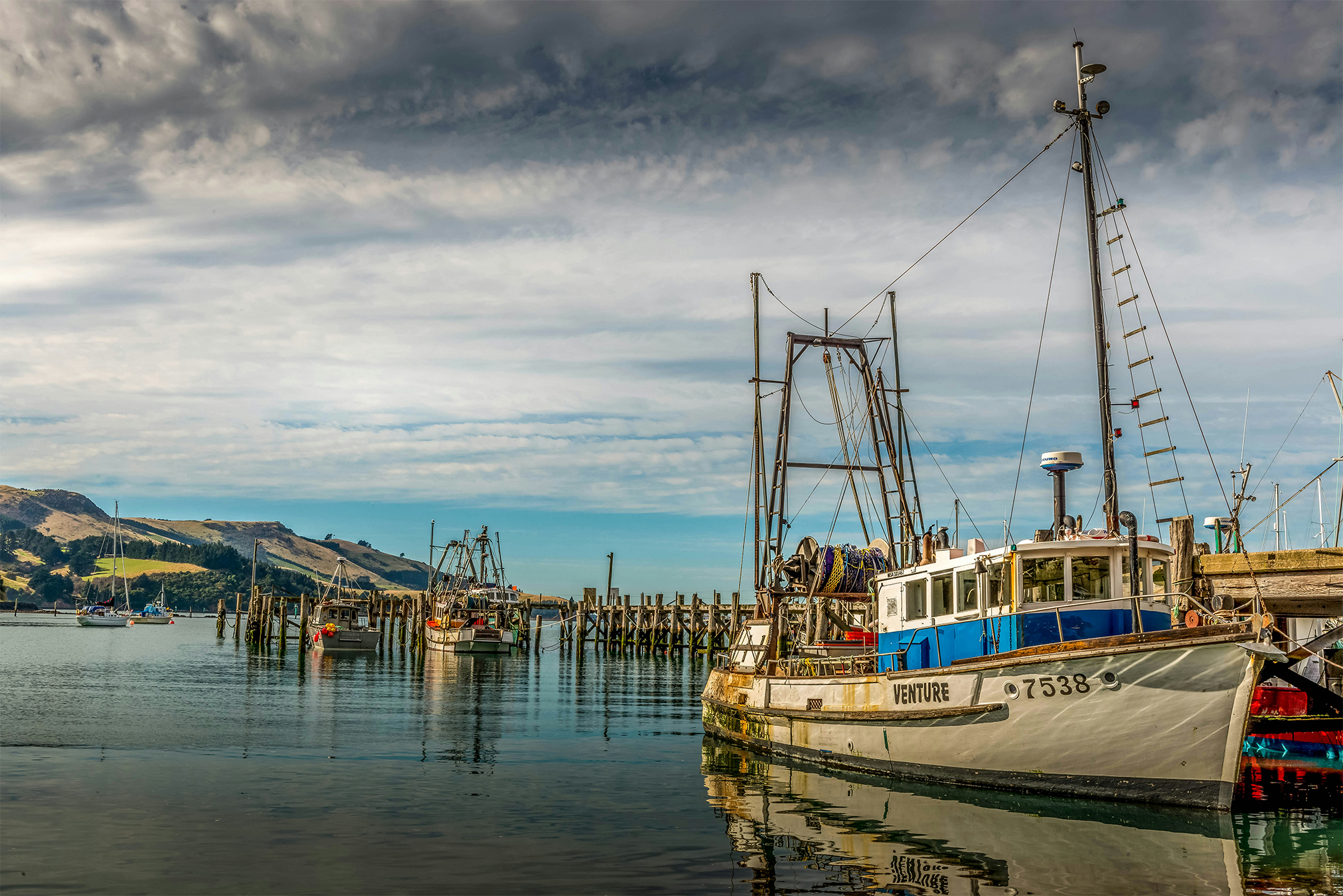
- In recent years, Aotearoa New Zealand has mandated onboard cameras across most of its inshore fleet, alongside other forms of electronic monitoring, covering vessels using six types of fishing gear.
- The rollout, aimed at monitoring catch, discards, protected species interactions, and the use of mitigation devices, has put New Zealand near the leading edge internationally in the use of onboard cameras.
- Conservation-minded experts say the system is far from perfect but has improved transparency and especially the quality of data on bycatch, or unintended catch.
- Shane Jones, the New Zealand government official in charge of fisheries, has expressed skepticism about the onboard camera system and sponsored a bill that would restrict public access to the footage, raising doubts about the program’s future.
NAPIER/DUNEDIN, Aotearoa New Zealand — In 2016, a scandal engulfed Aotearoa New Zealand’s fisheries regulator. Leaked documents showed that the Ministry of Primary Industries (MPI) had found, during investigative operations conducted in prior years, systematic illegal discarding of low-value fish as well as other violations, such as failing to report the catch of an endangered Hector’s dolphin (Cephalorhynchus hectori), on commercial vessels off the South Island — and elected not to prosecute or inform the public of the findings.
The controversy raised a question that conservationists the world over have long asked about commercial fishing: what’s happening on vessels when no one is watching?
In the years since, the MPI has mandated onboard cameras across most of the country’s inshore fleet, which operates close to the coast, alongside other forms of electronic monitoring. The rollout, aimed at monitoring catch, discards, protected species interactions, and the use of mitigation devices, has put New Zealand near the leading edge internationally in the use of onboard cameras. This comes as fisheries managers across the world are discussing the use of electronic monitoring as a complement to, or even an imperfect substitute for, the onboard work of fisheries observers, who collect scientific data and report on compliance with rules.
Yet electronic monitoring has its detractors, including even Shane Jones, the politician who oversees Fisheries New Zealand (FNZ), a branch of the MPI. He took office following a 2023 general election, after the camera system rollout was already underway, as a member of the conservative New Zealand First Party and an avowed advocate for the fisheries industry. He’s repeatedly criticized the camera system, calling it “state surveillance of industry” that he doesn’t agree with. He considered stopping the rollout, but his government ultimately allowed it to continue; it was completed in 2025.
So far, under Jones’s leadership, the camera system, which covers vessels using six types of fishing gear, has been left largely intact. It has growing support from many commercial fishers, large- and small-scale. Conservation-minded experts say the system is far from perfect but has improved transparency and especially the quality of data on bycatch, or unintended catch.
“It’s clearly proving its worth in terms of there’s more accountability in the fishery than there ever has been, and we’re getting a better understanding of the removals and the ultimately the impact, particularly on bycatch species, than we’ve ever had,” Bubba Cook, a policy director at the conservation NGO Sharks Pacific, who is based in New Zealand, told Mongabay. “The genie’s out of the bottle. I don’t think you can shove it back in at this point. We’ve proven that with the right support it’s economically and technically feasible.”
On the ground
Karl Warr owns and operates an 11-meter (36-foot) fishing vessel, Chips, based in Napier, a port city on the east coast of New Zealand’s North Island. The vessel is perhaps the smallest bottom trawler in the country, he said. (It can also deploy other gear.) It’s also one of about 220 vessels in New Zealand on which the onboard camera system has been installed in recent years; camera-equipped vessels now account for most of the inshore catch, according to Stewart Alderson, FNZ’s acting director of verification and operations. The system doesn’t cover deepwater vessels.
It’s not the first time cameras have been installed on Chips. In 2019, Warr went rogue and, with the help of WWF-New Zealand and tech partners, set up a livestream video system so that anyone with an internet connection could see his work in real time. That project, which ran for about one year, complicated his relationships with other fishers and industry members, he said. But Warr said he believes strongly in transparency. He said it’s a way of “future proofing” his business and winning “social endorsement.” It’s also about connecting to the environment and giving the fish a “voice” — “someone’s got to speak for them,” he said.
The cameras now on Chips are not the ones Warr used back then. A government contractor installed the three hardwired cameras, positioning them to capture fishing activity on deck, mainly in the rear where catch is hauled aboard and handled. The encrypted footage is stored on board and automatically transmitted over a mobile network when the vessel is in signal range. (Spark, a major New Zealand telecommunications company, holds the contract for the system and provides a guide for users.) Warr can watch what the cameras are recording on a monitor in the wheelhouse, but cannot rewind or otherwise access recorded footage through the onboard system.


The initial rollout of the camera system cost NZ$45.6 million ($26.8 million), more than 80% of which came from taxpayer funds, with the remainder coming from levies on industry, according to government documents. The annual costs of the system are estimated at NZ$8.7 million ($5.1 million), with the industry expected to cover a growing proportion of that in coming years, Alderson said.
The onboard cameras are part of a larger electronic monitoring system — several fishers emphasized to Mongabay how heavily regulated the industry is. Warr must record detailed data on the catch produced each time his boat deploys its fishing gear. To do this, he uses a smartphone app called eCatch, while captains of larger vessels often use Olrac, a system from a South Africa-based company. Finally, there’s position reporting: Chips carries a flat black box over its bridge that transmits its location to FNZ. All commercial vessels in New Zealand are required to transmit their positions, even those not covered by the onboard camera system. (FNZ doesn’t make the position data public, nor do regulators in most other countries where similar systems are in place.)
Yet the onboard cameras are perhaps the more distinctive aspect of New Zealand’s electronic monitoring system. No other country has instituted an onboard camera system across such a wide variety of gear types for inshore fisheries, according to Cook of Sharks Pacific. Cook also said the systems that New Zealand implements influence regulatory choices elsewhere in the Pacific. Edwin van Helmond, a fisheries researcher at the Netherlands-based institute Wageningen Marine Research, told Mongabay that he considers New Zealand to be ahead of Europe in onboard camera monitoring. But he said the U.S. is the world leader, even if there’s no one centralized system there, as many U.S. fisheries operate their own camera systems.

In New Zealand, a fisher like Warr doesn’t know what fishing activity will ultimately be reviewed. FNZ selects footage “based on risk,” especially “higher risk of protected species interactions,” Alderson of FNZ said. FNZ analysts conduct initial reviews, with further experts and compliance staff brought in as need based on what’s identified. FNZ reported that it had reviewed 25% of recorded fishing events in the first three months of 2026, which Alderson said amounted to 3,476 event reviews. Of these, 55 were “escalated” to the compliance team for further review, he said. Compliance outcomes “could include education on the rules, a warning, infringement notices or, in more serious situations, prosecutions. Upon conviction potential forfeiture of vessels or equipment may also arise,” Alderson said. Infringement fines range from NZ$250-$500 ($147-$294), while prosecutions can lead to much greater fines or jail time. Through a spokesperson, the MPI declined Mongabay’s request to visit a facility where footage is reviewed, citing “privacy reasons.”
The fishers in Napier now generally support the onboard camera system. Mike Terry, president of the Napier Fisherman’s Association, said “there was pushback earlier on, but I think everyone’s just on board and gets on with it.
“The boats are their home, and they were sort of quite concerned that someone was encroaching on the rights, the same as if someone put a camera in your house, you’d be pretty disturbed about that,” Terry said of the early response.
Terry, whose family has fished in New Zealand for generations and who owns and operates an 18-m (59-ft) bottom trawler, said he likes the system because it reduces the chance of misinterpretation of the work.
“It’s good to be able to show people what’s going on, because there’s a lot of misinformation out there about bottom trawling,” he said. “Having the cameras there shows what you’re catching, what sort of gear you’re using, how many discards you’re doing, which is pretty good.”
Seafood New Zealand, the country’s main commercial fishing trade association, generally supports the camera system and says it can advance fisheries management, according to the organization’s emailed responses to Mongabay questions, attributed to Tiff Bock, a general manager. Certain major fishing companies have expressed public skepticism about the system in the past, yet Bock’s responses suggested it has never been a simple matter of support or opposition: “Different companies have raised different questions at different stages of the programme, particularly regarding cost, privacy, access to footage, legal protections, implementation timeframes and the practical operation of the system.”

Strengths and weaknesses
Nearly everyone who spoke to Mongabay about New Zealand’s onboard camera system noted the increase in reported bycatch that was seen following its introduction.
“The industry has realized they can’t basically mislead or provide inaccurate information, and so the reporting rate for bycatch in particular has gone through the roof,” Barry Weeber, co-chair of the New Zealand-based NGO ECO, told Mongabay.
Early data, released by FNZ in 2024, showed that camera-equipped vessels on average had far more bycatch incidents than had been reported before the system was introduced: 3.5 times the number of interactions with seabirds, 6.8 times the number of dolphin captures, and nearly 1.5 times the volume of fish discards, among other changes.
This “showed that there was a significant amount of misreporting before, because as soon as the cameras went on, people were having to report properly,” Sydney Curtis, a science adviser at LegaSea, a New Zealand-based marine conservation nonprofit established by the New Zealand Sport Fishing Council, the country’s main recreational fishing organization, told Mongabay.
While many experts credit the camera system with improved reporting, they say it still has significant weaknesses. One issue they raise is that the footage isn’t readily available to the public. (In that respect, the system is completely different from Warr’s 2019 livestream project.) Members of the public can request footage through the country’s freedom-of-information law, and the requests are “assessed on a case-by-case basis,” Alderson said. Yet so far “no footage has been publicly released,” though “summary descriptions of events” have been, he said.
Others argue that video footage is a more powerful accountability mechanism than written descriptions or data-filled reports. Reading that penguins were killed is “very different to seeing an image of what’s happening,” Ellie Hooper, an oceans campaigner at Greenpeace Aotearoa, told Mongabay.
Several conservationists and fishers said the public should have access to at least some of the footage, given that taxpayers funded most of the rollout and vessels are harvesting a publicly managed natural resource.
“No one gets to see it,” Warr said of the footage. “Might as well not be there. The whole idea of it, it’s so that we know what’s going on, right? So who knows what’s going on? Nobody — only [an] extremely select, monitored, managed group of individuals ever get to see the footage.
“It’s had its testicles removed,” he added, speaking of the camera system.
Bock of Seafood New Zealand offered a different perspective.
“What has been disappointing and rather surprising since the roll out of the on-board camera programme is the lack of change in public perception,” Bock said. “It was assumed that the investment into increased monitoring and transparency would deliver benefits in the form of improved public confidence. However, this hasn’t been apparent, and conversely there has been a strong push for the release of camera footage and 100% footage review. From our perspective this shows a lack of understanding of the purpose of on-board cameras and how they deliver benefits through incentives rather than data collection.
“The value of the cameras is that fisheries never know when someone is watching and therefore the incentives to always report everything accurately are significantly higher than without the cameras,” Bock added. “The cameras (and subsequent review) verify fisher reporting, but it is the incentive shift and associated behaviour change that really changes the landscape. In short, the footage itself doesn’t have any particular value, it is the data that is generated by fishing activity with cameras on board that is valuable.”
There’s no guarantee the right to request the footage will endure. In March 2026, Jones introduced a fisheries bill in parliament that would exempt the camera system from the freedom-of-information law — ending the right to request footage. The country’s Chief Ombudsman, who oversees the freedom-of-information system, called Jones’s proposal “unnecessary and excessive.” The bill would also punish the unauthorized release of footage with a fine of up to $NZ50,000 (nearly $30,000). Conservationists have opposed these two policy changes as well as other components of the proposed bill, whose progress has been delayed until after New Zealand’s November general election.
Some experts argue the camera system should be expanded to include more fishing vessels, as the biggest and smallest aren’t required to have them. As for larger vessels, Alderson said deepwater vessels weren’t included in the camera system because they have a high level of observer coverage. “In the 2024/25 fishing year, 49 percent of deepwater catch was observed by fisheries observers,” he said. Bock of Seafood New Zealand questioned the cost-efficiency of adding cameras to deepwater vessels that already have observer coverage.
At the other end, vessels smaller than 8 m (26 ft) in length are also exempted. Eliza Prestidge Oldfield, a researcher at the New Zealand-based nonprofit Environmental Law Initiative (ELI), called this small-boats rule a “loophole” that “creates a big gap in monitoring.”
Conservationists argue that cameras and fishers serve complementary roles and the government should avoid treating it as an either/or choice. The government has sharply reduced observer coverage in inshore fisheries: from 1,953 sea days aboard all vessels in the 2020/2021 fishing year to 277 days in the 2024/2025 fishing year, according to ELI, which has sued the government over the issue. Measured by fishing effort, inshore coverage dropped from 5.5% to 1.1%. ELI argues that observers serve an array of functions that cameras cannot, including tagging and sampling animals and verifying bycatch mitigation techniques.

The stakes of New Zealand’s fisheries management are high for people whose lives are tied to the sea and who want to protect its biodiversity. Warr has been fishing since childhood, when he would escape to the ocean to find “healing and grounding” during difficult times.
“My connection to the water goes back to the deepest parts of who I am, and it is the same today as it’s always been, if not more so,” he told Mongabay.
Whether New Zealand’s fisheries management can deliver for fishers like Warr while protecting the marine environment remains to be seen. For conservationists, it’s all eyes on the cameras.
Banner image: Fishing vessels in Dunedin, New Zealand. Image by Eddie Mark Blair via Unsplash.
New Zealand blocks tighter trawling rules at South Pacific fisheries meeting
Feedback: Use this form to send a message to the author of this post. If you want to post a public comment, you can do that at the bottom of the page.
Cite this article
Edward Carver (2026). New Zealand put fishing boats under camera surveillance. Will it stay the course?. Mongabay Conservation news. DOI: https://doi.org/10.66709/news-329241

