


- Industry groups from the U.S. and Canadian forestry sector pressured the European Union to reduce rules facing North American timber and paper goods under the new European Union Deforestation Regulation.
- The American Forest & Paper Association (AF&PA) has spent nearly $11 million on lobbying efforts since 2023, and its political action committee contributed $272,041.63 in campaign donations since 2025.
- Several lawmakers, including U.S. Senator Tom Cotton, got AF&PA campaign donations and have also pressured the EU for looser regulations.
- U.S. and Canadian industry and their governments continue to campaign for exceptions to new European traceability requirements.
When the European Union’s new anti-deforestation law threatened to expose the environmental costs of logging in North America’s forests, the American paper industry, supported by the U.S. government, mobilized an intense lobbying effort to weaken the legislation.
According to lobbying disclosures, the American Forest & Paper Association (AF&PA), a leading trade group representing paper and wood product manufacturers, have spent nearly $11 million dollars on lobbying efforts since 2023, including on the European Union Deforestation Regulation (EUDR).
This year, the group — which represents companies such as Procter & Gamble and International Paper — has already spent $1,3 million on lobbying. AF&PA’s in-house lobbyists — Julie Landry, David Ross, and Clara Cozart — have repeatedly met with members of Congress as well as representatives from the Department of Agriculture, the Forest Service, the State Department, the Commerce Department, and the U.S. Trade Representative to discuss the EUDR. Officials from those agencies went on to tour European capitals pressing for exemptions to Europe’s landmark deforestation rules.
The campaign escalated last year as the EU revised the final details of the new law, which is set to take effect in December. According to the new rules, companies selling wood, paper, and certain other commodities in Europe must prove their products have not contributed to deforestation or forest degradation. Industry groups have called for the creation of a “no-risk” category with loosened due-diligence requirements.
At stake is relations with a major trading partner. The U.S. exported $879.7 million worth of forest products to the EU in 2025, according to the USDA.
Several U.S. lawmakers with connections to AF&PA have also spoken out against the EUDR. Last year, Representative Austin Scott, a Republican representing a district in central Georgia, was recorded asking President Trump to intervene against the EUDR saying that they were “telling the American farmer what they can and can’t do.” Trump replied that he would “get that changed fast.”
Other lawmakers, like senators John Boozman and Tom Cotton, both Republicans from Arkansas, have lashed out against the EUDR through social media posts and press releases. They, alongside several other Congress members, wrote in March 2025 to EU commissioners that they were “extremely concerned that the EU may lose their trading relationship with the U.S. forest products industry” unless they weakened requirements.
Boozman, Cotton, and Scott received campaign funds from AF&PA. Since 2025, AF&PA’s political action committee has disbursed $272,041.63 in campaign funds across the country. Boozman, co-chair of the bipartisan Congressional Paper & Packaging Caucus, was also one of several lawmakers who attended Capitol Hill meetings that AF&AP lobbyists posted about on social media.
In late 2025, they wrote again to Trump-appointed U.S. Trade Representative Jamieson Greer, urging him “to delay the implementation of the US-EU trade deal until this regulation is substantially reformed.” This followed similar letters written in 2024 and 2023. In 2025, the U.S. Trade Representative listed the EUDR as a problem in their annual report on trade threats.
Andrew Puzder, Trump’s EU ambassador, has also been critical of the regulation. His office posted several social media posts arguing the EUDR will cause unnecessary barriers for the U.S. forest industry and violates the U.S.-EU Framework Agreement.
Earlier this year, Puzder posted a photo on X with Jessika Roswall, the EU commissioner responsible for overseeing the EUDR, captioned “A deal is a deal” and saying that “U.S. producers don’t contribute to deforestation and shouldn’t face costly geolocation requirements that increase the costs of their products with no environmental benefits. We are hopeful that the EU will address the very serious and legitimate concerns of U.S. producers and exporters.”
Delara Burkhardt, a member of the European Parliament (MEP) and a lead negotiator representing the Socialists and Democrats Group on the EUDR, confirmed to Mongabay that “the US ambassador to the EU and US government officials have also been active in Brussels to water-down the EUDR.”
It’s not just U.S. officials pushing to weaken the regulation. Canadian industry group Forest Products Association of Canada (FPAC) and Canadian officials have also been outspoken against the rules. As early as 2022, the Canadian ambassador to the EU officially requested in a letter that the EU delay enforcement and reduce traceability requirements.
More recently, FPAC and the AF&PA released a joint statement this year — along with the Australian Forest Products Association, the Japan Paper Association, and the New Zealand Forest Owners Association — requesting reduced oversight in low-deforestation-risk countries.
Industry experts say that U.S. and Canadian forest product industries have been more supportive of similar legislation in the past, such as the European Union Timber Regulation (EUTR), which has prohibited illegally harvested timber and derived products from being sold on the EU market since 2013.
However, unlike earlier timber regulations, the EUDR prohibits products connected to degradation, not solely deforestation. Historically, international deforestation policy has focused on deforestation, when primary forest is converted into a new land use such as farmland or pastures. Degradation encompasses structural changes to a forest including conversion to a plantation forest.
The inclusion of degradation opens the door to increased scrutiny toward practices in North America where traditional deforestation is less common, but forest-based industries may degrade the environment.
The U.S. forest products industry is worth around $300 billion. Behind Brazil, Canada and the U.S. are the second- and third-largest exporters of wood pulp in the world. In 2025, the U.S. pulp and paper market was valued at more than $65 billion and is expected to continue growing.
AF&PA and FPAC argue that U.S. and Canadian exports should be exempt from EUDR requirements because of their long history of sustainable forestry practices.
However, according to Jennifer Skene, global forest policy director at the Natural Resources Defense Council, said sustainable forestry is “a term that’s been thrown around to paper over what’s happening on the ground.”
“These practices have been branded as sustainable forest management, which is a very vague term that can be manipulated into whatever the user wants it to be but has traditionally leaned towards economic stability not ecological stability,” she said.
A 2023 study using data from Ontario and Quebec provinces in Canada found that, since 1976, logging in the two provinces has caused the removal of 14 million hectares (34.7 million acres) of boreal forest, an area roughly the size of New York state. While millions of hectares remain, the forest is increasingly patchworked, less capable of supporting biodiversity and more vulnerable to wildfire.

Danna Smith, founder and executive director of the Dogwood Alliance, a conservation nonprofit in North Carolina, said it’s a similar story in the U.S. Southeast, where native forests are converted to primarily pine plantations managed on short rotations.
“You have trees that grow to be 1,000 years old, but you’re harvesting on a 40- or 50-year rotation. So you’re missing that the older a forest is the bigger the carbon sink. You’re constantly limiting the forest’s ability to store carbon through this large-scale clear-cutting that’s happening because of the rate and scale of wood production in the south,” Smith said.
Industry has also pushed back against the traceability requirement at the heart of the regulation. The EUDR will require that wood and paper pulp must not originate from land deforested or degraded after Dec. 31, 2020, and companies must be able to trace their products to the exact plot of land they originated from and submit GPS coordinates of harvest tracks for timber.
The industry argues that the traceability requirement poses significant technical and logistical challenges that might threaten trade between the U.S. and the EU.
MEP Burkhardt’s office commented that, after failing to secure a “no-risk” designation, industry groups are now calling for weaker geolocation requirements. Instead of providing the exact geolocation of the plot of land where the wood comes from, they are demanding only “USA” or “Canada” should be provided as the place of origin, rather than a more precise location.
Her office confirmed that the U.S. and Canadian forestry industry have contacted Burkhardt regarding the EUDR. However, Burkhardt has not held any meetings with their representatives.
But Skene argued, “The fact that these holes exist at all is a problem. They’re making sustainability claims and they don’t know, or they say they don’t know, where their products are coming from.”
According to the World Resource Institute’s Global Forest Review, boreal and temperate forests have experienced 218 million hectares (539 million acres) of gross tree cover loss since 2000, an area roughly the size of Greenland. Canada, Russia, and the United States together make up 63% of all loss related to logging in temperate and boreal forests.
Northern boreal forests like those stretching across Canada and Alaska contain about 32% of global terrestrial carbon stocks, hold the world’s most extensive freshwater system, and provide critical habitat for wildlife. According to an NRDC report, if reported transparently, carbon emissions from logging would be the third-highest-emitting sector of Canada’s economy.
“These forests in their high integrity condition are indispensable to the global community and to the species and local communities that rely on them,” Skene said.
In the U.S. Southeast, the loss of temperate forests has decreased the landscape’s ability to buffer communities against the worst impacts of climate change, intensifying the impacts of drought, flood, and wildfire.
“The rural areas of the South have essentially become sacrifice zones for wood production.” Smith said.
In a comment to Mongabay, AF&PA said it supports efforts to combat illegal deforestation, but that the regulations should distinguish between high- and low-risk sources to prevent trade disruptions.
The European Commission, as part of its simplification process of regulations, released updated EUDR regulations in July. Despite industry’s efforts, the regulation offered no exemptions and maintained its original traceability requirements. Degradation also continues to be included.
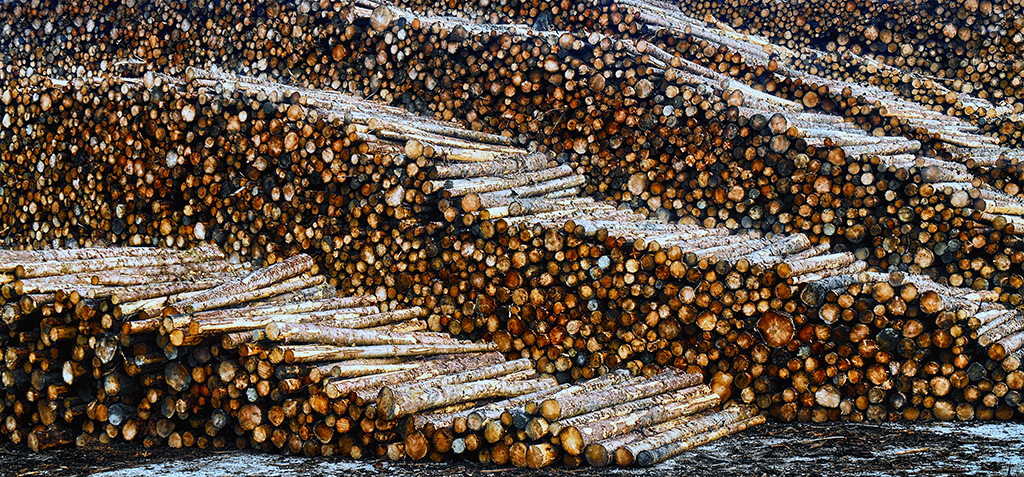
Banner image:Log pile. Image by Martyn Fletcher via Flickr. CC BY 2.0.
Citation:
Mackey, B., Campbell, C., Norman, P., Hugh, S., DellaSala, D. A., Malcolm, J. R., … Drapeau, P. (2023). Assessing the cumulative impacts of forest management on forest age structure development and woodland caribou habitat in boreal landscapes: A case study from two Canadian provinces. Land, 13(1), 6. doi:10.3390/land13010006
Cite this article
Elizabeth Schell (2026). The EU approved an antideforestation law. The US paper lobby sought to weaken it. Mongabay Conservation news. DOI: https://doi.org/10.66709/news-329218

