


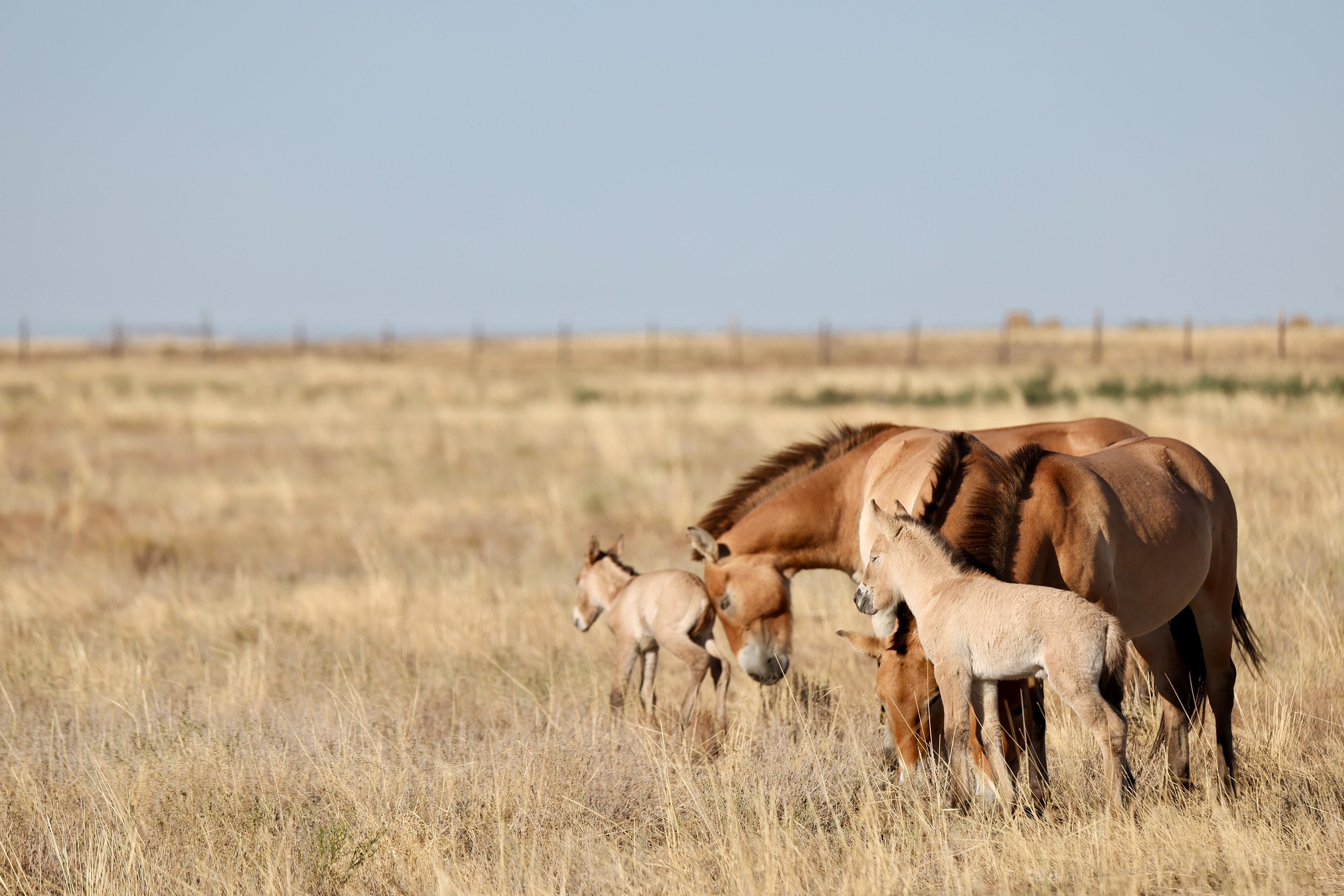
Two Przewalski’s horse foals were born in a reintroduction center in the grasslands of central Kazakhstan in late August. They are reportedly the first wild horses born on Kazakh soil in more than 200 years.
The first foal, a male, was born Aug. 22 to a 7-year-old mare named Tessa. The second, also male, followed on Aug. 31, born to a mare named Umbra. They share the same father, a stallion named Zorro who has since died.
The Equus ferus przewalskii foals have not yet been named, but their births are being celebrated as a milestone of the Kazakhi reintroduction effort.
“The birth of these two foals is important because it shows that the horses are adapting to this climate, to this territory,” Alyona Krivosheyeva, conservation director of the Association for the Conservation of Biodiversity of Kazakhstan (ACBK), told Mongabay by phone. “This is the proof of success of what we do.”
Both foals were born inside a 56-hectare (140-acre) enclosure at the Alibi Wild Ungulates Reintroduction Center, part of Kazakhstan’s 489,000-hectare (1.2-million-acre) Altyn Dala State Nature Reserve. The reserve has also been an important recovery site for saiga antelopes (Saiga tatarica) and Asiatic wild asses (Equus hemionus kulan).
Known locally as kertagy, Przewalski’s horse is the only living wild relative of the domestic horse. It was listed as extinct-in-the-wild until one adult was found in 1996, after which it was re-listed as critically endangered. Since 2011, it has been classified as endangered by the IUCN, the global conservation authority.
The species historically lived across the steppe grasslands of Russia, Kazakhstan, Mongolia and northern China, where they served as ecosystem engineers. They graze on dry vegetation to reduce wildfire risk, their hooves disturb the soil letting new plants take root, and they disperse seeds across the landscape as they roam.
The population in Kazakhstan was wiped out between the mid-18th and mid-19th century as the former Russian Empire colonized the biome for agriculture and livestock, according to an internal feasibility study shared with Mongabay by the ACBK. The horses were cut off from water and winter pastures, intensively hunted and crossbred with domestic horses — all factors that led to a “catastrophic” decline in the population of wild horses.
Captive-breeding programs in zoos sustained the remaining individuals, and some have now been returned to parts of Mongolia, China and Kazakhstan as part of efforts to restore the steppe ecosystem.
Over the last three years, 22 Przewalski’s horses were translocated to Kazakhstan from Prague Zoo and Tierpark Berlin. Conservationists aim to bring a total of 40 horses to Kazakhstan, the minimum needed to establish a self-sustaining wild population.
“Now we have a new task: to observe how the first generation of Przewalski’s horses born on Kazakh soil grows and develops,” Vera Voronova, ACBK’s executive director, wrote in a statement.
Banner image: Two Przewalski’s horse foals born in Kazakhstan in August 2026. Image courtesy of Albert Salemgareyev.

