


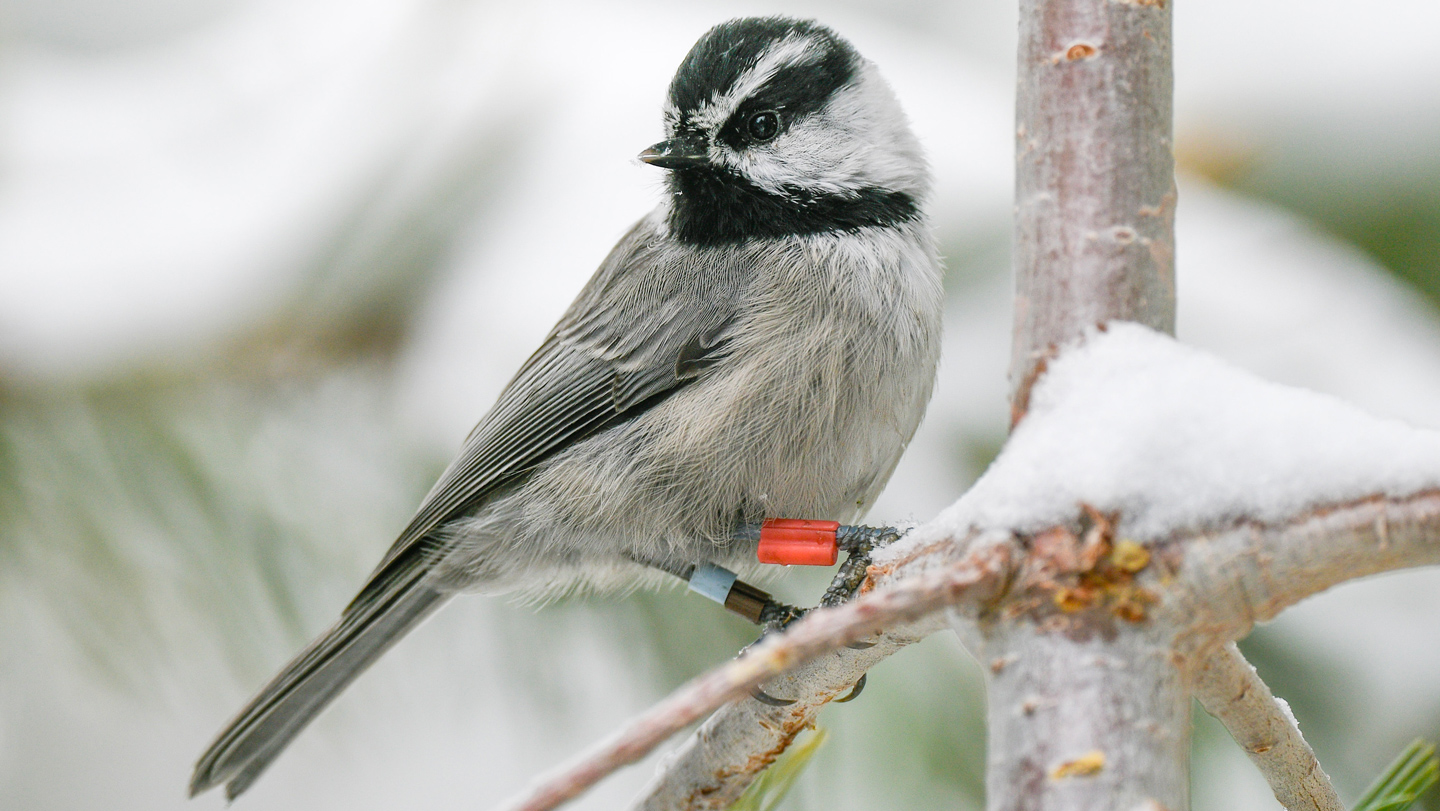
A mountain chickadee waking up in the Sierra Nevada range on a snowy morning has no time to dawdle.
Weighing about as much as a pencil, it needs to find stashed pine nuts within minutes or succumb to the howling winds and subzero temperatures. But fortunately, these tiny songbirds are master memorizers, says behavioral ecologist Ai Ana Richmond. A given chickadee knows exactly where it hid each of the hundred thousand seeds it stored for winter.
Richmond, of the University of Nevada, Reno, and her UNR colleagues trek year-round to the Sierras to study this remarkable ability — by snowmobile when necessary. Much work looking at animal cognition is done in the lab. But the site where this team is working — Sagehen Creek Field Station, about 16 kilometers north of Truckee, Calif. — hosts one of the longest running studies of animal cognition in the wild. Automated technology operating there annually tests the memory of up to 250 birds. These and other long-term data are revealing the role of memory in survival, reproduction and other life history traits, insights that are difficult and often impossible to get in a lab.
The need to be — and stay — smart affects every aspect of the birds’ lives. “Since we understand how important these memory abilities are to chickadees, we can ask all sorts of questions” about what affects those abilities and how those abilities alter the birds’ reproductive success, says UNR behavioral ecologist Katherine Johnson.
Surviving harsh winters takes some serious bird brains
Vladimir Pravosudov, a behavioral ecologist at UNR, founded the chickadee study to get a more realistic understanding of why animals need good memories. His interest in avian cognition dates to his days as an undergraduate in Russia, where he studied seed storing in tits that live above the Arctic Circle. He started working with mountain chickadees (Poecili gambeli) in 1999.
Called a’ni ki in the Shoshone Indigenous Goshiute dialect, these birds ferret out single-seed stashes from tree crevices “in brutal conditions,” often with more than four meters of snow on the ground, Richmond says.
About two-thirds never make it through their first winter, the team’s work showed. Those that do can survive a decade or more. The smartest live the longest, the researchers reported in Science in 2024. Now the team is studying the consequences of such long lives.
These discoveries were made possible because in 2013, Pravosudov and his colleagues developed arrays of eight feeders that enable testing of spatial memory in the wild.
Keeping those feeders operating and observing the birds in person sometimes requires Herculean effort. Behind her snowmobile, Richmond pulls a sturdy storage tub — built for Canadian ice fishers — filled with birdseed, computer boards, batteries, shovels, other tools and spare parts, extra layers of wool sweaters, a thermos of hot tea and a chainsaw in case downed trees obstruct her 30-kilometer round trip. “On rough days, it’s rather fun in a strange way to strip down to your T-shirt and shovel your snowmobile free,” Richmond says.
Memory experiments are seeding results
The effort is worth it, as the arrays have boosted the group’s ability to understand what the birds are capable of and what’s driving their smarts.
For example, the group has determined that genetics can explain about 80 percent of cognitive differences among these birds. Richmond wondered whether the mix of microbes in the gut might also influence how smart they are. So she examined the makeup of bacteria in droppings collected from 41 birds while at their feeders. She and her colleagues identified the microbes and examined their DNA to see what by-products they produce.
Birds with the best spatial memory had more of the bacteria that produce short-chain fatty acids, Richmond reported in July at the annual meeting of the Animal Behavior Society in Cincinnati. A few studies from other labs have suggested these fatty acids may be good for brain health. Thus, it could be that the makeup of the gut bacteria — with some birds having more beneficial microbes — could help explain the nongenetic component of the birds’ cognitive abilities, she says. Next, she hopes to track whether these so-called microbiomes are stable over time. That work should help confirm their contribution to how good the birds’ memories are. “If the microbiome is very critical to memory then technically it shouldn’t be changing,” Pravosudov says.
Some researchers are cautious about this linkage. “There’s a lot of hype about what [it is] about the microbiome [that] can improve cognition, but no clear connections yet,” says Anya Parks, an evolutionary psychologist at George Washington University in Washington, D.C., who studies cognition in dogs. “So, it’s really valuable for there to be comparative research [in different species] to further what we know about the gut-brain relationship.”
Most animals, humans in particular, show memory decline as they age. Hence the saying, “You can’t teach an old dog new tricks.” But that adage doesn’t apply to old chickadees, Johnson reported, also at the Animal Behavior Society meeting. She’d developed an interest in bird smarts as an undergraduate but nearly decided not to pursue animal cognition research because so much of it takes place in controlled laboratory conditions. When she learned about Pravosudov’s work, “my heart leapt.” For this project, she analyzed cognition tests given to 804 chickadees through the years, with some going back a decade. There is no decline, she found: “Our old birds are sharp!”
Johnson’s result “just blew my mind,” says Meenakshi Vengarai, a neuroecologist at the University of Kentucky in Lexington who studies cognition in honeybees.
The work could have relevance beyond chickadees. “Finding the cause for this result in birds could certainly be advantageous for other species including humans,” says Preston Foerder, a comparative psychologist at the University of Detroit Mercy. It may lead to ways to prevent this decline in other animals, he says.
Chickadees’ smarts impact their mating game
More broadly, others working on this cognition project have been looking at connections between cognition and mating success. Carrie Branch, now a behavioral ecologist at Western University in London, Canada, analyzed which males successfully cheated on their lifetime mates. The smarter males sire plenty of young with their usual mates. But they also attract other females and produce more young outside their usual family than less smart males, Branch, Pravosudov and colleagues reported June 16 in eLife.
Moreover, the analysis revealed that these females are choosing to cheat with partners that are smarter than their permanent mates. These “matings may provide females the opportunity to obtain ‘good genes’ that they may not obtain [otherwise],” says Branch.
How the female knows a male is smarter is unclear. These males sing more during the day, the team reported May 20 in Proceedings of the Royal Society B, so that’s a possible cue, Pravosudov says. There could be other factors, such as how shiny the male’s feathers are, that attract these females, so the team is looking into that as well.
Overall, he’s trying to take a very integrative approach to the chickadees. “We’re not just looking at one behavior,” he says. “All of these components are part of the same puzzle and it would be really nice to understand all of them.”
At 65, Pravosudov plans to keep studying these birds as long as he’s physically able. “I just love being in the field,” he says. “I get all my ideas by watching birds in the wild.”
