


Using NASA’s Chandra X-ray Observatory, scientists have discovered a new class of objects behaving unlike any they have seen before. Astronomers suggest these newly spotted objects in other galaxies may help solve not one, but two long-standing questions in astrophysics.
These mysterious objects give off unusually low-energy X-rays but intense levels of ultraviolet radiation. This discovery is featured in a paper published Wednesday in Nature Astronomy.
“We’ve never encountered a group of objects that act like this,” said Mustafa Muhibullah of the University of Alabama who led the study. “Of course, the next step was to try to figure out what these things are.”
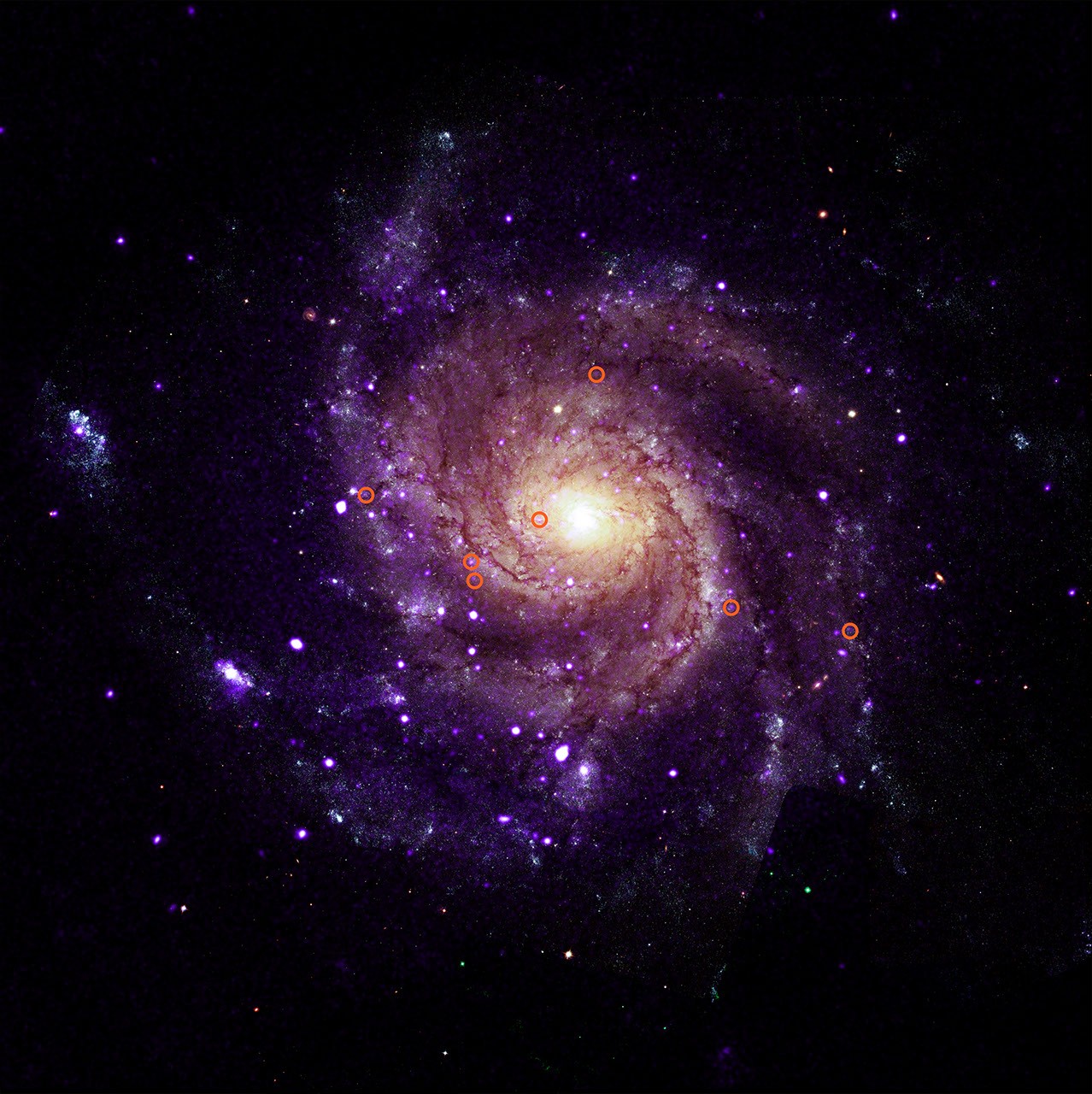
The researchers found a total of 84 of these “hypersoft X-ray sources” – so named because they give such low-energy X-rays – in the six different galaxies they searched, using data openly available to the public in the Chandra archive. Two of the galaxies are spirals, M31 (the Andromeda galaxy) and M101 (the Pinwheel galaxy), while the other four are ellipticals. They found hypersoft X-ray sources both in regions of active star formation and areas where there are older stars.
The team spotted the sources by finding objects that appeared in Chandra images taken at the lowest X-ray energies but vanished in higher-energy images. That means these objects give off far more low-energy X-rays than high-energy ones. Because low-energy X-rays border energetic ultraviolet radiation on the electromagnetic spectrum, the researchers determined that these sources are producing large amounts of energetic ultraviolet radiation as well.
It is unclear what types of objects are responsible for these low-energy X-rays and intense ultraviolet radiation. The team thinks they most likely involve a black hole, neutron star, or white dwarf pulling material from a companion star. The material pulled from the companion star is heated up to produce X-rays before falling onto the white dwarf or neutron star, or into the black hole. Such binary systems have been seen before, but not with such bright ultraviolet radiation and low-energy X-rays.
The discovery suggests that there may be large populations of binary systems with energetic ultraviolet radiation that have been undetected until now.
“These clandestine X-ray sources are actually among the most energetic objects in galaxies, and they could be solving two cosmic mysteries at once,” said Muhibullah.
Scientists think that some white dwarf systems pulling material from companion stars may eventually explode as a supernova – known as a Type Ia – that is critical for measuring the expansion of the universe. These supernovae played a key role in discovering that this expansion is accelerating. Astronomers have been looking for the stars that turn into Type Ia supernovae for many years, so far without success.
“If we could find a way to spot these Type Ia supernova explosions before they go off, that would be really important,” said co-author Jimmy Irwin, also of the University of Alabama. “Right now, we study them after they’ve exploded, and astronomers have struggled to understand what is actually ignited.”
The other mystery these hypersoft X-ray sources might explain is what strips electrons from gas between the stars in some galaxies. This stripping of electrons is important to probe because it can affect how quickly stars form and influence the life cycles of galaxies. Hot, massive stars play a role, but they do not completely explain what is causing this stripping. The intense levels of ultraviolet radiation from the hypersoft X-ray sources may play a vital role.
Why were these hypersoft X-ray sources not found until now? In addition to the low-energy X-ray output, which is very difficult for X-ray telescopes to detect, the high-energy ultraviolet radiation is readily absorbed by helium and hydrogen gas that fills the space between the stars, creating a nearly impenetrable barrier to look through.
“By combing through the Chandra archive, we were able to eliminate what used to be a blind spot for telescopes,” said co-author Rosanne Di Stefano of the Center for Astrophysics | Harvard & Smithsonian. “That’s how we found what appears to be a new class of cosmic objects with remarkable qualities.”
NASA’s Marshall Space Flight Center in Huntsville, Alabama, manages the Chandra program. The Smithsonian Astrophysical Observatory’s Chandra X-ray Center controls science operations from Cambridge, Massachusetts, and flight operations from Burlington, Massachusetts.
Read more from NASA’s Chandra X-ray Observatory
To learn more about NASA’s Chandra mission, visit:
This release features a composite image of a spiral galaxy, M101; one of six identified galaxies housing a new class of mysterious objects that give off unusually low-energy X-rays.
In this composite image, M101 faces us directly. It has multiple arms in shades of purple, spiraling clockwise around a golden yellow core. Scattered along and between the arms are scores of tiny specks in white and purple. Most of those specks are pairs of stars, but seven of them are a mystery.
To casual observers, the unusual objects are visually indistinguishable from the other specks of light in the galaxy. An annotated version of the composite image is included in this release, with red circles around the mysterious specks for easy identification.
These mystery specks behave like no other class of object discovered before. The curious objects give off X-rays of such low energy, they in fact produce large amounts of ultraviolet radiation, as UV radiation borders X-rays on the electromagnetic spectrum. Searching images of galaxies with low-energy X-rays in the Chandra Observatory archive, scientists have found a total of 84 such objects spread across M101 and five other galaxies. They have dubbed these mysterious objects “hypersoft X-ray sources.”
