


Amid an escalating Russian sabotage campaign against Europe, Germany’s measured response to one recent attack is ringing alarm bells for many. But with rising populism at home and fears of escalation, it may be the best the country can offer.
In early August, Germany discovered an explosive-laden drone near a Ukrainian cargo plane at Leipzig Airport. Last week, Germany formally accused Russia of being behind the attempted attack, and in turn shuttered a Russian diplomatic mission, ramped up travel restrictions for Russian nationals, closed a Russian cultural center, and urged the EU to slap additional sanctions on Russia.
Russian President Vladimir Putin has denied involvement, accusing Berlin of planting evidence against Moscow. But Western officials have said the alleged attack is tied to a “broader pattern” of nefarious behavior from Moscow across Europe—involving drones, sabotage, cyberattacks, and disinformation campaigns—that is meant to sow discord and confusion among Ukraine’s allies.
“This was an attack using military-grade material, carried out by Russian operatives on EU soil. And we will not tolerate it. We stand in full solidarity with Germany,” European Commission President Ursula von der Leyen said Monday. “Leipzig marks a new escalation on European soil, directly attributed to Russia. But it is part of a broader pattern of increasingly dangerous incidents.”
Instances of Russian sabotage and other forms of interference in Europe have risen sharply since Russia’s 2022 invasion of Ukraine, with some of the most dramatic attempted plots targeting Germany. These include the planned assassination of a major German arms CEO, the planned assassination of a German drone company CEO, and a plot to send mail bombs via a German parcel carrier.
Germany’s response has appeared relatively muted. For instance, in the case of the reported Russian plot to assassinate Armin Papperger, the head of Germany’s largest arms company, Germany announced no specific punishments for Russia, and then-Chancellor Olaf Scholz made no direct comment.
Many commentators have slammed Germany’s response to the attempted drone attack in Leipzig. “If every time Germany is attacked by Russia it does nothing[, then] Putin the bully will keep doing it,” wrote former British Defense Secretary Ben Wallace on X.
“The German response so far reminds me of pre-2022,” Liana Fix, a senior fellow for Europe at the Council on Foreign Relations, told Foreign Policy. “It does not rise to the moment of Russian hybrid campaigns.”
A more robust response from Germany might include seizing the ships that Russia uses to evade energy sanctions, as other countries are already doing, Fix said. Germany could also take action in the intelligence sphere, such as launching offensive cyberattacks—which would legally require sign-off by parliament. At least some of those efforts may be in the offing, Fix said, but could be difficult to trace due to their sensitive nature.
Retired Lt. Gen. Doug Lute, who served as U.S. ambassador to NATO from 2013 to 2017, said many of the responses from Europe to Russia’s hybrid or gray-zone attacks have “been simply the most mild response, and that’s been to reveal them publicly, to disclose them, to bring them out into daylight.” It’s clear such responses have been “insufficient,” Lute said, but the “closing of diplomatic facilities by Berlin is a step in the right direction” and marks a “stronger” reaction than “most of the previous episodes.”
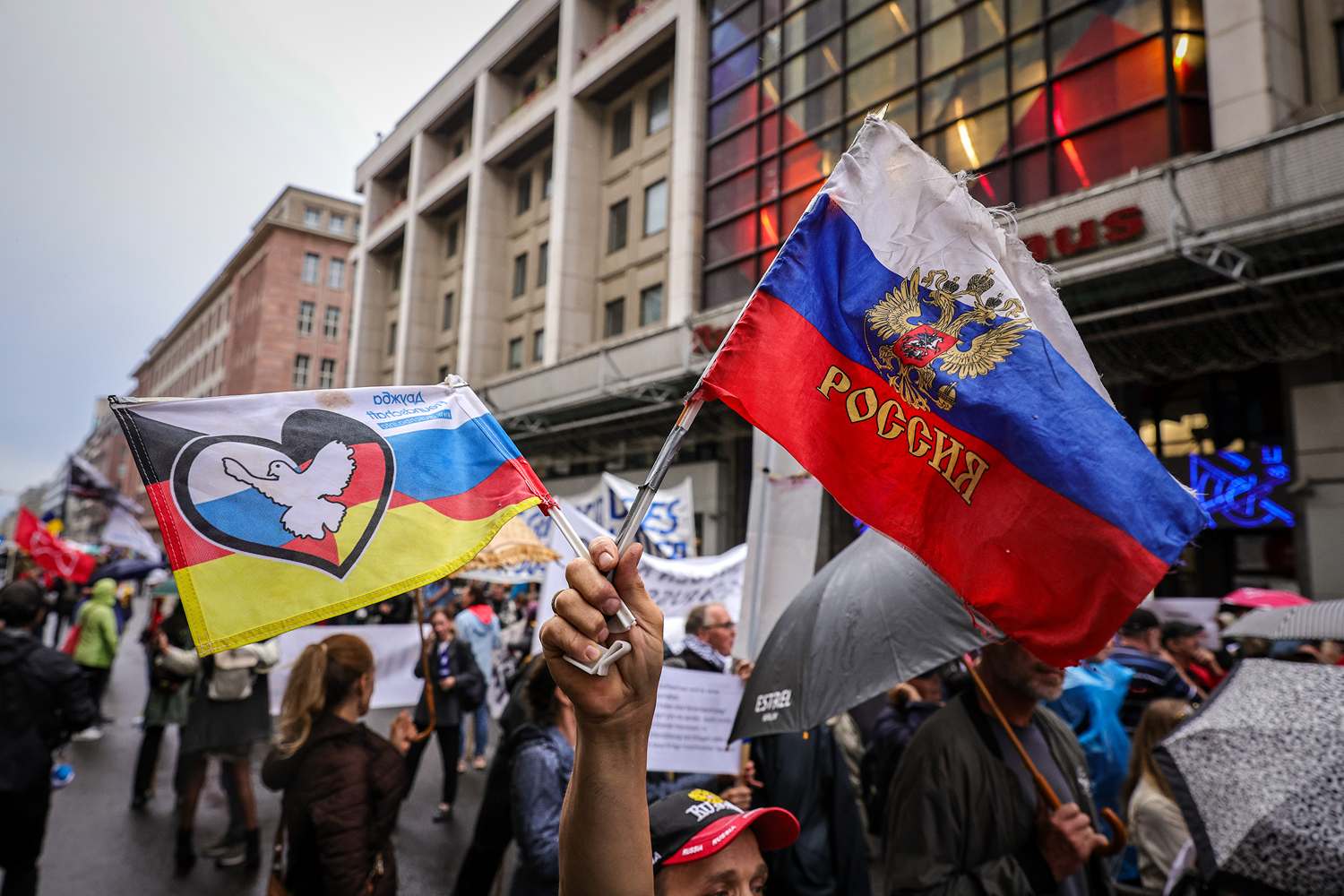
Meanwhile, any German response to Russia must factor in the rising power of far-right and -left parties, which have taken pro-Russian stances, as well as the plummeting popularity of Germany’s pro-Ukraine leader, Chancellor Friedrich Merz.
In April, Germany’s far-right Alternative for Germany (AfD) polled at 28 percent, while Germany’s far-left party, Die Linke, polled at 11 percent. For comparison, Germany’s current chief of the ruling parliamentary coalition, the Christian Democratic Union, polled at 24 percent. The AfD also won its first state election last week, a major victory for the party.
Many AfD and Die Linke voters do not see Russia as a threat. “Intelligence information and plausibility are not evidence,” wrote Die Linke parliamentarian Lea Reisner, in critique of the German government’s assertion that Russia was behind the attempted Leipzig Airport attack. “The current escalation is highly dangerous.”
And despite broad support for Ukraine in Germany, many fear nuclear escalation, which Russia has proved willing to manipulate. “This nuclear angst is still there in Germany,” Fix said.
Still, some Western officials view Germany openly accusing Russia of coordinating this attempted attack as a significant development in and of itself—particularly from the perspective of Baltic countries such as Estonia, which continue to face disruptive drone incursions tied to the Ukraine war.
Germany was “very clear” in stating that there’s direct evidence that “Russia was behind this attack,” and it’s important that it was officially designated an “attack,” Estonian Foreign Minister Margus Tsahkna told Foreign Policy. “This is the change I saw from the German side,” he said.
There’s been a narrative that the “Baltics are next” and that it’s “somehow only our concern that Russia is provoking and organizing different attacks,” Tsahkna said, but it’s now “public for everybody in Europe that Russia is attacking Germany and attacking many other countries as well.” However, Tsahkna conceded that it’s “hard to say” what the “proportional” response should be, adding that it’s “clear that we are not going to organize” the same “kind of attacks” against Russia.
The Baltics, which share land borders with Russia, have long expressed impatience over the broader Western response to the Kremlin’s hybrid attacks. The West “needed to respond already years ago,” Tsahkna said, emphasizing that Putin has been “turning on the heat” to test regional unity and NATO. “Putin is a master of playing with fears,” he added, and “the fear of escalation” is something he’s been using for years.
One action Germany declined to take in response to the alleged attack was to invoke Article 4 of NATO’s founding treaty, which allows members to consult allies “whenever, in the opinion of any of them, the territorial integrity, political independence or security of any of the Parties is threatened.” This is a rare step that’s only been taken nine times since NATO’s founding in 1949, but it does not immediately lead to further political or military responses.
Yet Article 4 was invoked twice in September 2025 alone in response to Russian drones and fighter jets violating the airspace of Poland and Estonia.
In late September 2025, after the Article 4 consultations, NATO warned Russia it would employ “all necessary military and non-military tools to defend ourselves and deter all threats from all directions.” That same month, U.S. President Donald Trump said NATO countries should shoot down unauthorized Russian aircraft that enter their airspace.
But even after such steps and warnings, Russia continues to be linked to an escalating series of provocative incidents across Europe. Between its full-scale invasion of Ukraine in February 2022 and February 2026, Russia conducted 151 hostile operations in Europe, according to a report by the Netherlands-based International Centre for Counter-Terrorism released earlier this year. Between August 2024 and February 2026 there were 144 reported drone sightings over a dozen European states, according to a July report from the London-based International Institute for Strategic Studies. The report concluded that “it is highly likely that the Kremlin conducted a UAV campaign over Europe.”
As the problem metastasizes, European leaders are also struggling with precisely what to call it. Germany has said it’s not at war with Russia but the target of “hybrid warfare.” The situation has sparked debate over whether such terminology falls short in terms of describing the issue and has contributed to a lackluster response. There’s a growing push for Russia’s actions to be labeled as state-sanctioned terrorism.
“We need to name it as it is, and state-supported terrorism is a very precise thing, and we know how to act and how we deal with other terrorist acts,” Tsahkna said. “Putin understands only the clear messages and actions.”
EU foreign-policy chief Kaja Kallas last week also said the failed attack “has all the hallmarks of state-sponsored terrorism,” while conceding that there’s still an open question about what to do about it.
The use of the word “terrorism” by NATO allies marks an “interesting escalation,” said Lute, noting that the only time Article 5 was ever invoked came after the 9/11 terror attacks on the United States. But in terms of defining the problem, Lute said it’s especially important for NATO to stop treating Russian hybrid attacks on a “one-off” basis and “compile the record.”
“There’s power in accumulating them and assembling them into a package so that you can see the breadth and depth and the persistence of the attacks,” Lute said, adding that there could also be more steps taken at NATO headquarters, ranging from table-top exercises to consultations with key allies, to send a signal to the Kremlin that the alliance is not sitting on its hands.
“We’ve progressed far enough along this spectrum towards armed conflict, towards armed attack, that NATO has got to be seen as more active and not passive,” Lute said.
“People say these kinds of political responses are not important because Putin is continuing,” Tsahkna said, but the Russian president “is very carefully watching what we do, how united we are.”
