


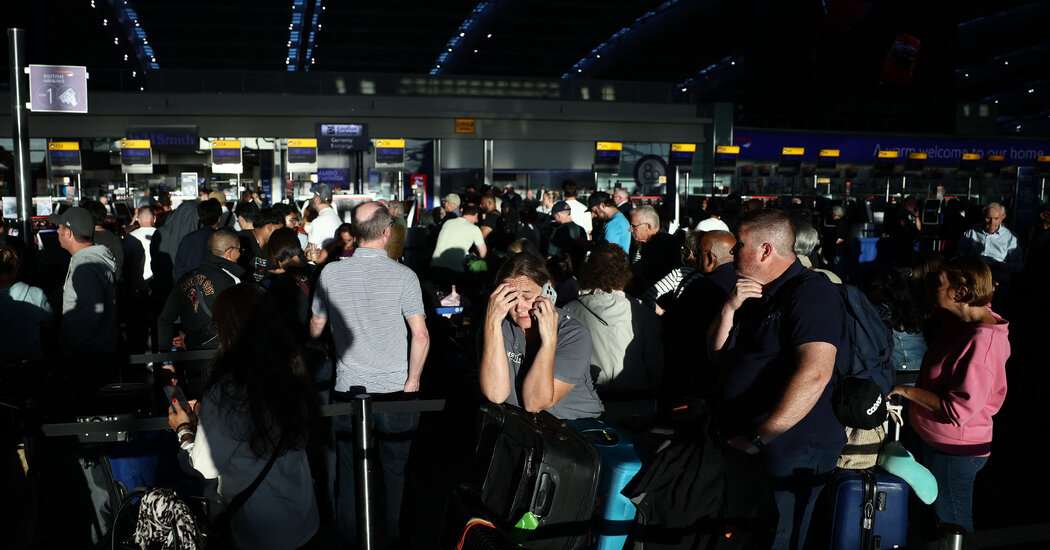
Hundreds more flights were canceled in Britain on Wednesday, a day after an air traffic control system failure that has disrupted more than 2,000 flights and upended the plans of tens of thousands of travelers, particularly at Heathrow Airport.
National Air Traffic Services, a company that provides most of Britain’s air traffic control services, said on Tuesday that there was an issue with one of its flight management computer systems. Its operations had stabilized on Wednesday, the company said, after engineers eventually resolved the technical failure, but passengers were warned that the widespread cancellations and delays would have residual effects.
“It was a pretty depressing experience,” said Jeanette Clement, who had arrived at Heathrow on Tuesday to take a Virgin Atlantic flight to visit a friend in New York City. Instead, Ms. Clement was held at the check-in desk for hours before being told her flight was canceled.
The disruptions led to chaotic scenes at airports including Heathrow, where travelers described hourslong queues, crowded waits for luggage to be returned and uncertainty over where to spend the night as local hotels were quickly booked. At Gatwick Airport, some travelers reported six-hour waits onboard grounded aircraft before they were offloaded. At London Stansted Airport, some passengers affected by the disruptions slept on the floor.
“I completely understand that major technical problems happen, but being stuck for hours with so little information made an already difficult situation much worse,” Ms. Clement said. Travelers were given little support at the airport, she added. With many airport hotels full, and Uber rides at double their usual price, Ms. Clement said she took a bus home.
Ms. Clement said she was eventually rebooked on to a flight scheduled for Wednesday night but she decided to cancel her trip, fearing more delays would cut into an already short vacation.
NATS said in a statement on Wednesday that it would conduct a full investigation. Earlier, it described the recovery as complex, adding that it had created difficulties for the whole aviation network and that it would take time to recover. The operator has faced criticism from airlines over several high-profile disruptions in recent years.
Martin Rolfe, the chief executive of NATS, apologized for the disruption. He told BBC Radio 4 that NATS did not believe this was a cyberattack.
Cirium, an aviation analytics firm, said that more than 2,000 flights had been disrupted in the past two days. More than 1,700 scheduled flights across Britain were canceled or did not fly on Tuesday, according to the firm. The cancellations upended travel in busy London airports, including Heathrow and Gatwick, and in other cities like Edinburgh and Manchester.
The disruptions continued into Wednesday, with about 320 flights canceled as of early afternoon across Britain, according to Cirium. Cancellations were expected to be lower on Wednesday, the firm said, with Heathrow Airport still being the worst affected. It estimated that at least 300,000 passengers had been impacted across the country.
Heathrow Airport said that disruption would continue as airlines repositioned their aircraft and crews. Dozens of flights at other airports, including Gatwick, Manchester, and Luton airports were also canceled, according to Cirium.
Serious disruptions at a major airport such as Heathrow — one of the world’s busiest — often have knock-on effects across continents. Malaysia Airlines said its Wednesday flight from Heathrow to Kuala Lumpur, Malaysia, was canceled because Tuesday’s inbound flight to London was diverted to Manchester.
“It was a nightmare at Manchester Airport,” said Jason Leong, a passenger on the diverted flight. He waited nearly four hours for his luggage, he said, before staff announced that it would not be unloaded that evening.
Mr. Leong, who works as a comedian, was due to perform at a gig on Thursday but he spent Tuesday night in Manchester before continuing his travels. He opted for a train to London instead of a rebooked flight scheduled for that evening, worried about more disruption. His luggage was still headed for Heathrow, and he hoped that he could retrieve it for a much-needed change of clothes.
“I feel like the hero of a very lukewarm action movie,” he said.
A spokesman for the aviation tracking firm Flightradar24, Ian Petchenik, said that he expected Wednesday to bring “a significant number of cancellations and the rest of the week to see smaller effects as airlines normalize their schedules.”
Airports at Gatwick, Luton and Stansted said on Wednesday that they were operating, but warned travelers to expect ongoing impacts.
Irish airports were also affected by the disruption because of the number of flights departing for and arriving from British terminals. Dublin Airport said that it planned to operate a full schedule of flights on Wednesday after airlines worked through the night to reposition their planes. The airport said on social media that it had remained open overnight to accommodate stranded passengers.
Ryanair, Europe’s biggest airline, said in a statement on Tuesday that more than 65,000 of its passengers were affected and it accused NATS and its leadership of failing travelers and airlines.
“Enough is enough, it’s time for the U.K. government to intervene,” Neal McMahon, Ryanair’s chief operations officer, said on social media.
Heidi Alexander, the British minister responsible for transport, wrote on social media late Tuesday that she was “seeking assurances that lessons will be learned and systems that support aviation are up to the job.”
NATS has experienced multiple high-profile technical issues in recent years. In August 2023, an air traffic control failure affected more than 700,000 passengers over several days, according to an estimate by Britain’s Civil Aviation Authority. In July 2025, some flights were briefly grounded because of an issue with a radar system.
Ceylan Yeğinsu and Megan Specia contributed reporting.
