


Hours after President Donald Trump predicted on Truth Social that oil prices would fall precipitously once the United States wins its war with Iran, strikes on Saudi Arabia’s oil infrastructure by Iranian-backed Houthis Tuesday caused global oil prices to spike to nearly $100 per barrel.
The latest runup, bringing the global crude price up 33 percent since the July pause in Middle East hostilities, shows the relentless conflict that the U.S. started with Iran in February is outweighing any other steps the Trump administration has said it is taking to reduce oil prices. Consumers so far have not seen any benefit at the gasoline pump from the rollback of environmental regulations or steps the administration says it is taking to increase domestic production. And moves like the deal announced last week giving the U.S. unprecedented control over Venezuela’s massive oil reserves are not likely to pay off quickly, energy analysts say.
Energy Secretary Chris Wright maintains the administration is “leaning in on maximum production” to address consumer costs. “The way to solve a supply shortage is to grow supply,” Wright said on CBS News’ Face the Nation on Sunday.
But oil demand is also part of that equation. China, for instance, reduced oil consumption for transportation 16 percent from April through June, with rapid electrification of vehicles the most important factor, according to a new analysis. The policies have helped China weather the global runup in oil prices.
Meanwhile, U.S. oil consumption has stayed steady and forecasts for U.S. electric vehicle adoption are falling. Analysts say the Trump administration’s retreat on climate and EV policy is making the United States more vulnerable to global energy shocks like those being touched off by its policy in the Middle East.
“There’s a real national security advantage to having an electrified economy that isn’t so vulnerable to the ups and downs of the global oil market,” said Jeff Colgan, director of the Climate Solutions Lab at Brown University’s Watson School of International and Public Affairs. “Of course, that’s not the direction that the Trump administration is taking us in as a country.”
The Brown lab has developed an Iran War Energy Cost Tracker that shows Americans have paid more than $101 billion in higher fuel costs since the conflict began on Feb. 28. That’s more than $771 per U.S. household.
More Smog but No Relief at the Pump
The Environmental Protection Agency announced a slew of regulatory rollbacks through the summer, framing them as moves to increase domestic energy supply or ease costs, from allowing more flaring of natural gas to eliminating diesel exhaust control equipment on trucks.
The most recent example came on Aug. 20, as a dangerous heat wave spread across much of the United States. The EPA announced it was calling an early end to the annual summer fuel requirements designed to cut down on smog.
The change in technical specifications, allowing sale of a faster-evaporating gasoline-ethanol blend despite the chance for increased pollution, would free up hundreds of thousands more barrels of fuel, the EPA said. “With the increase of domestic gasoline supply on the market, Americans can expect to see reduced gas prices,” an agency press release said.
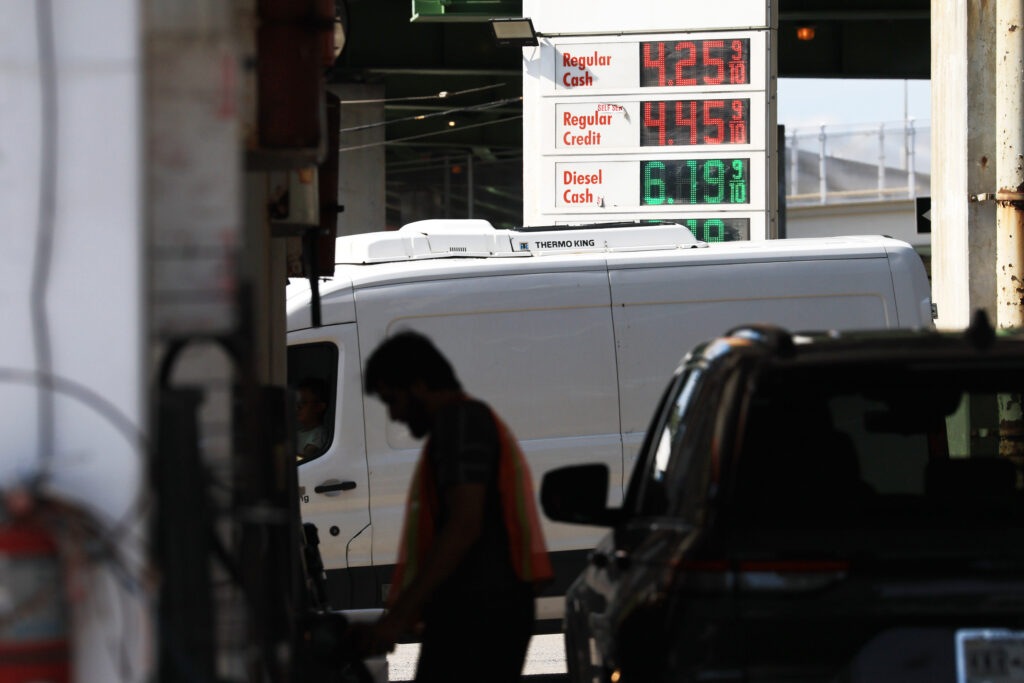
That’s not what happened, as motorists learned over the Labor Day holiday. Even before the bombing on Saudi facilities, the average national gasoline price was $4.14 per gallon heading into the weekend, up 4 cents from the previous week and on track to set a Labor Day record, according to AAA.
Dan Becker, director of the Safe Climate Transport Campaign of the Center for Biological Diversity, said the move to end the summer gasoline requirements—in effect, allowing more sale of gasoline blended with 10 percent ethanol—was “ludicrous” from both an environmental health and energy cost standpoint. Because the ethanol blend delivers fewer miles per gallon of fuel, any small savings per gallon would be offset because drivers would need to buy more gallons to drive the same distance, he said.
“Summer smog limits are designed to protect kids’ health,” Becker said. “So it’s a disastrous move from that perspective, but it doesn’t actually lower the cost at the pump.”
This story is funded by readers like you.
Our nonprofit newsroom provides award-winning climate coverage free of charge and advertising. We rely on donations from readers like you to keep going. Please donate now to support our work.
In his Face the Nation appearance, Wright said he expected pump prices would fall with the end of the summer driving season. But even while he spoke, a major escalation in Middle East hostilities was building, all focused on oil infrastructure and delivery. The U.S. military said on Saturday that it had struck three Iranian oil tankers in retaliation for missiles launched at U.S. Navy ships. Defense Secretary Pete Hegseth posted on social media Sunday that Iran’s oil tankers were “defenseless” against such attacks. The next morning, Iranian-backed Houthi rebels launched an offensive against Saudi oil facilities.
Because Saudi Arabia is the world’s third-largest oil producer, behind the United States and Russia, any damage to its facilities can have a profound impact on the global market.
A Venezuelan Deal and More Uncertainty
Wright also pointed to steps the Trump administration was taking to increase the world supply of oil overall, including the increase in production from Venezuela since January, when President Nicolás Maduro was unseated in a U.S. military operation. According to figures the U.S. Department of Energy released last month, Venezuelan production is up 25 percent, to 1.25 million barrels per day—with half of that crude going to U.S. Gulf Coast refineries.
The U.S.-Venezuela oil agreement announced last week—described by some analysts as the largest oil deal in international history—will also pay dividends in lower gasoline prices, Wright said. “We’re going to get massive amounts of discounted oil price and ownership interest in some production there,” Wright said, adding that it was at “zero cost” to U.S. taxpayers.
But analysts believe that any growth in production will be gradual, and great uncertainty remains about the political situation in Venezuela.
“The challenge facing Venezuela has always been whether the right conditions would emerge to develop the country’s resources,” said Radhika Bansal, a senior vice president with Rystad Energy. “This agreement improves those conditions. … However, investors looking at multi-decade projects need confidence that a contract signed today will be honored by whoever governs Venezuela in 10 or 20 years.”
Becker said policies like Corporate Average Fuel Economy standards originally were adopted in the 1980s as an effort to protect U.S. consumers from the volatility and uncertainty of the global oil market. The Trump administration is expected to soon finalize its rollback of CAFE standards as part of its retreat on climate policy. The result, Becker said, is sure to be increased gasoline demand, increased emissions and vulnerability to the global oil market’s swings.
“If they actually did want to save money at the pump, the way to do it is more efficient vehicles or vehicles that don’t use gas,” Becker said. “Everything they’ve done has been about increasing our dependence on oil, increasing our reliance on the countries that produce it and the companies that produce it, and not protecting consumers one iota.”
About This Story
Perhaps you noticed: This story, like all the news we publish, is free to read. That’s because Inside Climate News is a 501c3 nonprofit organization. We do not charge a subscription fee, lock our news behind a paywall, or clutter our website with ads. We make our news on climate and the environment freely available to you and anyone who wants it.
That’s not all. We also share our news for free with scores of other media organizations around the country. Many of them can’t afford to do environmental journalism of their own. We’ve built bureaus from coast to coast to report local stories, collaborate with local newsrooms and co-publish articles so that this vital work is shared as widely as possible.
Two of us launched ICN in 2007. Six years later we earned a Pulitzer Prize for National Reporting, and now we run the oldest and largest dedicated climate newsroom in the nation. We tell the story in all its complexity. We hold polluters accountable. We expose environmental injustice. We debunk misinformation. We scrutinize solutions and inspire action.
Donations from readers like you fund every aspect of what we do. If you don’t already, will you support our ongoing work, our reporting on the biggest crisis facing our planet, and help us reach even more readers in more places?
Please take a moment to make a tax-deductible donation. Every one of them makes a difference.
Thank you,

Bureau Chief, Washington, D.C.
Marianne Lavelle is the Washington, D.C. bureau chief for Inside Climate News. She has covered environment, science, law, and business in Washington, D.C. for more than two decades. She has won the Polk Award, the Investigative Editors and Reporters Award, and numerous other honors. Lavelle spent four years as online energy news editor and writer at National Geographic. She spearheaded a project on climate lobbying for the nonprofit journalism organization, the Center for Public Integrity. She also has worked at U.S. News and World Report magazine and The National Law Journal. While there, she led the award-winning 1992 investigation, “Unequal Protection,” on the disparity in environmental law enforcement against polluters in minority and white communities. Lavelle received her master’s degree from Columbia University Graduate School of Journalism, and is a graduate of Villanova University.
