


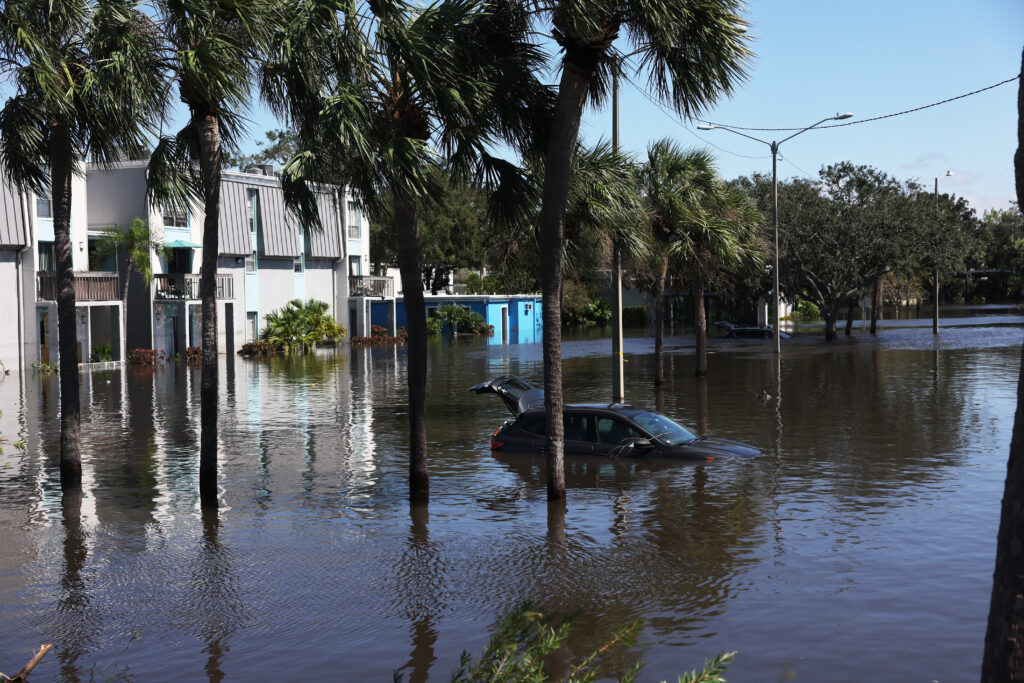
At the end of August, devastating floods and a debris flow triggered by a glacier collapse crashed through the valleys of Nepal, killing more than 1,300 people. Earlier this summer, deadly heat waves plagued much of the United States and Europe. Meanwhile, record-low snow levels and a long-term drought stoked wildfires across the western U.S.
It’s been a relentless summer of extremes—only the latest in a half-decade packed with record-breaking weather events. A growing body of research shows they’re becoming more frequent and severe as human-caused climate change accelerates.
But recent studies show that many people aren’t making this link in the wake of a weather disaster, a disconnect that could affect our ability to combat worsening warming. At the same time, a recent analysis found that fewer journalists are doing the kind of climate reporting that could help to close this gap. And even when hurricanes, wildfires or floods get widespread attention, it’s often not long before another story overwhelms the news cycle.
The good news: Scientific understanding of climate change and its impact on extreme weather is the best it’s ever been. But experts warn if people remain in the dark about these climate connections, it will be more difficult to prepare and adapt.
Understanding the Disconnect
For decades, scientists have been trying to grasp how people perceive extreme weather in the context of climate change. Dozens of studies, surveys and models seem to support only one consensus: It’s complicated.
“Most people do not automatically, intuitively, on their own, connect that event—a flood, a heat wave, a wildfire—to climate change,” Anthony Leiserowitz, the director of the Yale Program on Climate Change Communication, told me. “Climate change is still a relatively abstract idea for many, many people.”
Whether someone makes the connection depends on a variety of factors, from their socioeconomic background to their political affiliation. For a 2019 study, researchers analyzed 73 papers that focused on the relationship between climate change experiences and public opinion. The results were mixed. Several studies supported at least some association between weather experiences on people’s climate opinions, while others found little to no impact. A major takeaway of the 2019 paper is that different methodologies across the research make direct comparisons challenging.
More recent studies suggest that the type of extreme weather can also play a part. A 2024 study found that fires were the only type of climate-fueled weather events to have a small but significant effect on individuals acknowledging the existence of global warming and supporting the need for action (even then, the impact was short-lived). Separate research co-authored by Leiserowitz found that more exposure to hot, dry days significantly increases Americans’ perceptions that they have personally experienced global warming. Individuals did not make the climate link with heavier rainfall, though.
Leiserowitz said one barrier preventing individuals from associating weather events with the warming that is often fueling them is something called “psychological distance.” That’s essentially a person’s perception of how much something hits home—literally and figuratively.
“In general, people are more concerned about things that are happening to them or to their loved ones than they are people or species or places on the other side of the planet that they’ve never been to [and] they don’t have any connection to,” Leiserowitz said. Pointing to the recent floods in Nepal, he added: “For most Americans, they’ve never been to Nepal. They don’t know anyone from Nepal. They don’t have any connections in Nepal. They probably couldn’t identify Nepal on a map.”
The long-term timescales of climate change can also distance a person from its impacts in the present, he said.
Unraveling how the perception of climate change following extreme weather can influence government policies, meanwhile, comes with its own set of complexities.
“Getting somebody to change their light bulb is totally different than getting them to pack an emergency go kit, which is very different than helping them buy an electric vehicle, which is very different than putting pressure on their elected officials to take greater action,” Leiserowitz said.
A “Teachable Moment”
An extreme weather event is often devastating, taking lives and a serious financial toll. From a climate communication standpoint, though, it can also act as a “teachable moment,” Leiserowitz said.
“Suddenly, the public, the media and political leaders all focus their very scattered and limited attention on the same event,” he said. “A lot of this is just about helping people connect the dots for the very first time. And once you’ve done that, you’ve taught them something, and they are now primed to make that connection themselves in the future.”
That’s where the media can come into play. A 2025 report drawing from survey data across eight countries found “strong agreement that climate news coverage is important,” though only around four in 10 said the news media does a good job explaining causes and offering solutions. A June study focused on European online news media found evidence that climate news in national outlets increases public concern about climate change.
However, as climate change impacts are worsening, coverage of them is dwindling. University of Colorado Boulder’s Media and Climate Change Observatory recently found that global news coverage of the topic has decreased by 38 percent since its peak in 2021. The authors pointed to a number of possible causes, including the avalanche of other news in recent years—from war to the Trump administration dismantling federal policies. Newsrooms such as The Washington Post and NPR have also downsized their climate reporting teams or focused on other beats, potentially to avoid “climate fatigue” among their audience, as Grist reports.
But this climate coverage cliff could leave people in the dark about crucial information, according to analysis co-author Max Boykoff, professor of environmental studies at the University of Colorado Boulder.
“People typically do not start their day with a cup of coffee and the latest peer-reviewed journal article. Instead, they turn to media—television, newspapers, radio, social media—to understand how science and policies could impact their everyday lives,” he told the university. “When the media fail to cover these pressing climate issues abundantly and accurately, people may not recognize how climate change shapes their daily lives, livelihoods and challenges.”
As my colleague Bob Berwyn recently reported, climate attribution science has advanced tremendously in recent years, which experts say could help communities understand and adapt to intensifying extremes. But ensuring that information reaches these communities is a different story.
“If you don’t know about climate change, you can’t make decisions knowing that the events that you’re already experiencing are going to become more frequent, more severe, and there’s going to be more surprises,” Leiserowitz said. “Now, if you understand that, you can start to take actions to both mitigate the risk to reduce and limit climate change, but you can also be taking the incredibly important actions now that are about preparing for and adapting to that future world.”
News About This Newsletter
Readers, we have a big update for you: Next week will be my last installment of “Today’s Climate.” But it’s for an exciting reason … we recently launched a podcast—and I am one of the co-hosts! In our “Inside Climate” podcast, my co-host and I interview our colleagues across the world to hear how they counter misinformation, expose environmental injustices and scrutinize solutions. You can find Inside Climate wherever you get your podcasts, including YouTube, Spotify, Apple Podcasts, Amazon Music and iHeart.
Along with hosting the podcast, I will be diving deeper into conservation and wildlife coverage, reporting stories like the recent investigation my colleague Katie Surma and I published revealing how dozens of wild sloths died at a planned Florida tourist attraction. (We spoke about the story on the podcast last month.)
My first installment of “Today’s Climate” was published more than two-and-a-half years ago, and I can’t express how much I have appreciated your readership, feedback and support of our work in that time. You can stay up to date with ICN by subscribing to our other newsletters: ICN Weekly on Saturdays, Inside Clean Energy on Thursdays and Breaking News daily. I can’t wait for you to join us over at the Inside Climate podcast!
More Top Climate News
The Trump administration proposed a rule on Friday that could leave vast swaths of U.S. wetlands with fewer protections, Maxine Joselow reports for The New York Times. The Environmental Protection Agency and U.S. Army Corps of Engineers are seeking to narrow the definition of “waters of the United States” that are protected under the Clean Water Act of 1972. While farming interests celebrated the move, environmentalists warn that it would threaten drinking water and wildlife habitat. Wetland ecosystems are already under threat from climate change, as Madeline Shaw recently reported for ICN.
Drought is impacting black bears’ food supplies in the Mountain West region of the U.S., forcing the animals closer to humans as they seek sustenance, Brittany Peterson and Mead Gruver report for The Associated Press. Past research has found that climate-fueled droughts are increasingly forcing bears, bobcats and pumas closer to people and increasing the risk of human-wildlife conflict.
Israel’s national water company says that a microalgae bloom in the Mediterranean Sea is responsible for temporarily inhibiting five of the country’s six coastal desalination plants, Laura Paddison reports for CNN. These types of facilities —which typically convert ocean water into potable supplies—provide at least 65 percent of the country’s drinking water. However, algae can damage the equipment. The desalination plants have at least partially come back online, but experts fear this type of rare event could happen more frequently as ocean temperatures warmed by climate change fuel algae blooms.
About This Story
Perhaps you noticed: This story, like all the news we publish, is free to read. That’s because Inside Climate News is a 501c3 nonprofit organization. We do not charge a subscription fee, lock our news behind a paywall, or clutter our website with ads. We make our news on climate and the environment freely available to you and anyone who wants it.
That’s not all. We also share our news for free with scores of other media organizations around the country. Many of them can’t afford to do environmental journalism of their own. We’ve built bureaus from coast to coast to report local stories, collaborate with local newsrooms and co-publish articles so that this vital work is shared as widely as possible.
Two of us launched ICN in 2007. Six years later we earned a Pulitzer Prize for National Reporting, and now we run the oldest and largest dedicated climate newsroom in the nation. We tell the story in all its complexity. We hold polluters accountable. We expose environmental injustice. We debunk misinformation. We scrutinize solutions and inspire action.
Donations from readers like you fund every aspect of what we do. If you don’t already, will you support our ongoing work, our reporting on the biggest crisis facing our planet, and help us reach even more readers in more places?
Please take a moment to make a tax-deductible donation. Every one of them makes a difference.
Thank you,

Reporter
Kiley Price is a reporter at Inside Climate News, with a particular interest in wildlife, ocean health, food systems and climate change. She writes ICN’s “Today’s Climate” newsletter, which covers the most pressing environmental news each week.
She earned her master’s degree in science journalism at New York University, and her bachelor’s degree in biology at Wake Forest University. Her work has appeared in National Geographic, Time, Scientific American and more. She is a former Pulitzer Reporting Fellow, during which she spent a month in Thailand covering the intersection between Buddhism and the country’s environmental movement.
