


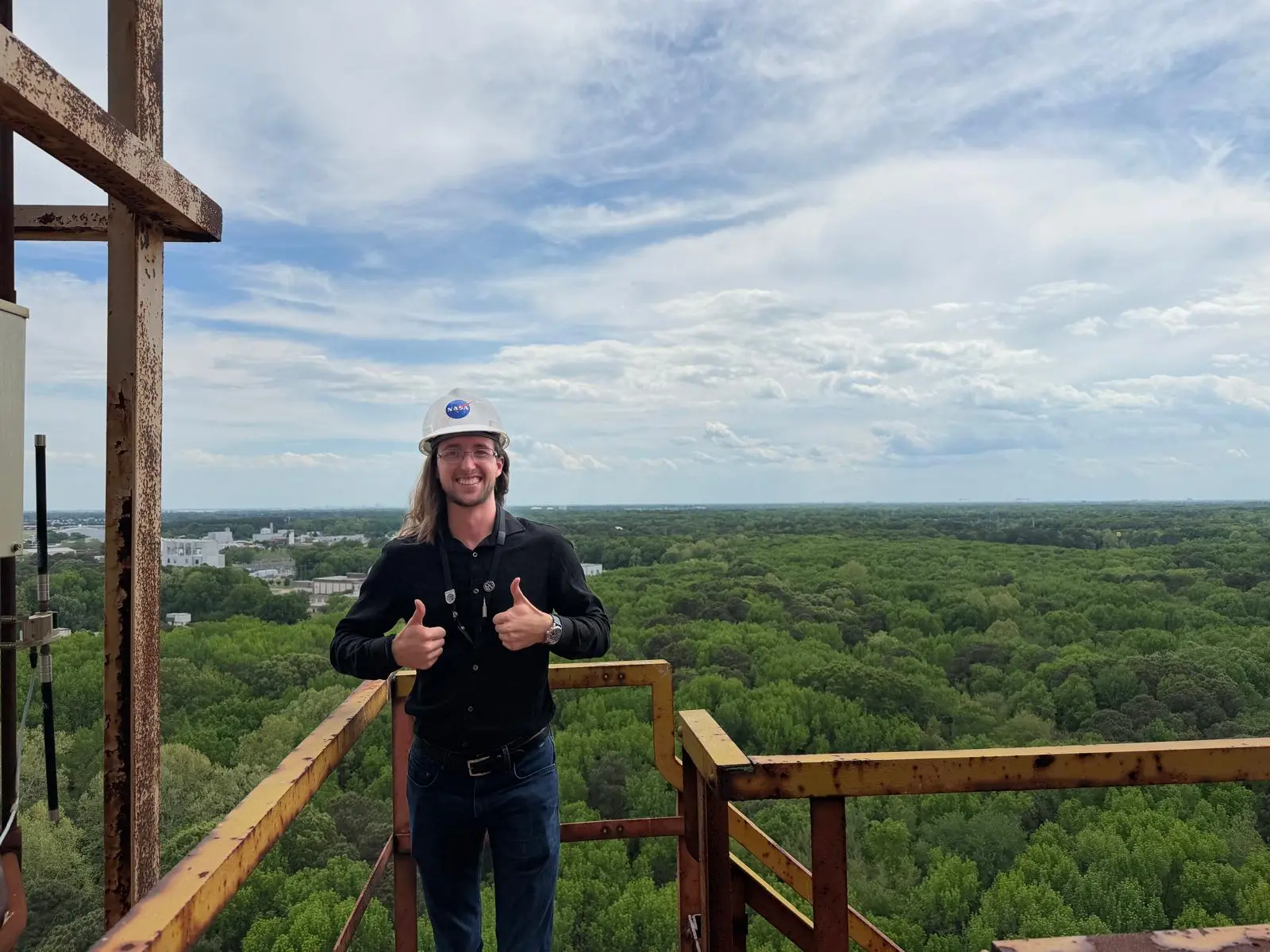
Jaden Caradine knew he wanted to be an engineer at eight years old. He just took a winding road to get there.
Before he enrolled at Embry-Riddle Aeronautical University, before he discovered the field that would become his focus, and before he landed a Pathways internship at NASA’s Langley Research Center in Hampton, Virginia, Caradine spent five years as a mechanic in the United States Marine Corps, four of them stationed in Japan. It was a deliberate detour, one that shaped how he approaches everything since.
“I’ve kind of always known I wanted to be an engineer,” he says. “I just had to figure out what kind.”
Caradine grew up in the Salt Lake City area, raised by a mother who put him on a snowboard at four and on a rock face not long after. He was the kind of kid who learned to love science not for its own sake, but for what it could do. “Math is an enabling skill,” he says. “It’s not about doing the math. Math has a purpose and it’s useful.”
By the time someone asked young Jaden what he wanted to be, the answer was immediate. “I was building Legos,” he says, “and I just thought — I want to build stuff. I can’t really see myself being anything other than an engineer.”
Right out of high school, Caradine enlisted in the Marines, trained as a mechanic, and shipped out to Japan. During those five years, between the technical work and the distance from home, he started reading books on decision-making, career planning, and long-term thinking. He found a framework he keeps coming back to: ikigai, a Japanese concept that maps the intersection of what you’re good at, what you enjoy, what the world needs, and what you’re paid to do.
“Your ikigai is the thing where all of those overlap,” he says. Engineering was already in the picture. The question was what kind.
The answer arrived through research and a company Caradine stumbled on while scanning the landscape of emerging aerospace technology. They were using magnets to spin a launch system to 14,000 or 15,000 RPM and release small satellites into orbit, recovering the energy on the way down through the same magnetic system. “I thought that was awesome,” he recalls. “So, I started looking into aerospace engineering, and it was a good fit.”
Once he had the field, the destination wasn’t hard to find. Caradine transferred to Embry-Riddle Aeronautical University’s Daytona Beach campus to study aerospace engineering and immediately started showing up everywhere he could — satellite conferences at Kennedy Space Center, industry events in Orlando, small satellite gatherings back in Salt Lake City. “I went to all the career fairs, even though I wasn’t looking for a job yet,” he says. “I just wanted to learn as much as I could, as fast as I could.”
At every NASA booth, he asked questions. He learned about Pathways, the program that places undergraduate and graduate students at NASA centers with the potential to convert to full-time civil service positions, but he waited a year to apply. “I hadn’t really done the things I wanted to do in order to write a strong application yet,” he says. He wrote the next application with the intention of using it as a practice run. He got in.
His reason for choosing NASA over industry was simple and firm. “NASA doesn’t work for profit,” he says. “We’re here to remove barriers so that industry can eventually do the things they weren’t able to do before.”
“Human beings are far more capable than we give ourselves credit for. A journey of a thousand miles starts with a single step and can only be taken one step at a time.”
At NASA Langley, Caradine is part of the Systems Analysis and Concepts Directorate, where “we help agency leaders figure out why they should make certain decisions, especially those that have lots of moving parts,” he explains. Specifically, he works with the in-space servicing, assembly, and manufacturing (ISAM) team, a group focused on the emerging field of building and maintaining infrastructure in space, rather than simply launching and discarding it.
A major part of his summer was curating the State of Play, a comprehensive document that consolidates everything happening in the ISAM sector across government, academia, and industry into a single, navigable resource.
“Jaden joined the team and immediately contributed to this year’s State of Play update,” says Dale Arney, aerospace engineer and Caradine’s mentor. “He also created an automated tool that will help the team create future updates more quickly.”
That tool scrapes aerospace news from across the web, compiles relevant updates into organized tables, and produces a readable summary on a regular cadence. “It kind of replaced the need for everyone on the team to spend 30 or 40 minutes every day scrolling through news to keep up,” he says.
“Jaden was constantly looking for ways to improve himself, the team, and our products,” Arney adds. “He was eager to take the lead in trying a number of new processes and ideas to try to make them work for us.”
The thing that surprised Caradine most about NASA Langley had nothing to do with the technical work. He had expected some departmental siloing that could develop in large organizations, where people become experts in narrow areas with limited cross-pollination among teams.
“That’s not something I’ve experienced here,” he says. “We all talk to each other, across all teams. We share resources. We collaborate quite extensively.” He describes a culture that expects everyone to engage with the whole problem, not just their corner of it. “Everyone kind of bounces around on different teams to learn the whole aspect of the problem and support each other.”
For anyone considering the Pathways program, his advice is direct. “Do it,” he says. “Human beings are far more capable than we give ourselves credit for. If it seems like too much, break it down. A journey of a thousand miles starts with a single step and can only be taken one step at a time.”
Caradine heads back to Embry-Riddle as a junior this fall, with plans to return to Langley next summer. Grad school is on the horizon, and he’s exploring programs that nurture important analysis skills for SMAB, including decision, strategic, and systems analysis.
“Before coming here, I was trying to do everything and cast a wide net,” he says. “Now I know what I need to know how to do. That’ll give me the opportunity to focus my efforts on the high-value skill sets.”
The Sirens of Titan by Kurt Vonnegut
Dungeon Crawler Carl by Matt Dinniman
Caradine’s instinct runs more toward fantasy than science fiction, but this one, he says, hits something real.
“I enjoy the leveling aspect — constantly improving, constantly getting better. In books it might be physical strength, but in reality, strength takes on many different forms. Constant improvement is quite rewarding in real life, as it is in books.”
The audiobook production, he adds, is its own experience: full sound design, character actors, the works. “It’s like listening to a movie.”
The team also recently convinced him to start Dune, by Frank Herbert. He’s about halfway through.
Part of the Systems Analysis and Concepts Directorate at NASA’s Langley Research Center.
Learn more about our work by visiting our website.
