


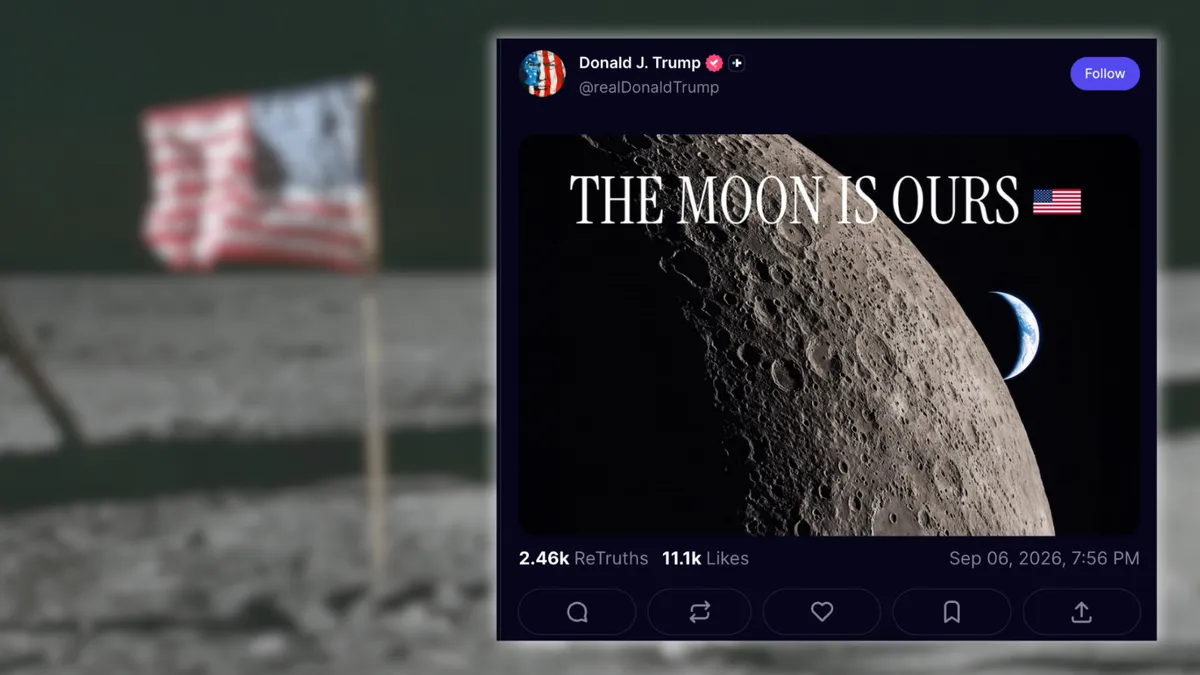
U.S. President Donald Trump appeared to claim U.S. ownership of the moon in a Truth Social post.
Trump’s Truth Social post strongly implied the president considers the moon to be under U.S. ownership, but it’s unclear whether the post amounted to an official declaration. The U.S. previously ratified a United Nations treaty that says countries can’t “claim” celestial bodies like the moon. It’s unclear whether Trump’s post constitutes a breach of that treaty.
In early September 2026, social media users shared (archived) an alleged Truth Social post by U.S. President Donald Trump that appeared to declare the moon a U.S. territory.

(X user @WarFrontIntel)
Some social media users who discussed Trump’s alleged post wondered whether the U.S. could actually own the moon. For example, on Sept. 7, one Facebook page wrote:
For a few hours, the internet has been asking the same strange question: can a country actually own the Moon?
President Donald Trump posted an image on Truth Social on September 6 with the words “THE MOON IS OURS” beside an American flag. The post is real, but the claim that he has formally made the Moon U.S. territory goes further than what actually happened. There was no accompanying executive order or legal declaration transferring the Moon to the United States.
Similar posts about Trump’s purported declaration and its legal validity circulated on Instagram (archived), Threads (archived), X (archived) and Bluesky (archived).
Trump did appear to claim U.S. ownership of the moon in a Truth Social post. On Sept. 6, the president posted (archived) an image of the moon on Truth Social featuring the text “The Moon is Ours” followed by a U.S. flag.
It was unclear whether Trump’s post amounted to the United States officially claiming ownership of the moon and, if so, whether other nations would recognize it.
Snopes previously reported that according to the United Nations Treaty on Principles Governing the Activities of States in the Exploration and Use of Outer Space, including the Moon and Other Celestial Bodies, no country, including the U.S., can own the moon.
The treaty’s Article II said that celestial bodies, including the moon, are not subject to “national appropriation by claim of sovereignty, by means of use or occupation, or by any other means.” This essentially means that nations signing the treaty agree not to claim celestial bodies as their own.
The U.S. was a founding signatory of the treaty and ratified it, meaning it could face political or economic consequences such as sanctions or embargoes for breaking it. It was unclear whether Trump’s Truth Social post amounted to a breach of treaty.
We contacted the White House Press Office to ask whether Trump would withdraw the U.S. from The Outer Space Treaty in order to move forward with laying formal claim to the moon. We also contacted the United Nations Office for Outer Space Affairs, which helps countries draft and revise international space laws, to ask whether it would treat Trump’s Truth Social post as a breach of that treaty. We await replies to our queries.
It was unclear as of this writing what would come of Trump’s apparent declaration. Declarations that a nation owns a territory are contingent on other nations respecting such an announcement. Given the fact that China, Russia, India and Japan (the four other nations that have reached the moon aside from the U.S.) also signed The Outer Space Treaty that said the moon was not subject to “national appropriation,” it appeared unlikely that they would recognize a U.S. claim.
Trump’s post suggesting he viewed the moon as a U.S. territory was consistent with his administration’s messaging about space.
The president has worked towards establishing a U.S. presence on the moon during his second administration. In a Jan. 25, 2025, executive order titled “Ensuring American Space Superiority,” Trump wrote that his administration aimed to establish “elements of a permanent lunar outpost by 2030.” The executive order also said the administration would work to deploy nuclear reactors “on the Moon and in orbit, including a lunar surface reactor” that would be ready for launch by 2030.
During his first administration, Trump signed an executive order titled “Encouraging International Support for the Recovery and Use of Space Resources” that said the U.S. did not view space as a “global commons,” meaning areas that lie outside of national jurisdiction. Essentially, the order suggested Trump’s first administration thought that space could be governed by individual nations like the U.S.
For further reading, Snopes has investigated a series of other rumors about the moon and space.
Sources
Cavendish, Richard. ‘The Soviet Union Is First to the Moon’. History Today, 12 Aug. 2009, https://www.historytoday.com/archive/soviet-union-first-moon.
‘Encouraging International Support for the Recovery and Use of Space Resources’. Federal Register, 10 Apr. 2020, https://www.federalregister.gov/documents/2020/04/10/2020-07800/encouraging-international-support-for-the-recovery-and-use-of-space-resources.
Executive Orders. ‘ENSURING AMERICAN SPACE SUPERIORITY’. The White House, 18 Dec. 2025, https://www.whitehouse.gov/presidential-actions/2025/12/ensuring-american-space-superiority/.
‘Global Commons’. UNESCWA, https://www.unescwa.org/sd-glossary/global-commons.
Kuthunur, Sharmila. ‘India’s Chandrayaan-3 Lunar Lander Barely Kicked up Any Moon Dust. Here’s Why That Matters’. Space, 18 Mar. 2024, https://www.space.com/india-chandrayaan-3-lunar-lander-moon-dust.
Lee, Liz, et al. ‘China Lands on Moon’s Far Side in Historic Sample-Retrieval Mission’. Reuters, 2 June 2024, https://www.reuters.com/technology/space/china-lands-uncrewed-spacecraft-far-side-moon-2024-06-01/.
Mehta, Jatan. ‘How Japan’s “Moon Sniper” Mission Hit Its Mark’. Scientific American, https://www.scientificamerican.com/article/how-japans-moon-sniper-mission-hit-its-mark/. Accessed 8 Sept. 2026.
‘Outer Space Treaty’. U.S. Department of State, //2009-2017.state.gov/t/isn/5181.htm. Accessed 8 Sept. 2026.
Roles Responsibilities. https://www.unoosa.org/oosa/en/aboutus/roles-responsibilities.html. Accessed 8 Sept. 2026.
United Nations Treaty Collection. https://treaties.un.org/Pages/ViewDetails.aspx?src=IND&mtdsg_no=XXIV-2&chapter=24&clang=_en. Accessed 8 Sept. 2026.
