


In 1906, in response to public outcry that came after Upton Sinclair’s The Jungle detailed the revolting conditions in Chicago’s meatpacking plants, the US government passed the Federal Meat Inspection Act. The legislation created what would become known as the Food Safety and Inspection Service, a force of federal employees who would spend their days in stockyards and packing plants, checking livestock for disease both before and after their slaughter. They did their work organoleptically—with their eyes, noses, and hands—an approach soon dubbed “poke and sniff.” This 100 percent testing method worked well enough for spotting the lesions that signaled tuberculosis and cysticercosis (a tissue infection caused by tapeworms), and the federal presence discouraged plants from using illegal preservatives and generally unsanitary practices.
But by the end of the 20th century, as American taste for beef mushroomed, the system was clearly and woefully inadequate. The gotta-catch-’em-all approach was no match for plants butchering hundreds of animals an hour. The bigger problem was that testing had once more fallen behind in the arms race. Decades of poking at hearts, bile ducts, spleens, lungs, lymph nodes, livers, and kidneys had effectively rid the country’s meat supply of diseases that could be spotted or sniffed out. But humans can’t see, smell, or feel Escherichia coli.
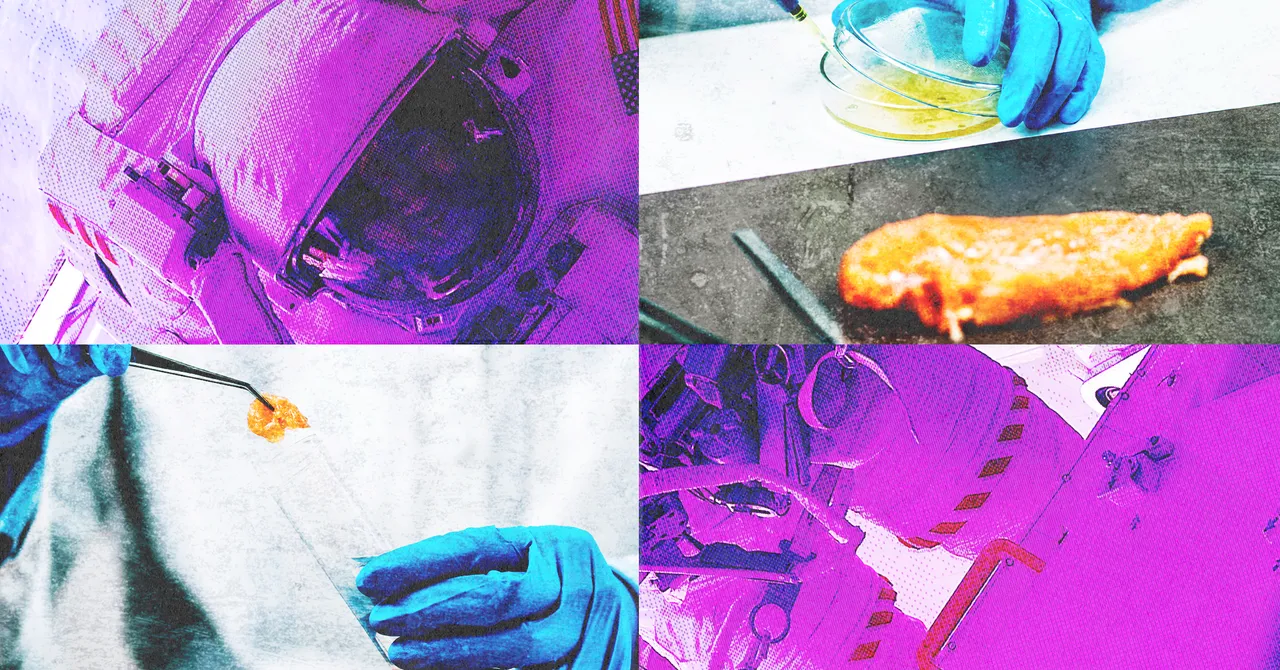
In 1993, the growing danger of E. coli made itself evident when hamburgers sold by Jack in the Box fast-food restaurants sickened more than 700 people and killed four children. The public outcry rivaled the one sparked by The Jungle and triggered two moves by the Food Safety and Inspection Service. As a short-term fix, it hired 160 extra meat inspectors. More importantly, it accelerated a change in approach that had been bubbling away in the background ever since NASA decided it was time to send astronauts to space for more than a few hours at a time—long enough for them to get hungry.
That happened in the early 1960s, when the Mercury program, which first put Americans into space, gave way to Gemini, which proved out the equipment and procedures necessary for the longer, moon-bound Apollo missions to follow. Sending astronauts into space for multiple days meant dealing with the various elements of sustenance in zero gravity, from swallowing to defecating. But it was the middle step, digesting, that most worried Paul Lachance, the space agency’s lead food scientist. Food poisoning on Earth is terrible. In a spacesuit or space capsule, it could be catastrophic.
The obvious approach would be a 100 percent testing route, screening every morsel for pathogens and taking a zero-tolerance attitude. This was unworkable, because, as with artillery shells, every bite of food that’s tested is one that can’t be eaten. This is known as “destructive testing.” Proving a given batch was absolutely safe would involve eliminating most of it. Private industry was no help; what inspection did take place in the 1960s was far from scientific or suitable for NASA’s needs. Most pathogens were “discovered” by the people who consumed them.
Lachance and his colleagues responded by creating a new way of testing food safety. Where Walter Shewhart’s control chart was a tool for spotting manufacturing issues that could then be resolved, they conceived of an approach that went further, proactively identifying all the points where problems are most likely to start, and focusing inspection there. The core idea was to test food not after it was produced, but to so control its production that such testing was unnecessary. They called it Hazard Analysis and Critical Control Point, today better known as HACCP.
To help digest this, think of basic acceptance sampling as the bit of wine the waiter has you taste so you know the bottle hasn’t spoiled before everyone gets a full glass. The basic Shewhart approach, then, is like the “test pancake” you make as you’re starting up breakfast. It tells you whether your production process, which requires a batter of the right consistency and a griddle at the right temperature, is on track. HACCP (pronounced hassip) is more like the way you should make a soup. Each time you add salt or broth or lemon juice or cream, you taste it to see how the flavor, saltiness, and acidity match what you’re aiming for.
For NASA, analyzed hazards could be physical (crystallized Tang powder could break a tooth), chemical (the presence of pesticide residues), or microbiological (the pathogens that posed the most serious threat in space). A critical control point could be any moment or action in the production process, from gathering raw materials to vacuum-sealing a package. “We identified the critical steps that would make the difference between something being safe or not safe,” Lachance said. “The temperature, the pressure, whatever that criteria was, whatever that critical control point was.” A chicken headed into space would be plucked, deboned, cut into pieces small enough to freeze-dry, and cooked, at which point it would be sterile. But as various people handled it, the meat would be checked on its way to the freeze dryer, then on its way into plastic packaging, then again after being vacuum-sealed. To this day, no astronaut has gotten food poisoning while in space.
