



Ethereum arbitrage generated about $5.24 in builder receipts for every $1 burned in a 30-day sample reported by blockchain data provider Bitquery. Its allocation puts 49.3% of measured surplus toward block assembly, 9.4% toward burned fees and 41.3% with trading operators.
For ETH holders, the finding shows why trading activity and the investment case for holding the token require different measures. Payments reward participants executing and ordering trades; fee burning changes ETH supply. Builders also pay validators to propose blocks, so the largest receipt bucket does not identify the largest final profit.
The investigation marks its figures verified Aug. 31, 2026. Its allocation table specifies 30 days without exact endpoints; a separate monthly trade-distribution table ends Aug. 29. The five-to-one comparison is calculated from the rounded shares and describes sampled arbitrage surplus, not Ethereum-wide revenue.
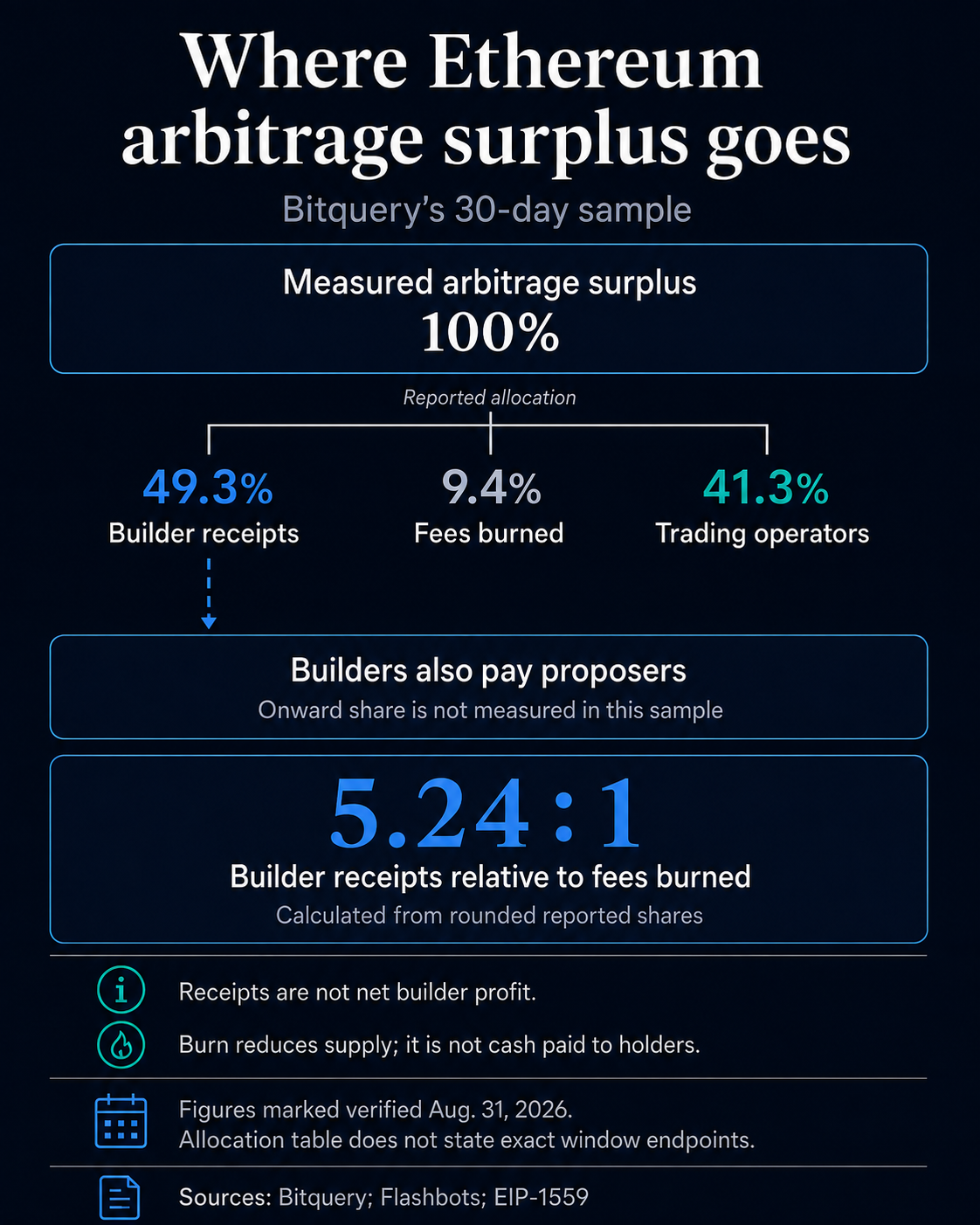
A payment to builders has another destination
Arbitrage software looks for a token available at different prices, buys at the cheaper price and sells at the higher one. Ethereum’s MEV documentation describes the specialized participants finding these opportunities as searchers. When several searchers pursue the same trade, getting a transaction included in the right position has economic value.
An operator must secure execution while the price difference still exists. Competition for that opportunity can turn part of a trading gain into a payment for inclusion, reducing what remains with the operator.
In the block-building arrangement documented by Flashbots, builders gather transactions and bundles, construct blocks, then bid for validators’ blockspace through relays. The validator acting as proposer is paid to propose the builder’s block.
The payment design makes the distinction visible. A builder sets its own address as the block’s fee recipient, then includes a transaction at the end of the block paying ETH to the proposer’s designated recipient. Money can reach the builder address and subsequently leave for the validator within that same block.
Counting only the incoming payment stops the accounting too early. To compare participants, the relevant builder figure is what remains after the proposer payment, with business costs a further consideration. The proposer receipt is a separate flow, not an additional arbitrage gain to add on top of the original surplus.
New York Fed Staff Report 1102 uses this distinction in its historical research: builder profit is direct payments plus priority fees, minus the payment to the proposer. It measures retained block revenue, rather than a complete business profit after operating costs.
Bitquery’s allocation does not measure the fraction of its builder receipts passed onward to proposers. Assigning that money between builders and validators would require matching the sampled trading payments to the relevant onward transfers. The protocol describes the route; it does not supply the missing percentage.
What fee burn means for ETH holders
Ethereum’s EIP-1559 specification separates the base fee from the priority fee. The base fee is destroyed by the protocol. The priority fee is a payment associated with transaction inclusion.
Base fee per gas adjusts according to gas used relative to the block target. That is a different mechanism from a searcher’s willingness to pay for a profitable trading position. Both can feature in the same transaction, but they answer different economic questions.
This is why the comparison cannot be read as though every payment made on Ethereum contributes equally to reducing ETH supply. A larger inclusion payment can change what a participant receives without representing an equivalent increase in burned ETH. Likewise, a transaction count does not disclose either the gas consumed or the base fee paid.
For a holder assessing the supply effect, the useful measurement is ETH destroyed over a defined period, compared with ETH created over that same period. Ethereum’s issuance documentation explains that the balance of issuance and burn determines whether supply expands or contracts.
Burn consequently reduces supply relative to a world without that destruction, but it does not by itself establish that total supply fell. Nor does it transfer cash to a passive holder. Those distinctions remain relevant even when the underlying activity creates a profitable trade for somebody else.
The study filters for surplus no greater than the capital committed in each transaction. Wallet reconciliation can reduce apparent earnings further, and incomplete Ethereum venue decoding misses activity. The separate annual comparison covers Ethereum, BNB Chain, Base, Arbitrum and Polygon for 12 months through Aug. 29, 2026; Optimism and Solana are excluded. Its fixed reference prices differ from the monthly prices used in the historical series.
These boundaries leave a useful allocation finding without establishing a trend in anyone’s profits. A later comparison would need consistent coverage, periods and accounting, including builder payments onward to proposers. Otherwise, a change in the reported share could reflect a change in what was counted.
The investment-thesis test therefore has distinct parts. Operators need retained trading surplus sufficient to cover their business costs. Builders need receipts considered alongside proposer payments. Validators receive compensation through their own role. Passive holders face a supply outcome that depends on issuance as well as destruction.
More transactions cannot answer all four questions. Evidence that activity strengthens ETH’s supply-reduction case would be comparable burn and issuance measurements; evidence of higher retained block revenue would be comparable receipts and onward payments. The distinction determines whether a busy network is producing more income for its participants, reducing its token supply, or doing both.
