


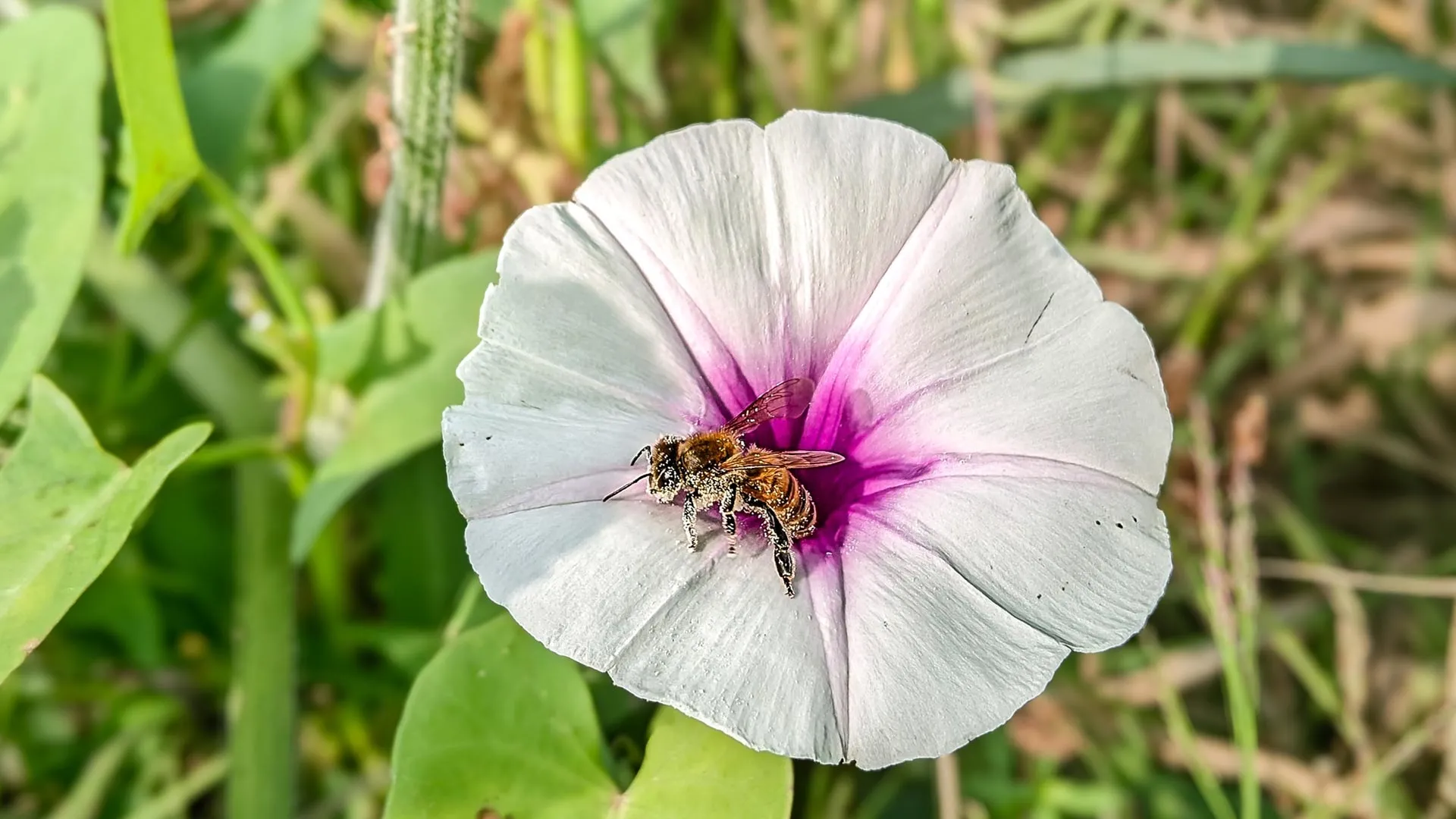
Plants facing both a warming climate and rapidly declining pollinator populations may be pulled in competing evolutionary directions. A University of Michigan study suggests that, instead of adapting primarily to climate pressures, some plants may be evolving traits that help them attract pollinators.
In morning glories, researchers found that the population’s rate of adaptation fell by 96% over nine years. That sharp slowdown could also have implications for agriculture because morning glory is often considered a troublesome weed by farmers.
“Because pollinator pressure strongly favors larger flowers, that linkage may limit how efficiently the population can respond to other selective pressures. Whether that ultimately makes the weed more or less of a problem for farmers is hard to predict — and that unpredictability is itself part of the story,” said Regina Baucom, a professor in the U-M Department of Ecology and Evolutionary Biology.
Larger Flowers May Come With an Evolutionary Cost
Baucom says the slowdown appears to stem from a conflict between two potentially useful traits. Larger flowers may improve a plant’s chances of attracting pollinators, while flowering earlier can help plants respond to changing environmental conditions.
In the morning glory populations, those traits became increasingly linked. That connection appears to restrict how freely the plants can adapt, with selection for larger flowers taking precedence over the potential benefit of earlier flowering.
Importantly, the newer plant populations still contained substantial genetic variation. In theory, that diversity should provide enough raw material for continued adaptation.
“The plant isn’t running out of evolutionary fuel — it’s increasingly locked into a trajectory that favors pollinator attraction, potentially at the expense of climate adaptation,” Baucom said.
Human-Caused Environmental Change
The research was led by recent doctoral graduate Sasha Bishop in collaboration with University of Toronto researcher John Stinchcombe. The team studied morning glories as part of a broader effort to understand how human-caused global change is shaping evolution.
Climate warming is only one of the pressures plants and animals now face. Human development has replaced previously undisturbed habitat, while widespread agricultural use of pesticides and herbicides has contributed to major declines in pollinator populations.
Bishop says the study, published in Evolution Letters, explores a growing mismatch between evolutionary theory and what researchers are observing in nature. Theory suggests organisms can sometimes adapt rapidly when their environments change quickly, but many wild plant populations do not appear to be keeping pace.
“Instead of evolving, there are all these wild populations that are dying off, declining or going through genetic bottlenecks,” Bishop said. “So we’re looking at a situation in which there’s a lag in what we’re seeing in the adaptive rate in wild populations compared to what we think might be theoretically possible in terms of rapid evolution.”
Testing an Adaptation Trade-Off
To investigate the problem, the researchers grew morning glory plants from seeds collected from wild populations at two separate times, with the collections occurring nine years apart.
They measured several traits that could be influenced by climate conditions or pollinator activity. These included the date of the first flower, flower size, nectar sugar, flowering time, and the distance between flowers’ anthers, or the pollen-producing part of the flower, and the stigma, the structure that receives pollen.
The team then calculated the plants’ adaptation rate using a statistic known as R. This approach estimates how a population is expected to adapt while accounting for relationships among multiple traits, rather than examining each trait independently.
That allowed the researchers to determine whether one trait might “constrain” another. In other words, changes in one characteristic could limit how much another characteristic is able to change.
When two traits are linked in this way, they are considered “covariants.” Bishop and Baucom found that flower size and flowering time became linked in the morning glory populations during the relatively short nine-year study period.
Plant Adaptation Falls Sharply
In the original morning glory populations, the researchers estimated that adaptation was occurring at about 76% of the rate expected if covariance between traits were not taken into account.
Nine years later, that figure had fallen to roughly 9% of the expected rate without covariance. The result points to a substantial increase in evolutionary constraints over a relatively short period.
Flowering time is especially important because plants can shift when they bloom in response to environmental changes.
“There are quite literally thousands of studies showing that flowering phenology is a really important adaptive path when it comes to climate change, particularly temperature changes and precipitation changes, both of which happened in these wild populations in the locations where they were collected from,” Bishop said. “The implication in my mind is that pollinator decline, or the lack of pollination and selective drive to attract pollinators, is making these plants potentially less able to adapt to climatic shifts.”
