


- Most urban poor living in Colombo, Sri Lanka’s commercial capital, rely on pipe-borne water for their daily needs.
- Many fresh water sources have become contaminated over a period of 20-25 years due to human interventions and environmental factors.
- As extreme heat impacts the island, water scarcity may force city people to use alternative or less protected water sources, researchers say.
- Studies indicate that other water sources, such as wells and community water schemes, are more likely to show bacteriological non-compliance.
COLOMBO — As part of his morning routine, Nalin Kaluwitharana from “Ranjan Wijerathnapura,” a low-income settlement in the heart of Colombo, waters his home garden before setting off to work. Like many others in his neighborhood, he works as a three-wheeler driver.
“We obtain pipe-borne water provided by the National Water Supply and Drainage Board (NWSDB). In the wake of drought conditions, NWSDB has requested people to use water sparingly. But we need water for our daily needs and have no alternatives but to rely on tap water,” he told Mongabay.
Despite increasing utility tariffs, he continues to water the plants to keep them green and his surroundings alive.
Kaluwitharana and a majority of houses in this settlement do not have water storage facilities and are dependent on the state utility to obtain water directly from the water line. The routine water cuts and maintenance work disrupt the regular water supply, inconveniencing them.
Linda Arulanantham is from the same neighborhood. “Immediately after a water cut, the water turns muddy. We use a water filter to make sure that the water we drink is clean,” she said.
But every household doesn’t have a water filter system, and water safety in urban low-income settlements is often neglected.
Community water supply schemes
In Sri Lanka, community water supply schemes were established around the 1990s to provide safe drinking water to rural communities.
Ananda Vijitha Kumara Mapa, director general at the Department of National Community Water Supply (DNCWS) told Mongabay that community water supply schemes were introduced to distribute water to areas, which were not covered by the NWSDB. At the time, there were no concerns pertaining to water safety.
“Most water schemes were established in places where there were natural water springs, streams and so on. The water sources were not contaminated at the time,” he said. “But 20-25 years later, the need to purify water arose. Water sources have become contaminated due to development activities, agricultural expansion, livestock farms and other activities happening in catchment areas. ”
The department now registers community-based organizations that manage community water supply schemes, and several new community water supply schemes have been initiated since 2019. “Around 367 schemes were introduced during 2019, 2020 and 2021. Out of the 367 schemes, we have completed 170, and the rest will be completed by 2027,” he said.
Enough water for Colombo
Atham Bawa, deputy general manager of environmental and water resources at the NWSDB said the total daily requirement of water for Colombo district is about 1 million cubic meters. “So far, we have no challenges in distributing water to Colombo district. Except for emergencies and standard maintenance work, which are rare instances, we ensure regular water supply to people in Colombo,” he said.
Novil Wijesekara, a consultant community physician at the Ministry of Health, said that according to the Department of Census and Statistics, access to NWSDB water supply in the Western province has spiked from 43.1% of households in 2012 to 58.7% in 2024.
Wijesekara said that this meant a substantial number of households still depend on other water sources, such as wells, community water schemes and so on. “These sources may be safe in some settings, but they require regular protection, monitoring, and household-level precautions,” he said.
“If non-NWSDB sources are more likely to show bacteriological non-compliance, people using such sources may face a higher risk unless proper household water treatment and safe storage practices are followed. This is why practices such as drinking boiled and cooled water remain important, especially for households relying on wells or other non-centrally managed sources,” he added.

In his 2026 research on household water treatment and storage in the Western province of Sri Lanka, Wijesekara proposed the household water treatment and safe storage (HWTS) method, which acts as an essential safeguard in places where centralized supplies are unreliable or absent.
The quality standard for drinking water in Sri Lanka is established by the Sri Lanka Standards Institution (SLSI).
“We do chlorination to remove bacteria. We filter water to get rid of mud. As for heavy minerals, we opt for complex purification systems,” he said. “We have to purify the water sample to bring it to the accepted local standard. As such, all three features should be brought to the standardized level. ”
Extreme weather and impacts
In recent years, Sri Lanka has become highly vulnerable to extreme weather events impacting water quality in different ways.
Wijesekara noted climate variability as a growing concern as floods, droughts, and unseasonal rainfall could all affect water availability and quality. “Water safety planning needs to consider both routine conditions and emergency situations,” he said.
He explained there is a risk of sewage, animal waste, solid waste, and other contaminants entering surface water sources during heavy rainfall and flooding.
“Floodwater can also enter dug wells and other household water sources, leading to bacteriological contamination. In such situations, water sources that were previously safe may turn unsafe for drinking unless properly treated,” he said. “During prolonged drought, the main challenge is water scarcity. When water becomes scarce, people may be forced to use alternative or less protected water sources .”
Preparedness measures
Nilantha Dhanapala, an engineer and director at the Water Management Secretariat at the Mahaweli Authority of Sri Lanka, said that as of Aug. 25, major reservoirs in the country have reached 55% of total capacity.
“As for domestic water consumption, the amount of water usage is significantly little compared to irrigation water. It is manageable at this moment. One of the issues is that even though there is an adequate amount of water, there is limited conveyance capacity, which makes it difficult for the NWSDB to distribute safe drinking water to all areas of the country. If this could be managed then this situation could be controlled,” he told Mongabay.
NWSDB’s Bawa added that a drought management plan is already in place. “Key areas in this plan include developing a groundwater division to extract more groundwater during the dry season and expediting emergency water supply efforts. We have provided water in bowsers upon the request of the Disaster Management Centre, and so far, over 70,000 people in drought-affected areas have been able to access these facilities,” he said.
Rising utility costs
Abdul Rahman Mohamed, also a resident of Ranjan Wijerathnapura, told Mongabay that many residents in his neighborhood are unable to pay utility bills as they engage in contract labor. He said that despite having a continuous supply of water, they are sometimes challenged during prolonged water cuts that drag up to nine hours.
In 2024, water tariffs were revised and a gazette notification categorized consumers and water tariffs for individuals in low-income settlements now range from 100 rupees to 1600 rupees ($0.30 to $4.87) per unit.
Meanwhile, a May 2026 special audit report highlighted management weaknesses within the NWSDB that contributed to the need for significant water tariff increases. The report showed the domestic consumer category generated the highest revenue contributing to about 73% of NWSDB’s total revenue. The report also indicated how revenue increased for NWSDB due to tariff revisions in 2012, 2022, 2023 and 2024.
But, according to Mohamed, even though there had been minor reductions during the 2024 water tariff revision, such decisions haven’t provided him much relief following the exorbitant water tariff hike in 2023.
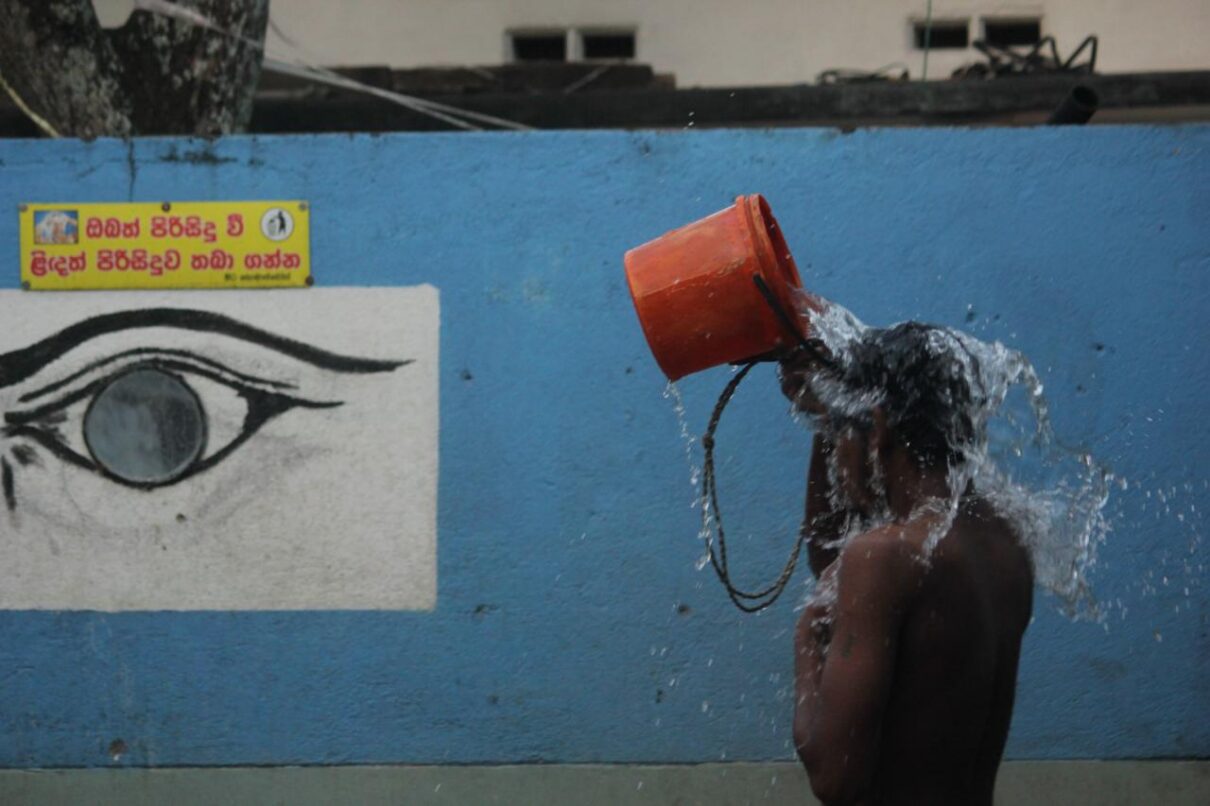
Banner Image: A man having a bath at a public well in Slave Island, Colombo, Sri Lanka. Image courtesy of Sakuna Miyasinadha Gamage.
Citation:
Wijesekara, N., Weerasinghe, M.C., … Seneviratne, S.R. (2026). Household water treatment and storage in the Western Province of Sri Lanka: an assessment of knowledge, behaviours, practices, and treatment effectiveness. Journal of Water, Sanitation and Hygiene for Development, 16(3), 165-175. doi:10.2166/washdev.2026.130

