


Welcome back to Foreign Policy’s Situation Report.
Here’s what’s on tap for the day: The USS Abraham Lincoln finally ends a 286-day deployment, Ukrainian intelligence agencies fight in the streets of Kyiv, and U.S. companies warn of AI’s threat to global cybersecurity.
Welcome back to Foreign Policy’s Situation Report.
Here’s what’s on tap for the day: The USS Abraham Lincoln finally ends a 286-day deployment, Ukrainian intelligence agencies fight in the streets of Kyiv, and U.S. companies warn of AI’s threat to global cybersecurity.
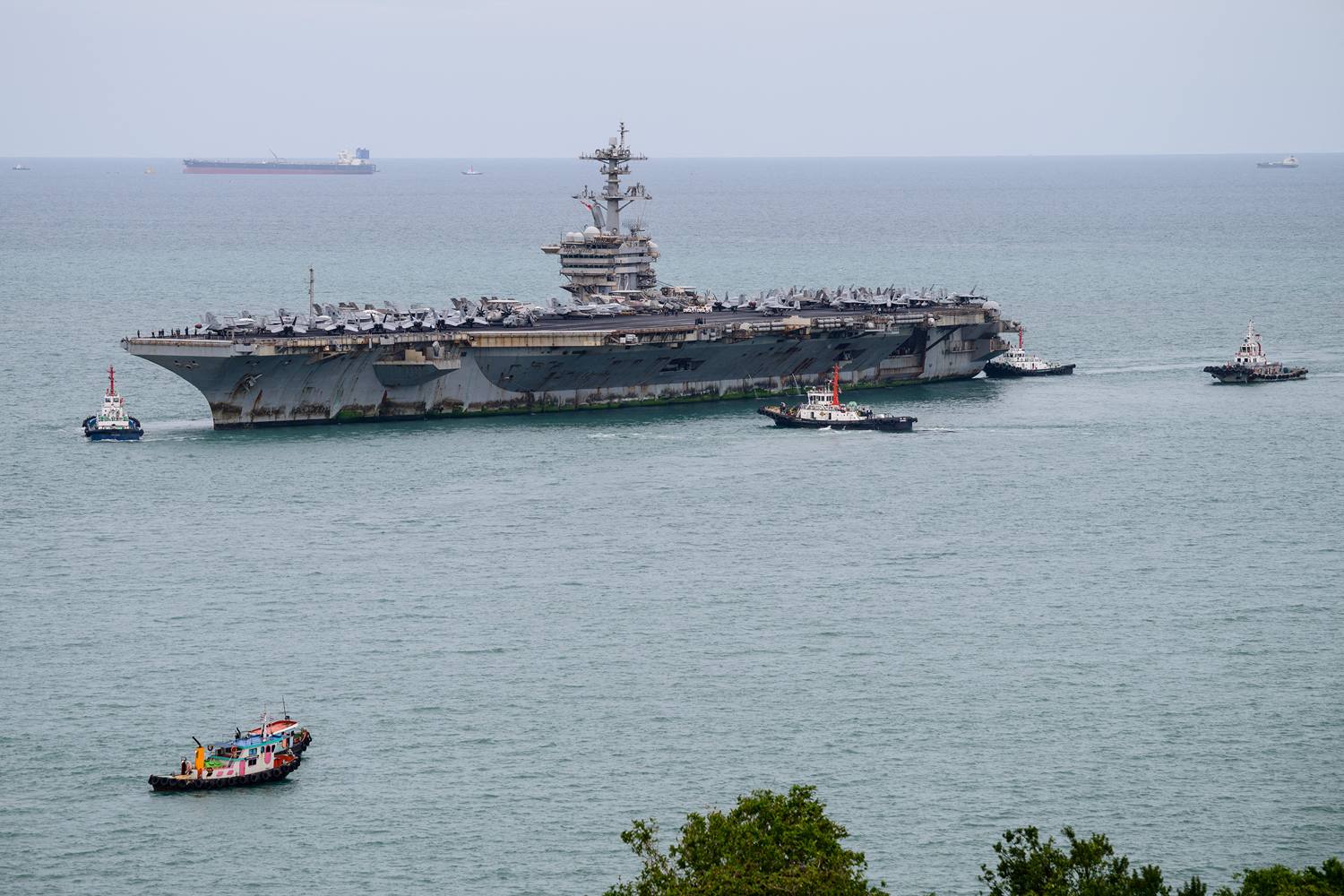
The USS Abraham Lincoln has seen better days. The nuclear-powered aircraft carrier docked in Thailand on Wednesday after 286 grueling days at sea—the bulk of which were spent in the Middle East supporting the U.S. war against Iran—and it’s covered in rust.
The Lincoln is now receiving repairs as its crew members enjoy some much-deserved R&R. The condition of the Lincoln, while not unexpected after a prolonged deployment, is an unsettling metaphor for both the state of the Iran war and the U.S. military more broadly at the moment.
The Iran war has left the U.S. military overextended, pulling vital resources and personnel away from other regions and priorities. And much like the war itself, the carrier’s deployment lasted far longer than the Trump administration expected or planned.
The 5,000 sailors and Marines aboard reportedly faced a range of challenges, from food shortages to sewage issues. The indefinite timeline surrounding their deployment also apparently (and quite understandably) had a detrimental effect on the mental health of some personnel aboard, leading family members to raise grave concerns. Multiple crew members reportedly attempted to jump overboard.
Their hardships can’t be divorced from the fact that they’re serving under an administration that has struggled to define its goals in the Iran war from the start. As retired Gen. Joseph Votel, the former Central Command chief, told John in July, “The military has done exactly what has been asked of them, and they’ve done that to the best of their ability,” but it’s been challenging “to appreciate what the long-term strategic objectives” are in the war.
Directionless. The Iran war reignited this week after a lull in fighting (for the umpteenth time), and this cycle appears to be poised to continue so long as the Trump administration refuses to change course in a significant way (or cut its losses).
This means that the U.S. military will keep using up already dwindled stockpiles of key munitions, and tens of thousands of U.S. troops will continue to be deployed in the region.
The Wall Street Journal reported that Defense Secretary Pete Hegseth is extending Middle East troop deployments into 2027, despite reported warnings from top military leaders that the prolongment of large-scale operations is unsustainable.
Pentagon problems. Meanwhile, there’s trouble on the home front as Hegseth’s controversial approach to leadership—and his efforts to consolidate power and ensure loyalty—continues to push key Pentagon figures out.
In one of the highest-profile departures under Hegseth’s tenure to date, Army Secretary Dan Driscoll resigned on Monday. Driscoll met with Trump at the White House ahead of his resignation. A U.S. official briefed on the meeting, who requested anonymity to discuss internal conversations, told SitRep that Driscoll used that meeting to present his concerns to Trump about the Army’s future and direction under Hegseth’s leadership. Driscoll also told Trump that Hegseth’s firing of several top generals made it difficult to implement the changes within the Army that Driscoll wanted, the official added.
Driscoll’s wartime exit has led congressional Democrats and even some Republicans to call for Hegseth’s resignation. GOP Sen. Thom Tillis wrote in a post on X that he’s “never witnessed more inept management” of the military, describing Hegseth as “intimidated by competence” while urging Trump to “find a new leader at the Pentagon who will retain and empower our military talent rather than diminish it.”
Though many in Washington are convinced that Hegseth is no longer (or never was) the man for the job, Trump has apparently not given up on him just yet. But with Trump’s polling numbers in the gutter amid the unpopular Iran war, it could become increasingly difficult for the president to overlook the dysfunction and negative press engulfing the Pentagon under Hegseth.
Estonian Defense Minister (and former SitRep interviewee) Hanno Pevkur resigned on Wednesday amid a defense procurement scandal, in which the country paid more than $80 million for artillery shells meant for Ukraine that turned out to be faulty. The contract was given to an Indian-owned, Italian-registered defense firm that had never sold a single artillery shell. In an exit interview with Estonian broadcaster ERR, Pevkur said that “the minister does not negotiate contracts” but that he was resigning to “take political responsibility” for the scandal.
Multiple reports indicate that Hegseth’s preferred candidate to succeed Driscoll as Army secretary is current Pentagon chief spokesperson Sean Parnell.
Former Ukrainian Defense Minister Mykhailo Fedorov was in Washington this week, where he met with Alex Karp, the CEO of U.S. defense tech company Palantir. Karp is set to be the first lead investor in a defense tech company that Fedorov—whom Ukrainian President Volodymyr Zelensky controversially fired earlier this year—is setting up, Fedorov said in a post on X. Fedorov also met with former U.S. cyber ambassador Nate Fick.
What should be high on your radar, if it isn’t already.
Kyiv shoot-out. Officers from Ukraine’s two leading intelligence agencies were involved in a shoot-out against each other on the streets of Kyiv this week, leaving at least three of them injured in what Zelensky described as an “absolutely shameful” event. Personnel from Ukraine’s civilian intelligence agency, known as the SBU, reportedly opened fire on their counterparts from the country’s military intelligence arm, known as the HUR. The SBU has accused senior Ukrainian military commander Stepan Kaplunov of working on behalf of Russia, and the shoot-out occurred while its officers were searching Kaplunov’s apartment.
Cyber warnings. Some of the United States’ leading companies this week issued fresh warnings about the threat to global cybersecurity from advances in artificial intelligence. An open letter calling for “collective action on cyber defense” was signed by more than 130 major companies, including leading AI companies OpenAI and Anthropic as well as Adobe, Capital One, Google, General Motors, Microsoft, PayPal, and Uber.
“In the coming months, AI-enabled cyber attacks will become far more widespread and sophisticated as models around the world become increasingly capable,” the letter warned. “The companies and public services our communities depend on—from hospitals to water treatment plants to the infrastructure that powers the internet—are at risk.” The letter comes after a series of high-profile hacks by AI models and a targeting of U.S. water systems by cyberattackers. It calls for companies, governments, and global organizations to urgently partner on cybersecurity.
U.S. Treasury Secretary Scott Bessent hosts the 2026 G-20 financial meetings in Asheville, North Carolina, United States, on Sep. 1.Melissa Sue Gerrits/Getty Images
Monday, Sept. 7: The 63rd session of the U.N. Human Rights Council begins.
The annual “Freedom Edge” joint military exercise—involving the United States, Japan, and South Korea—begins.
Tuesday, Sept. 8: Canada’s retaliatory tariffs against the United States go into effect.
Wednesday, Sept. 9: The International Space Summit begins in Paris.
“This piece of shit should never be allowed in the US.”
—U.S. Sen. Ruben Gallego, referring to Israeli National Security Minister Itamar Ben-Gvir, who posted a since-deleted AI-generated video on X depicting plump Palestinian prisoners being funneled into a prison camp on a conveyor belt and coming out emaciated and crying.
The U.S. Mint appears to have sold out of new $1 coins with Trump’s face on them just hours after releasing them on Wednesday. The mint’s website shows the coins, which feature Trump’s presidential portrait on one side and the presidential seal on the other, as “not currently in stock.” That’s despite each coin costing far more than the $1 they’re valued at—the mint is selling a roll of 25 coins for $61 and a bag of $100 coins for $154.50.
