


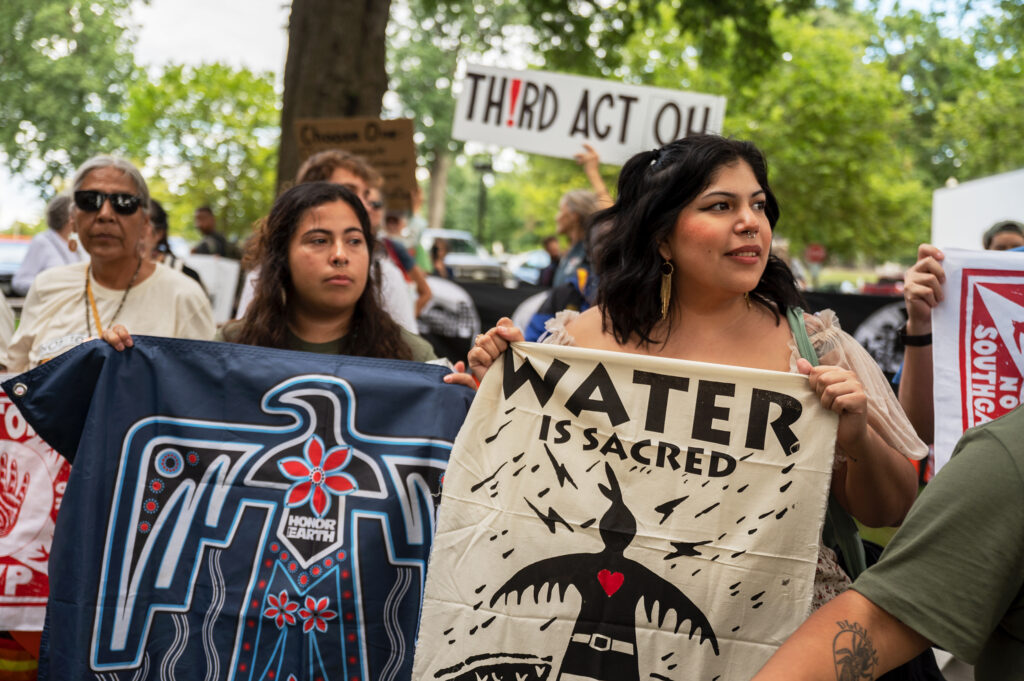
When the Trump administration last fall unveiled its cornerstone policy for carrying out the Clean Water Act—new language spelling out the reach of the Environmental Protection Agency’s authority—it said one of its goals was to return power to states and tribes.
“This proposal recognizes that states and tribes know their local land and water resources best,” the EPA said in a news release announcing its revised definition for “waters of the United States.” That plan is still in the works and may be opened for public comment again as the administration weighs potential revisions.
But the EPA is moving forward with revisions to a separate set of Clean Water Act regulations that would limit state and tribal authority over waterways—especially when it comes to weighing in on major energy projects like oil and gas pipelines, export terminals and hydropower dams.
At issue is Section 401 of the Clean Water Act, which requires that any such projects that could result in pollution to a navigable waterway get a water-quality certification from the states or tribal lands where the pollution would originate before they can obtain their federal permits.
The Trump administration maintains that state and federal cooperation—what it calls “cooperative federalism”—is a key pillar of EPA Administrator Lee Zeldin’s policy framework. But the EPA says this requires clear rules, including that states cannot improperly use Section 401 to veto projects for reasons other than specific aspects of water quality.
Environmental and state advocates, including some representing Republican-led states, say the net effect of the changes the Trump administration is making will dramatically reduce federal protection of water resources at the same time it is limiting states’ power to act on threats to water quality within their borders.
“The only unifying theme of those … proposals is reducing environmental protection,” said Jon Devine, director of freshwater ecosystems for the Natural Resources Defense Council.
Pipeline and Export Battle Backlash
A handful of high-profile state battles against fossil fuel infrastructure laid the groundwork for the moves the Trump administration is taking to limit actions by states and tribes.
A proposal for what would have been the largest coal export terminal in North America in Longview, Washington, died after the state, then led by Democrat and climate action advocate Gov. Jay Inslee, denied the project Section 401 water quality certification in 2017. The project developer, Millennium Bulk Terminals, challenged the decision, including on the grounds that the state improperly considered greenhouse gas emissions in its analysis. But battered by court defeats and the weakened economy of the COVID-19 pandemic, the company filed for bankruptcy in late 2020.
In Virginia and West Virginia, the Mountain Valley Pipeline was tied up in disputes over state water quality permits for a decade before it opened in 2024. The natural gas conduit only was completed after intervention by Congress.
Environmental and state advocates say the Millennium and Mountain Valley cases are outliers. A survey by the Association of Clean Water Administrators, a nonpartisan group that represents both Democratic and Republican-led states, found the vast majority of permits are approved quickly—with the process averaging 77 days. Thirteen states reported never denying a Section 401 certification.
“States are not sort of running amok, using 401 to willy-nilly randomly deny important projects,” said Julia Anastasio, executive director and general counsel for the association. “States work really hard, typically, to avoid denial because look, their governors want development too. Their main goal is just to protect water quality.”

The Mountain Valley Pipeline, in fact, became an example of a pro-development state using the 401 process to enact such protections. West Virginia ultimately added conditions to its water quality certification for the project that required, for example, advance notice to state authorities and the presence of state auditors during construction work that crossed the state’s waterways.
The Trump administration proposal would specify that states or tribes are limited in the Section 401 review process to looking at the impact of “point source discharges”—that is, pollution from a pipe, ditch, channel or other conduit. During Trump’s first term, the EPA finalized rules that contained similar provisions narrowing state authority, but they were reversed by the Biden administration in 2023 regulations that made clear states were to consider project impact holistically when they decided on water quality certification.
The Association of Clean Water Agencies said states historically have considered factors such as sedimentation, temperature changes and flow alterations caused by projects as well as point source pollution. “Water quality impacts often arise from multiple, interconnected components of a project and may not be fully captured by a narrow focus on discrete point source discharges,” the association said in comments to the agency. The Trump administration’s proposed changes would mark “a substantial narrowing of state authority compared to historic practice,” the association said.
The Trump administration’s proposal also would sharply limit tribal participation in water quality certification, recognizing that authority only for tribes that have their own full water quality standards programs. Currently, that is 84 of the nation’s 575 federally recognized American Indian and Alaska Native tribes. Administering a full-blown water quality standards program analogous to those in the states is a costly undertaking out of the reach of many tribes. The Biden administration’s rules provided a pathway for them to participate in Section 401 certification, but the Trump administration argues the EPA did not have legal authority to do so.
This story is funded by readers like you.
Our nonprofit newsroom provides award-winning climate coverage free of charge and advertising. We rely on donations from readers like you to keep going. Please donate now to support our work.
An EPA spokesperson said the agency is working to support the important role of states and tribes under the Clean Water Act and other statutes, but that requires putting rules in place that follow the letter of the law and can withstand court scrutiny.
“The agency is honoring the clear authority provided by Congress to states while ensuring that states do not inappropriately leverage that authority for environmental goals untethered to water quality,” the EPA spokesperson said. “This is not at odds with cooperative federalism. In fact, establishing clear, legally defensible, and durable rules of the road only enhances cooperative federalism.
Constitution Pipeline Plan Under Scrutiny in New York
The EPA’s new Section 401 rules, first proposed in January, have been undergoing final review at the White House this summer and administration officials are slated to meet with state and local water managers and administrators next week to hear their views on the plan. Some environmentalists said they believe the administration may have been waiting to see if Congress would include similar limits on Section 401 in a larger overhaul of the federal permitting process that Senate Environment and Public Works Committee Chair Shelley Moore Capito (R-W.V.) said she hoped could advance in Congress this month with bipartisan support. A bipartisan Congressional deal on permitting reform has proven elusive, however, and 58 environmental groups sent a joint letter to Congressional leaders this summer imploring them to maintain states’ role while they tackle the larger issues of federal permitting.
If EPA finalizes its Section 401 overhaul this fall, one of the first tests could be Williams Co.’s proposed Constitution Pipeline, which would deliver natural gas from Pennsylvania’s Marcellus Shale region to Albany, New York, and the pipeline system that connects with New England.
Williams had cancelled the 125-mile project in 2020 after New York’s objections to its potential impact on hundreds of streams and wetlands, but revived the plan after Trump returned to office. New York’s Department of Conservation filed a formal objection early this year, saying the company was trying to bypass environmental review. “DEC did not waive its Clean Water Act Section 401 authority and will explore all available options to vigorously defend our state rights,” the agency said.
Trump took to Truth Social earlier this summer to castigate Gov. Kathy Hochul for her administration’s opposition to the Constitution Pipeline, blaming her for high energy prices and accusing her of reneging on a wind energy for gas pipeline deal that she has said she never made. But the future of the project may be decided outside the political limelight, by EPA’s re-writing of the regulations to limit objections that states like New York can make to energy projects that affect its waterways.
About This Story
Perhaps you noticed: This story, like all the news we publish, is free to read. That’s because Inside Climate News is a 501c3 nonprofit organization. We do not charge a subscription fee, lock our news behind a paywall, or clutter our website with ads. We make our news on climate and the environment freely available to you and anyone who wants it.
That’s not all. We also share our news for free with scores of other media organizations around the country. Many of them can’t afford to do environmental journalism of their own. We’ve built bureaus from coast to coast to report local stories, collaborate with local newsrooms and co-publish articles so that this vital work is shared as widely as possible.
Two of us launched ICN in 2007. Six years later we earned a Pulitzer Prize for National Reporting, and now we run the oldest and largest dedicated climate newsroom in the nation. We tell the story in all its complexity. We hold polluters accountable. We expose environmental injustice. We debunk misinformation. We scrutinize solutions and inspire action.
Donations from readers like you fund every aspect of what we do. If you don’t already, will you support our ongoing work, our reporting on the biggest crisis facing our planet, and help us reach even more readers in more places?
Please take a moment to make a tax-deductible donation. Every one of them makes a difference.
Thank you,

Bureau Chief, Washington, D.C.
Marianne Lavelle is the Washington, D.C. bureau chief for Inside Climate News. She has covered environment, science, law, and business in Washington, D.C. for more than two decades. She has won the Polk Award, the Investigative Editors and Reporters Award, and numerous other honors. Lavelle spent four years as online energy news editor and writer at National Geographic. She spearheaded a project on climate lobbying for the nonprofit journalism organization, the Center for Public Integrity. She also has worked at U.S. News and World Report magazine and The National Law Journal. While there, she led the award-winning 1992 investigation, “Unequal Protection,” on the disparity in environmental law enforcement against polluters in minority and white communities. Lavelle received her master’s degree from Columbia University Graduate School of Journalism, and is a graduate of Villanova University.
