


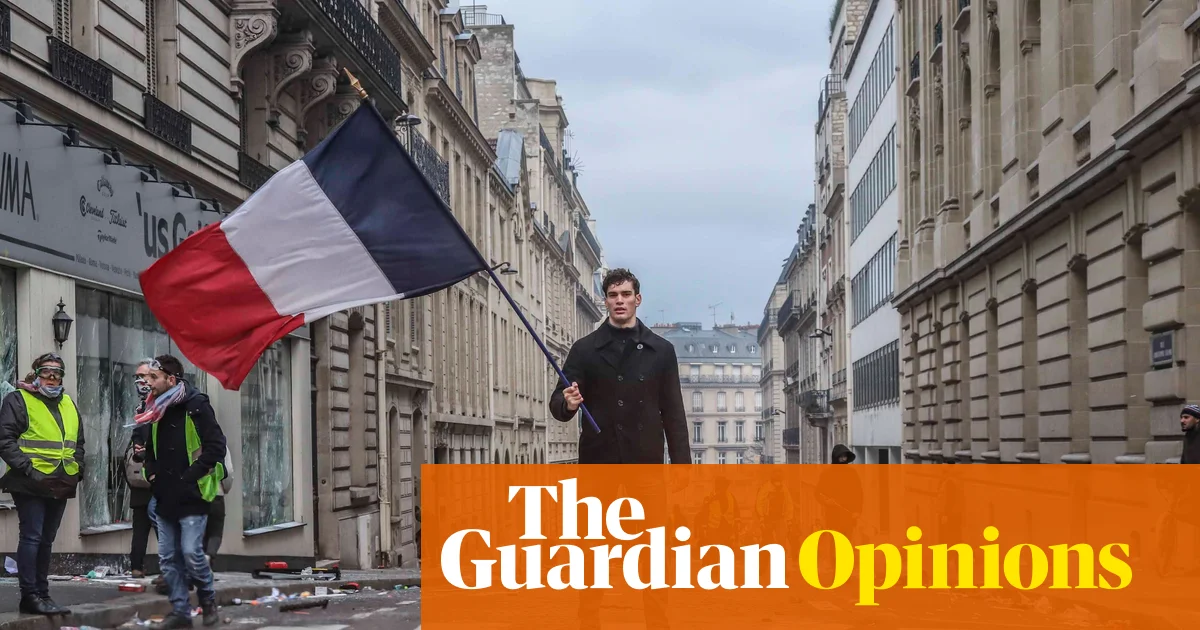
France, as the French travel writer Sylvain Tesson once noted, “is a paradise inhabited by people who think they live in hell”. As the campaign for next year’s presidential election hits its stride with ever more wannabes declaring their candidacies, the country is in a particularly sullen mood.
If the vote were held now, the anti-immigration populist Marine Le Pen would have a strong chance of romping into the Élysée palace, riding a wave of voter disillusionment with the entire political class and a sense that “we’ve tried everything else”. But a lot can happen between now and 18 April 2027, the date of the first round. France is also a country of sudden shocks.
In spring 2011, Dominique Strauss-Kahn, the then head of the IMF and an admired former finance minister, was hot favourite to become the Socialist party candidate who would beat the incumbent conservative Nicolas Sarkozy in the 2012 race. But Strauss-Kahn was felled by a sexual harassment scandal and the unfancied socialist politician François Hollande ended up in the Élysée. In 2016, the former conservative prime minister François Fillon was well ahead in the race to succeed Hollande, then he was exposed as having arranged taxpayer-funded phoney parliamentary jobs for his wife. He finished third and a young centrist outsider without a party machine, Emmanuel Macron, went on to triumph.
To understand the backdrop to next year’s election – with huge stakes for Europe and the western alliance as well as for France – it’s worth examining the unique features that distinguish the French funk from the crisis facing other advanced democracies. After all, politics has become more raw and polarised in many countries. Other big European economies are stagnating. Mainstream parties are shrinking and fragmenting across Europe under growing challenges from insurgent rightwing national populists as well as a new radical, often ecologist, left. Political instability is accelerated everywhere by social-media frenzy and the 24/7 news cycle.
But several historical factors make the French malaise special, as I explored in a recent conversation with Michel Wieviorka, an eminent sociologist and author of numerous studies on French society, including Où va la France: Métamorphose ou Déchéance? (Where is France Headed: Metamorphosis or Decline?).
France was Europe’s first centralised state, with a culture of dirigiste economic development harking back to Cardinal Richelieu, Louis XIV and his minister Jean-Baptiste Colbert in the 17th century. That tradition was revived by Charles de Gaulle and postwar governments that used a powerful national economic planning commissariat to drive industrial modernisation, including the nuclear programme, the aerospace sector and massive public infrastructure investment.
This helps explain why French people have great expectations of the state and accept some of the highest levels of taxation, income redistribution and public spending as a proportion of economic output of any major economy. It also helps explain why France’s debt-to-GDP ratio of 118% is among the highest and fastest rising in Europe.
“The French are very attached to public services and anxious about their degradation, which is spectacular in public education but also in the justice system, the police, the tax system and health services, as revealed by the Covid-19 pandemic,” Wieviorka said. “They have the feeling that we used to be a great country at the forefront of modernity, but it is now falling apart.”
Another unique characteristic is a multi-century tradition of often violent protest. From the peasant jacqueries and Paris barricades of the 16th and 17th centuries to the landmark upheaval of the 1789 French revolution, revolt against authority has long been seen as legitimate by a large part of society. As Jean-Paul Sartre put it, “It is right to rebel.” The French labour movement, too, was rooted in anarcho-syndicalism before being dominated by the communist party, and lacks the British or German trade unions’ tradition of reformist compromise.
Like the English did in the 17th century, the French executed their king in the 18th century, but it took almost another century to finally abolish monarchy after two royal restorations and two emperors. The French left fought for the republican principle, prevailing over authoritarian forces backed by the Catholic church in the Dreyfus affair at the end of the 19th century. That led to a strict separation of church and state and the principle of secularism that enjoys consensus support today.
However, as Wieviorka noted, the decline of France’s Christian identity and religious observance has coincided with the rise of Islam, mostly among people of immigrant origin. This has stirred anxieties fanned by mainstream conservative and hard-right politicians and the new-right media empire of the billionaire Vincent Bolloré.
These fears explain the rise of the extreme-right Front National founded by Jean-Marie Le Pen in 1972, which Wieviorka called “the pioneering national-populist party in Europe”, putting the fight against immigration at the centre of its agenda. Rebranded in 2018 as the National Rally (RN) by his daughter, Marine, in a quest for respectability, the party has roots in the Vichy regime that collaborated with Nazi Germany but swapped antisemitism for anti-Islamism, advocating “national priority” for French citizens in welfare, housing and healthcare.
Another distinguishing feature is France’s political and administrative elite, rebuilt on meritocratic lines after the second world war with the creation of L’École nationale d’administration (ENA) to train top civil servants and captains of nationalised enterprises, many of whom made a career in politics. The system has become ossified and spawned a self-perpetuating elite – the so-called énarques – increasingly seen as remote from ordinary French people’s concerns.
after newsletter promotion
These factors combined explain the state of public opinion on the eve of the campaign – deeply pessimistic about the state of the country, anxious about identity, declining public services and the cost of living, and disillusioned with a political establishment seen as having failed on all these fronts.
To Wieviorka’s matrix of factors underlying the political malaise, I would add a widespread lack of economic realism and a belief that what the French call “public money”, which in the UK or Germany is known as “taxpayers’ money”, is infinitely extendable.
Economic unrealism makes France particularly susceptible to magic money solutions such as RN’s fantasy that the debt and deficit would melt away if the government only stopped welfare payments to immigrants and slashed its EU contribution, or the radical leftist Jean-Luc Mélenchon’s claim that France just needs to write off “cost free” 18% of its debt held by the European Central Bank and confiscate all inheritances of more than €12m.
No wonder there’s little time for politicians who propose dreary real-world solutions such as raising the retirement age or curbing some welfare benefits. A famous slogan in the student uprisings of May 1968 proclaimed: “Be realistic, demand the impossible”. The big risk now is that the French vote with their gut rather than with their head. At a time of such geopolitical and fiscal peril for France and Europe, that is an alarming prospect.
