


Unlock the Editor’s Digest for free
Roula Khalaf, Editor of the FT, selects her favourite stories in this weekly newsletter.
The Spanish government is demanding answers from the country’s police over an investigation that reportedly concluded Morocco had “planned” the overwhelming surge of migrants into Ceuta this summer.
After Spain insisted for weeks that Morocco played no part in the rush of more than 70,000 people into the tiny territory on the north African coast, Madrid’s position was undercut by a newspaper report that claimed a police probe had blamed Morocco’s security force for orchestrating the influx.
The report in El Español, published on Wednesday, prompted Spain’s interior minister, Fernando Grande-Marlaska, to write to his police chief demanding information “as soon as possible” about the contents of the investigation, which was carried out by a police intelligence unit.
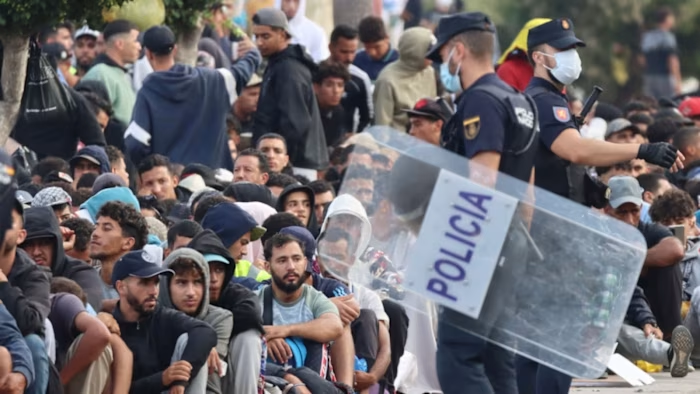
The rush of people from Morocco into Ceuta on July 30 was the EU’s most dramatic episode of illegal border crossings in recent years and reopened the bloc’s deep divisions over immigration policy.
Spain has repeatedly blamed the influx on human traffickers and misinformation spread on social media. Prime Minister Pedro Sánchez condemned it as “an attack on Spain’s territorial integrity”, but on Monday he said he did not “see any information” to suggest Morocco played a role in it. Sánchez accused Russia and Israel of using social media to stoke discord over the episode after it began.
Morocco has denied any role in planning or facilitating the surge of migrants.
Lahcen Haddad, a Moroccan lawmaker, said the report had not been endorsed by the Spanish government and added: “The allegations published so far do not provide verifiable evidence showing who in Morocco supposedly ordered, planned or co-ordinated the events.
“A hypothesis, however serious, should not be reported as an established fact — particularly when Morocco subsequently co-operated in the rapid return of tens of thousands of people.”
According to the El Español report, Spanish police concluded that the influx was overseen by Moroccan security agents and “designed to overwhelm the border-control system and eliminate Spain’s capacity to respond”.
A first wave of migrants who swam to Ceuta before 11am on July 30 were men aged between 15 and 25, equipped with wetsuits, flippers and various flotation devices, according to the newspaper’s account of the police probe.
Their role was to swamp Spain’s border defences. Thereafter, with Spain unable to respond, women, children and entire families with no specialist swimming equipment began arriving in Ceuta.
The police probe “describes how Moroccan gendarmes gave migrants instructions on how to enter Ceuta and managed the flow of the thousands of people who had arrived in [a border town], directing them towards pre-determined areas from which they could reach Spanish territory”, El Español reported. It said police had sent the probe to a judge at Spain’s National High Court, which said it had received it. The FT could not immediately confirm the details of the report.
Spain’s interior ministry said Grande-Marlaska asked the police chief “whether the media report is accurate and, if so, to be told how long the national police had been in possession of the investigation”. The ministry said “the information is essential for the government to be able to take the appropriate decisions in relation to the Ceuta migration crisis”.
Ángel Víctor Torres, the minister managing the Ceuta crisis, declined to “speculate” on the police report until it was published, saying it was not known who requested it or wrote it.
Although the vast majority of migrants who entered Ceuta returned within 48 hours, about 5,000 are still living rough in the territory, stoking tensions and conflict with the exclave’s 83,000 residents.
Rachid El Khalfi, Morocco’s interior ministry spokesperson, said on August 3 that misleading information on social media and exploitation by human trafficking networks were behind the mass movement of migrants into Ceuta.
He added that misinterpretations of a Spanish Supreme Court ruling in early July had created “the false impression that entry into the European area could be achieved easily and without legal consequences”.
Additional reporting by Carmen Muela in Madrid
