


A new award has been created in honor of late conservation icon Jane Goodall by the board of the Starmus Festival, an international gathering of scientists and artists to be held from Oct. 17-22 in Tenerife, Spain. Christiana Figueres has been selected as the recipient of this inaugural Jane Goodall Earth Medal. Figueres is the former executive secretary of the United Nations Framework Convention on Climate Change and is known for her work in securing the negotiations leading to the Paris climate agreement.
She joins the podcast this week to discuss the significance of this medal and her thoughts on the future of science communication and truth — both of which are focal points of the upcoming festival.
“What an absolute giant [Goodall] was to her very last day,” says Figueres. “The fact that a medal has been made in her honor, and that I will debut that is just an unbelievable honor.”
Astrophysicist and co-founder of the Starmus Festival, Garik Israelian, also joins the podcast to discuss the festival theme, “The Search for Truth.” He credits the idea for the medal to his advisory board, which includes Starmus co-founder Brian May, also an astrophysicist but better known as the guitarist for the rock band Queen, and fellow musician Peter Gabriel.
“Brian was very active in protecting animals, and he had a foundation called Save Me. And another member of our advisory board, Peter Gabriel, was also very active in human rights, and also he knew Jane Goodall very well,” Israelian says.
Goodall appeared at the sixth and also the seventh Starmus Festivals. At the former, she was presented with the Stephen Hawking Medal for Science Communication, and at the latter, themed “The Future of Our Home Planet,” she gave the festival a “second life,” according to Israelian.
“The idea came both from Brian and Peter Gabriel. So we nominated Jane Goodall for Lifetime Achievement Stephen Hawking Medal, and that was the second life of Starmus, basically.”
Both Figueres and Israelian agree that this year’s theme, “The search for truth,” runs into challenges in the age of social media, which previous newscast guest Bram Büscher described as ushering in a “post-truth era,” where factual information is increasingly hard to discern. The solution, this week’s guests agree, may lie in regulating tech companies and their algorithms, which prioritize engagement over truth, with platforms often pushing content that may contain false information.
“We are swimming in both disinformation and misinformation all the time without even knowing it,” Figueres says.
“It is time for us to make a conscious decision,” she adds. “We need to surround ourselves with different kind[s] of information. We cannot continue to search for the tiger that is going to eat us up.”
Mike DiGirolamo is the host & producer for the Mongabay Newscast based in Sydney. Find him on LinkedIn and Bluesky.
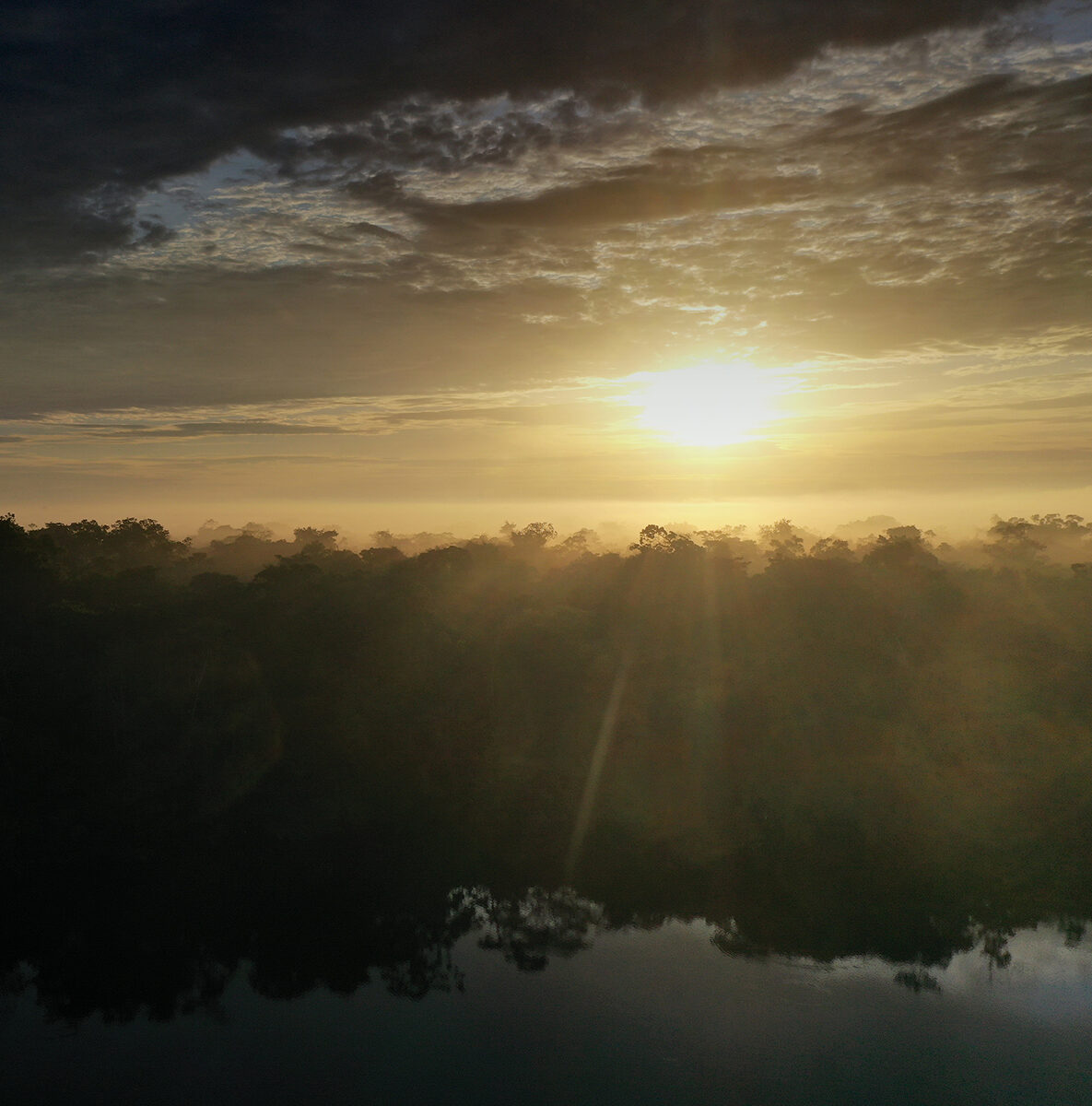
Banner image: Sunrise over the Amazon Rainforest. Image by Rhett A. Butler/Mongabay.
Notice: Transcripts are machine and human generated and lightly edited for accuracy. They may contain errors.
Christiana Figueres: We can now begin to relate to the fact that nature actually has a healing effect on us. That when we walk through the forest, that when we are in the ocean or even just watching the ocean, that there is awe, that there is admiration, that there’s reverence that is awoken in us. The fact that we can understand that nature is living, that it is a living being, that it is the collection of all living beings, and that we are a tiny little part of that. And that if we approach nature with that humility, we can actually be fed by life, written with a capital L, because life does create life.
Mike DiGirolamo: Welcome to the Mongabay Newscast. I’m your host, Mike DiGirolamo, bringing you weekly conversations with experts, authors, scientists, and activists working on the front lines of conservation, shining a light on some of the most pressing issues facing our planet, and holding people in power to account. This podcast is edited on Gadigal land. Today on the newscast, we speak with Christiana Figueres, the former executive secretary of the United Nations Framework Convention on Climate Change, perhaps best known for her work in leading the negotiating process for the Paris Climate Agreement. We also speak with astrophysicist Garik Israelian, who is the co-founder of the upcoming Starmus Festival, an international gathering of scientists, musicians, artists, and experts to celebrate science, space, and its intersection with the arts and communication. Figueres will appear at the eighth edition of the Starmus Festival to accept the inaugural Jane Goodall Earth Medal. She shares her thoughts on receiving this award and on Goodall’s legacy. Israelian explains why this medal was created in Goodall’s honor, how the Starmus Festival highlights the importance of nature, and what he hopes science communication can achieve. The two of them discuss the theme of the upcoming festival, the search for truth, in an age where the truth is becoming increasingly hard for the public to discern. We discuss the negative impacts of social media and the tech companies that own and run algorithms designed for engagement and profit rather than communicating factual or truthful information, and how we as a society can work to overcome this. We also touch upon artificial intelligence, both its positive and its negative impacts, and how they hope it can be used in the future
Cristiana Figueres and Garik Isralian, welcome to the Mongabay Newscast. It’s great to have you with us.
Christiana: Thank you for inviting me, and us maybe.
Garik Israelian: Thank you for inviting us. Thank you.
Mike: Cristiana, it’s great to have you back here. We had you on, on the show a while ago. So I’d like to direct my first question to you since you’re the one receiving the inaugural Jane Goodall Award. I just wanna say congratulations. As Jane was a longtime supporter of Mongabay and our audience is really familiar with her work, do you have any words to say about the significance of this award?
Christiana: first, the significance of Jane herself, right? honestly, what, what an icon, what an absolute giant that she was to her very last day. I just celebrated my 70th birthday, and I keep on thinking how all of those who have come before me have continued their leadership, such as Jane. Amazing leadership just to her very last day. And honestly, when you turn 70, you begin to wonder like, “Hmm, can I continue with this level of energy all the way to the end?” And the answer is, I have no idea. So, huge gratitude to Jane for the strength of her message, of her standing, her uncompromised standing about our relationship with nature to the very day. And the fact that a medal has been made in her honor, and that I will debut that is just an unbelievable honor.
Mike: And Garik, thank you for joining us. Can you explain why this medal was launched, and if you don’t mind, why you chose Figueres?
Garik: Yeah, definitely. as a festival, we have a long story. It’s going back to, mid-2003, ‘4, when the idea of creating science communication festival, which is using power of arts- Like music and films to bring science to society, right? So this idea comes from me and from Brian May, who’s a co-founder of Starmus Festival, and Brian is also an astrophysicist. He’s a scientist with a background and with papers published in astrophysics. So for a long time, we thought that the science communication needs new ways and new algorithms and new weapons to, to go to public, because it’s getting harder and harder for science to compete with world media and when the mainstream media, which is, there’s all sorts of stuff in, in social media and so on, and we are really having hard times to bring serious science to society. And we thought, okay, so we have to join forces with artists. So that was the idea. And so we created Starmus, but it was mostly space and, and very serious science, a festival, nothing really to do with preserving life on Earth. So our first mission was to bring serious science to society. But as we grow, as some of us, for instance, Brian was very active in protecting animals, and we had a foundation called Save Me. And another member of our advisory board, Peter Gabriel, was also very active in, in human rights, and also he knew Jane Goodall very well. So we were all the time talking about that our mission is perhaps beyond bringing science to society, but also it’s probably much larger. It– We have to do something more. And we were so lucky many years later, bring the Stephen Hawking medal to Jane Goodall So the idea came both from Brian and Peter Gabriel. So we nominated Jane Goodall for Lifetime Achievement Stephen Hawking Medal, and that was the second life of Starmus, basically. So it was a second life of the festival.
And with this, we invited Jane to join our advisory board, and we met Jane, and then she learned what are we doing, what is our mission, and she was very kind and, and accepted our invitation. So that became like a second phase of Starmus Festival. And she joined and, and we dedicated an entire festival to life on Earth. It was called Starmus Earth-that took place in Slovakia. It was in Slovakia, and an entire festival. Most of the festival was about climate change and biodiversity, oceans, and amazing, amazing festival. And we realized that from now on, we have two missions. One is actually preserving life on Earth, and we have to do this because of Jane and because we have grown already as a festival. So we have power, we have, we have amazing network, and we have incredible musicians on board. So we thought it’s the right time that we take the second challenge, and the challenge comes from Jane. And, and we keep going with, with the Stephen Hawking Medal. And, and, and, and while Jane was alive, I have been discussing already with my advisory board that we have to create Jane Goodall Medal And we had some private discussions with Brian and with Peter, with Tony Fadell, and they were all like, “This is amazing idea. Let, let’s do it.” And I started discussing this with Jane, in fact.
Mike: Hmm.
Garik: And she was very honored, and she said, “Yeah, if you want. And I’ll be honored and Star Wars because…” And then we were so close to doing this announcement with Jane herself, and in fact, we were a few months away. Oh.
Christiana: Wow.
Garik: And, and, and we were so convinced that she’s doing well. She was so well. she came to La Palma, to the Star Wars Festival in La Palma, and she was in a great shape. And- Yeah … and we agreed, and I spent two days. we– I was always going to her room, and with Mary, we were sitting a little, drinking some whiskey and, four hours and talking about many things. And I have to say, this was the most amazing period of my life I spent with Jane. I’ve never seen anyone, anyone… So it is so positive atmosphere, so peaceful atmosphere. You spend five minutes next to Jane, and you feel the life is about different things. It was so amazing. And so we decided that we are going to create the meta, but unfortunately, a few months later, so I received a call from Mary about this tragic, That of Jane. And, but, and then we said, “All right, but we have to carry on. We have to carry on with the medal submission that we agreed-“
Christiana: Caught us all by surprise, her, her- Yeah … sudden departure, all by surprise. Yeah. I think we all thought she would just be completely eternal.
Garik: Absolutely. Absolutely. Absolutely.
Mike: And in many ways, she’s, she is very much eternal, and her-
Christiana: Yes, absolutely
Mike: her legacy lives on. So Garik, can you explain why Christiana Figueres was the, the right choice for the inaugural version of this medal?
Garik: Yeah. I’ve been discussing with our advisory board, with Mick Bryan, Peter, and Mary Lou eaves who joined us, especially for selecting the best candidates for Jane Goodall Earth Medal. And we have a list of candidates, and the, and the first… W- when, when we learned Christiana’s biography, and we were really impressed and quite shocked. It was quite remarkably close to Jane Goodall’s, that someone can take a fight, and without stopping, and carry on, and just carry on, and just carry on. This was very much in the spirit of Jane. Honestly, this is, this is so close to Jane’s spirit. You don’t find many people like that. the… And, and there was no even question about whether we have to choose someone else. That’s… And we, we all decided that, that, that we have a, a, a case where someone can go against politicians, against big companies, against, and carry on the message that, that we have a serious challenge now, extremely serious challenge. And then, and, and honestly, we need more, more people like Christiana, much more. We need more people in, in many different fields, in biodiversity, in… Christiana is in climate, but we, we need in, in all maybe, and we need 100 Christianas and 1,000 Christiana Figueres. And a million Janes. A million Janes, absolutely. Christiana, we are so honored. And she’s coming and to be the keynote speaker. Yeah, yeah, yes. So thank you very much, Christiana, again.
Christiana: No, thank you, Garik. Thank you very- Thank you. I’m, I’m really quite, quite humbled. Thank you so much.
Mike: So this, this eighth edition of the Starmus Festival, it’s titled The Search for Truth. So can you elaborate on why this was chosen as the theme for this year?
Garik: Yes, absolutely. That’s, again, something we’ve been discussing last year because the truth itself became a, a, a debate. The, the US president’s channel is called the Truth Channel, but you can see what is happening in the Truth Channel. Yeah. So the truth itself is very simple scientific arguments which have been for 300, 400 years confirmed and so on, can be questioned today by not just the social media, not just by– but, but even some serious media will start questioning things, and this is very, very, very concerning. And about, you know very well with climate change what is happening is that, is that enormous organizations work against. And now we decided to bring experts in artificial intelligence, in philosophy, in physics, and in different branches of science, in psychology, and together to open a debate how we are going to fight, how we are going to join our forces against this negative, this, this negative ambient or atmosphere happening today that virtually anyone can come up, question something. And im- imagine, because the, the trouble I think is that the algorithms which in, in social media, they work with emotions. They- they, they don’t work with, with science. They don’t work with reality. They work with emotions. So-
Christiana: And, and usually negative emotions, Garik.
Garik: Negative, exactly. And negative emotions. Unless this is changed, unless this, this, this process… And we had a long conversation with Brian Eno about this. He was one of our keynote speakers and, and the winner of the Holt Med. And he wrote letters to, to Meta, to Google, to everywhere saying, “Please stop this. Change the algorithms. Change, change the way you, you do business because this is not, this is not good for society. This is not good for, for the new generation.” But this is how it is.
Mike: Yeah. You’ve both just hit on something that I wanted to bring up with you, which is that I had a political ecologist on the show, and he pretty much argued the same thing you’re arguing i- in, in so many words. And he said that we live in what, what is called a post-truth era, basically where our information is being gatekept by tech companies that don’t have an allegiance to the truth And th- the algorithms don’t really care about what’s factual, what’s not, but what rather generates the most engagement. So these could be like fabricated AI videos spreading misinformation. And so the remedy he was suggesting was, was regulating tech companies or perhaps getting rid of them entirely and, and replacing what we have today with, with basically publicly run social media platforms, almost like a utility. So Christiana, I’m actually really curious to, to get your thoughts on this because you’re, you, you have a lot of knowledge in, in, in terms of international policy, and I’m, I’m kinda cur- curious to hear from you, how do you feel we, we solve this problem?
Christiana: I think we all wish we had the magic wand there to solve this, but that we are swimming in both disinformation and misinformation all the time without even knowing it, Mike. that- that’s right, Garik. We, we sometimes we don’t even know that we’re in disinformation or misinformation, even those of us that try to stay on solid ground. And at, at an ethical level, I think this expansion of misinformation and disinformation is just such a, s- such an abuse of free speech to justify that distortion of the truth and of science as free speech. It just really goes beyond the boundary of ethical behavior. And so for me, it really is about the question, it’s not just regulation, it’s how does regulation come back to morality, to ethics, to, to, to truth ? And, and, and it, that doesn’t mean, interestingly enough, that science or scientists always agree with each other. There is a lot of, conversation and of different opinions among scientists about the very same research. So we’re not trying to say there can only be one view made public and disseminated about any, any issue. What we are trying to say is let us ensure that what is going out there and what is consumed actually does represent the facts, not the one opinion- but represents the facts. And, and, and that’s really, really difficult to regulate companies Manipulate positively their algorithms? Yes. And I go back to the, the, the one insertion I made there into, into Garik’s analysis that it, it is because there is such an, a thirst for negative emotions. And let’s remember something, Mike. Newspapers, most people don’t remember that newspapers existed sometime three centuries ago, but also the written press, the written material, newspapers also sold on bad news. So there is something about the way that we humans are programmed that attracts us to the bad news, to the negative emotions. You could say, yes, that is from an evolutionary perspective, that was a good thing 60,000 years ago, that we had to be aware of what the threats were going to be and be able to react. But that is no longer the case. And so the fact that we humans are still reacting and going toward more and more negative emotions, toward more fear, toward more hate, toward more attraction almost to the threats That is in part has to do with what can these companies then do to clean up their algorithm, but it also has to do with the evolution of human nature. It also has to do with that, and that it is time for us to make a conscious decision that we’re at that point in human evolution and planetary evolution that we need to be fed and we need to surround ourselves with different kind of information. We cannot continue to search for the tiger that is going to eat us up.
Garik: Can, can I just add something to what Christiana said? Obviously, it’s in human nature. It’s a part of our evolution, so we look for maybe for negative news and the impact and, and that’s… So tech companies take advantage of that. They, they intentionally power the algorithms, so they will look for scandals, they will look for negativity, and so on. And somehow this is connected to the truth and, and whether it can be scientific truth or whatever, so it directly can be, yeah, so emotions can dominate and even define the truth, the, the, the truth in brackets, which has nothing to do with reality, with the real truth, right? So this is… But I believe one of the ways to, to go against this is education. Definitely. It’s much, much, much more h- harder. It’s much harder to lead very educated, very knowledgeable people to this route of using misinformation, emotional brain storms and so on to, to, e- to disinformation and to, to inform them people completely wrong things. I- you can imagine it’s gonna be much harder to convince me that the Earth is flat Than to any other one because I have a knowledge, so I can prove that, and I, I, I not believe in those things because of the knowledge. So recently was a interview with me about flat Earthers, and, and I told them that it- the flat Earthers is not a tr- problem for astronomy, but for psychologists. It’s not us who have to solve why there are still hun- hundreds of thousand people who believe that Earth is flat. It’s a problem for, for, for social media, for psychologists, and, maybe education will be one of the answers, but also limiting the power of tech companies, those who do social media, to limit the algorithms or to control those algorithms, that they should be under control. That’s, as, as Christiana was saying. Yeah.
Christiana: The, the thing, Eric, that I think is so difficult, where I think that we have, the, the crux of the matter, is that it is, it is clear that these companies are being motivated by sales and use of their algorithms more than by anything else. And so if you follow that up the value chain, yes, we complain about how the algorithms are behaving, but if you follow that up the value chain, why do they program these algorithms like this? They program them because they’re motivated by trying to maximize use and sales of the algorithm. And why is that? Because of what we were saying before, that we as humans tend to crave those bits of bad news, the drama, the accident that happened, the, the, the, the killing. And so ultimately, it’s about our consumption patterns, what we choose to consume. And I’m not talking about material consumption. I’m talking about information consumption. The fact that we choose to consume More misinformation and disinformation than science-based, truth-based information is to me the root of the problem of why these companies do what they do with algorithms. So I am not exempting them from responsibility. I’m just trying to follow it up and understand why are they doing this?
Garik: For profits, I think that is a- Profit … very direct relationship between… So- Yeah … more followers, more emotions, more clicks, more content, more profits.
Christiana: Yep.
Garik: It’s probably as simple as this. It’s just the profit. It is very simple. It’s a business. For them, it’s a business. For humanity, it’s a serious problem.
Mike: There was a brief pause in the conversation here to double check our internet connection, and the first portion where I address Christiana for the next question was cut off from the audio. So I, I understand that you’re on a Lancet Commission to examine the health impacts of sea level rise and e- examining legal frameworks to potentially hold countries accountable for these health impacts. Big question, but is there anything you can tell us about this commission a- and the work that you’re doing on it right now?
Christiana: Yeah, you actually mentioned two things that for me come together. One is this effort of the brilliant commissioners that are on, on this collective effort to do the research on three factors that are coming together. One is sea level rise, one of the slow onset effects of climate change, but may be called slow onset, but is already a reality for many Pacific Islanders. The second is, of course, to understand that this is being produced by climate. And the third is to understand the health impacts of this. What are already the health impacts that are being felt by saltwater intrusion into agricultural lands, by water intrusion into, for example, hospitals? You have to understand these Pacific Islanders are… One could think that they are separated by the waters because the islands are separated by water, but they’re actually joined by water. And the way that they transport themselves from point A by, to point B is on the water. And so it is not surprising that many of their social need infrastructure bu- buildings are on the water, hospitals, for example. So when you have a situation in which the critical hospitals that represent Health capacity for these islanders when those hospitals are on the water, and the water is rising, and the hospitals can no longer function. That’s a serious not only health issue, it’s a serious human rights issue. So I am thrilled that we’re beginning to bring all of these strands together because we had not done so before. And as you also mentioned, this comes at the time in which the ICJ, the International Court of Justice, which is the highest court of the world, has already come out with their advisory opinion that states have the responsibility to protect their people from the consequences of climate change, such as high-level waters and the consequences of that on human rights and on health. And both of these initiatives are actually being put forward by Pacific Islanders. So let’s remember that Pacific Islanders are, among all nations, they are very likely the most affected by climate change and the least responsible. Talk about justice. The least responsible, the ones that have to be adapting to this already, the ones that are most impacted, and in most cases, the ones that have least resources to deal with it.
Mike: Christiana, I’m also curious to hear your thoughts on what you think of the, the first conference on the phaseout of fossil fuels that was conducted, which formed the Santa Marta Coalition. It certainly seems like this conference, built a lot of consensus and cooperation from many nations wanting to phase out fossil fuels. So what are your thoughts on the Santa Marta Coalition?
Christiana: Yes, I think that was a very helpful gathering of certainly of nations, but also of many other different stakeholders who are pushing forward on the agenda of the f- hopefully fast diminishing reliance on, on fossil fuels. And it builds on many other initiatives that have been started in the past, but hopefully it is bringing all of those other coalitions and the other alliances together in joint efforts to diminish our reliance on fossil fuels. What is, of course, going to be a, a critical transformation is when there are, and there will be some countries who are themselves fossil fuel exporters, such as Colombia, who are joining these alliances, and they understand that the export of fossil fuels, that the date for that is actually coming, coming to an end. And so I would really love to, to highlight the role of Colombia in this. Of course, all of the other non-exporting countries and the one– are the ones that feel the effects first, and for them, their, their skin is in the game, but only from the vulnerability and adaptation perspective. It’s more and more interesting over time to see that the countries that have a different skin in the game, countries that depend on the export of fossil fuels, that they begin to understand that they need also to change their economic reliance on, on that.
Mike: Hello, listeners, and thank you for tuning in. As I always like to mention to you, Mongabay is a nonprofit news organization, and while the Mongabay Newscast is our flagship newscast, we rely on funding from listeners like you to keep it going. So if you’d like to support the podcast, go to patreon.com/mongabay to become a monthly sponsor of this show. I encourage you to also listen to our previous conversations with Christiana Figueres with former co-host Rachel Donald, and also check out my conversation with political ecologist Bram Buscher, who discusses many of the themes that we touched upon in this episode. Both will be linked in the show notes. If you’d like to learn more about the Starmus Festival, that too will be linked.
Mike: This is a question for both of you, and maybe I, and maybe I’m wrong, but this came up in conversation when I talked with Neha Sinha at WWF India. And it, and it certainly feels like humanity is starting to wake up to the preciousness of nature and at least hold some healthy skepticism towards, towards technology such as artificial intelligence. And I know of almost no one personally that isn’t highly skeptical of AI. So I, I wanted to ask both of you, do you feel like there is some sort of momentum building in the public that environmentally speaking, something has to change, that we have to turn this ship around? Are you seeing hints of that in and around the places that you frequent?
Garik: Yeah, I think I do see that change, and I see this, and I see more and more people trying to, to, to control their life, to organize their life in a way that they will not have much waste and they will control energy consumption. They try to go for electric cars, and they organize their… I see that, and I see this during the last 10 years During last 10, 15 years. So the public awareness of organizing our life and looking after planet is, is more, probably much more than 10 or 15 years ago. And whether the AI can help in this, I think it’s, I hope it will. Because basically with AI, the question comes, can machine discover the truth? And it’s a very interesting question. AI intelligence and misinformation, whether we can trust systems whose reasoning we don’t fully understand. It’s a very interesting question. As for today, I did some tests with AI programs with ChatGPT. You can’t really convince them that the laws of Newton or Maxwell are wrong. That’s absolutely impossible. Doesn’t matter how you can build your algorithms, they are so well-informed about complete logics of science, and it’s so rigid, so you can’t convince AI that the laws of physics are wrong. This is a good sign.
Christiana: That’s a good sign.
Garik: And, it’s a, it’s a very good sign. I like that. And I like that. And but why humans believe in false things, how bias and, distort our understanding of reality, and whether reason and evidence can overcome them. That’s again, that’s such a, such a interesting question, and I hope we will discuss them at, at the festival.
Christiana: let me, let, let me come in here in support of, what Kerik has said, and also take the other side of your question, which is, do, do we see that there is an awakening of the need for us to recognize our relationship with nature? To that, I would say, radically, yes I, I think it’s pretty clear that the extraction mentality that has led to the fossil fuel industry, that has led to the Industrial Revolution, that has led to climate change, to biodiversity collapse, et cetera, et cetera, all of that is because of the extraction mentality that w- with which we have been operating and relating to nature. And that extraction mentality is possible because at some point, we humans, in our evolution, decided that we were not a part of nature, but that we were actually superior to nature, and that that gave us the right to extract, use, and discard all of nature, whether that is minerals, metals, whether that is fossil fuels that are none other than organic matter, animals, plants that lived on the face of this Earth millions of years ago. And that disassociation from nature is at the root of our extraction mentality. Probably started with the agricultural revolution, because we then decided that we can put a little fence around an area and claim ownership over that, claim ownership over the animals that are in there, over the plants that are in there, over human beings that are within that, that sphere of, of ownership. That is the root cause. Our disassociation from nature is the root cause of all of this. So it then follows, do we then, looking at that root cause, have we then identified the way that we can go to the bottom of our abusive behavior with nature? By understanding, re-understanding, because we did before, but by rediscovering, re-understanding that we are a part of nature, not apart from. The fact that we are one species The fact that, yes, we may think of ourselves as the most intelligent species. Really? we’re causing here major suicide at, at a species level, so perhaps not so smart. The fact that we can now begin to, A, appreciate the intelligence of other animals, in part through AI, one of the good uses of AI. The fact that we, that we can now begin to relate to the fact that nature actually has a healing effect on us, that when we walk through the forest, that when we are in the ocean or even just watching the ocean, that there is awe, that there is admiration, that there’s reverence that is awoken in us. The fact that we can understand that nature is living, that it is a living being, that it is the collection of all living beings, and that we are a tiny little part of that, and that if we approach nature with that humility, we can actually be fed by life, written with a capital L, because life does create life. And we have migrated away from that. We have migrated to a mentality that our little life is based on destroying other lives.
Garik: Yeah. Yeah.
Christiana: It doesn’t- Yeah … take much to understand that that is the root of war also. So there is a fundamental shift, and I am always impressed by how many more people, increasing number of people, especially young people, Mike, especially in your generation. Sorry, Garik, I’m putting our generation outside of this. But in your generation, how many young people are waking up to this and to understanding that we are an intricate and dependent part of nature, and that in as much as we can heal-
Garik: Absolutely …
Christiana: our relationship with nature, we will actually be able to create a new world that is not dependent on our supposed superiority to nature
Garik: many think people, many people blame technology and science of bringing us to this crisis, to situation. But this is not true, because we know that today’s satellite technologies help a lot, help a lot for conser- conse- conservation of, of biodiversity of animals and so on, with only satellite technologies do so much for a compare for… And the same thing, probably AI is coming for good, because if we find ourselves in such a deep crisis, maybe we need an amazingly powerful tool to come and organize and solve so many technological challenges that we are facing today, and we can’t solve it ourselves. So we can also look at things with this angle that AI will be the tool. AI will be that tool that’s going to help humanity to solve those problems
Mike: I suppose the, the concern that people have around AI, which I tend to agree with, is the, the massive amount of resources that data centers use in terms of water consumption and power consumption. And so I guess maybe that feeds into the sort of the extraction mindset that you’ve both highlighted, which is that if we’re using this tool under that extraction mindset for profit or for a corporate profit primarily, then it, it looks like it could run amok, it could run afoul. So do you have any thoughts to add to that?
Garik: Yes. I think that-
Christiana: Yes, me too, but Garik, you first.
Garik: Yes.
Christiana: Yes.
Garik: Yes. If, if, if we– AI is also there to solve contradictions. If on one hand you are creating these plants, and those plants create problem for ecology, problem for water, et cetera, and you, on the other hand, you have AI also to solve those problems. So if you allow both problems to be solved, this is a very interesting situation actually. You, you don’t build AI only to solve problems that you want to solve, but you create AI for the global. Otherwise, you are stuck. There’s nothing you can do. we, we need this generative AI not only for solving very specific things, but it’s for the global, for humanity. And in that case, we will have a system which will be self-consistent, so all internal contradictions will be a part of a formula. Everything will be in a formula. In that case, problems that we humans cannot solve, hopefully AI will be able to solve them. So this is my positive hope about the fu- future of AI. So maybe it’s not as bad as media and many people present that, the skeptical view about AI. who knows? Maybe it’s coming to help us. It’s coming to solve problems. Just like you cannot cheat AI against physics or maths, it’s just impossible. You cannot do that. it’s so consistent in logics, in, in experiments and everything. So maybe the same situation will happen globally about ecology, about biodiversity, about protecting life, energy resources. So let AI to get into all these and maybe end up with corruption End up with lots of misorganization, with bureaucracy, with so many bad things, a waste of energy. How are we gonna solve all these things? We were not able to solve them during the last 30, 40 years, and they get worse. So maybe, maybe AI is there, is coming to help with those things.
Christiana: Oh, I love that. I totally love that, that thought and, and the scenario and possibilities that it opens. And to that, I would, I would just add that we should be aware of the fact that we are trained to automatically think that more use of electricity is bad, that it is polluting, that it is gonna cause more and more climate change. That is only true if the electricity is fossil fuel-based. It is not true if the electricity is renewable energy based, and we know that the sun, just to use one of the renewable energies, but solar energy, is limitless. So if that… Let’s just go to a world in which we have, what, 95, 98% renewable energy. then the use of energy is not a problem. It is only a problem if the energy is fossil fuel-based, and we know that we have to move toward a world of renewable energy anyway. So that should not be a limiting factor of the use of AI, if AI is used for good, as Garik has said. Yeah.
Garik: Exactly.
Christiana: On the, on the water issue, what is really interesting is that, and Garik, please correct me if I’m wrong, because I’m not a scientist, but the quantity of water on the planet is a permanent quantity. We do not have more or less water. We do have more and more emissions that are concentrating in the atmosphere, but that is not, that accumulation is not a factor for water. What we have is a change in distribution and a change in physical form of water, that it goes from liquid to vapor to snow to ice and that, that, so that shift in physical form is occurring all the time, and also in geographic distribution because some areas are getting more water, some are getting less water. But if you think about the planetary resource of water, it is a constant. And so if we can actually, or even with AI, as Garik is proposing, figure out how do we- incorporate the use of water in a circular fashion for those data centers. Because it is not that they consume and then the water doesn’t exist anymore. No. Of course, the water is used for, for cooling purposes, but then it goes out. So how, how can we actually plan from a full circle of life the use of water for these data centers such that ultimately we’re not affecting the use of water that was there before the, the construction of the data centers? So as, as Garik says, we can use AI to solve the very issues that we’re concerned about. Furthermore, I would like to highlight a, a particular initiative that I happen to be on the board of, which is the Earth Species Project, which is using AI to understand animal communication and s- to understand how they communicate with each other intraspecies, but also interspecies, between species. Can you imagine a world in which we are aware of the communication that is happening around us, both flora and fauna? We would be so much wiser species and so much more coherent with the other species that are around us, so that, to get back to my supremacy point, so that we would be able to give up our supremacy impression and act in consonance and in harmony with the other species that we have.
Mike: Well, Christiana and, and Garik, you’ve both been very generous of your time. We’re getting to the end here. So is there any, final words you have about Starmus Festival that you would like to share with our audience, information about where they can learn more about it?
Garik: about Starmus, we, we’ve just confirmed seven astronauts from Artemis II mission that will join Starmus. And, we, we also want to touch the issue about colonization of space because that’s a very sensitive topic. Is it make sense to go and build cities on Mars, and why we are going to the moon if we are polluting our own planet? But I think the, the, the point here is not really that we are going to Mars, et cetera, but the technologies, all technologies that we build for those future cities, if they will ever happen, they will be used here on Earth. So that’s a very important thing. Now, imagine if we can build technologies to survive on Mars, labs, cities, and water circles and everything. And if something happens on Earth, we’re gonna use those technologies and this knowledge, first of all, on our own planet. And so this is something that is one of the key topics that we will be discussing at the festival, that space is not a waste of money, but is a knowledge that returns back to Earth and is used on Earth.
Christiana: I’m, I’m very much looking forward to, to coming. This will be my first Starmus, and I, I am certain just from the reading that I’ve done and from, especially from this conversation with you, Garik, that this is going to be just mental explosion to- Yeah … to be able to delve into so many topics so deeply and, and from such an openness of heart perspective.
Garik: Thank you. Yes, yes. We are very much looking forward to see you, Christiana, and to join our panel discussions with, with, with artists and astronauts and, and scientists. We, we, we truly believe that we should educate those influencers and celebrities in arts about respecting science and following science because they have a huge influence. They have millions of followers, and we think that we have to integrate them into this process of education and science, and we will benefit a lot, a lot if we involve arts community.
Mike: Christiana Figueres and Garik Israelian, thank you both for joining me today, and I wish you the best of the festival.
Christiana: Thank you very much, Mike, and lovely to see you, Garik.
Garik: Thank you very much, Christiana. Thank you very much, Mike. Thank you. See you in Starmus.
Mike: As always, if you’re enjoying the Mongabay Newscast or any of our podcast content and you want to help us out, we encourage you to spread the word about the work that we’re doing by telling a friend and leaving a review. Word of mouth is one of the best ways you can help us, but you can also support us by becoming a monthly sponsor at our Patreon page at patreon.com/mongabay. As I mentioned earlier, Mongabay is a nonprofit news outlet, so even when you pledge a dollar per month, it makes a very big difference. It helps us offset production costs and hosting fees. So if you’re a fan of our audio reports from Nature’s Frontline, go to patreon.com/mongabay to learn more and support the Mongabay Newscast. I also encourage you to read our news and inspiration from Nature’s Frontline at mongabay.com and follow us on social media. You can find Mongabay on LinkedIn at Mongabay News and on Instagram, Threads, BlueSky, Mastodon, Facebook, and TikTok, where our handle is at mongabay or on YouTube at mongabaytv.
Thank you as always for listening
