


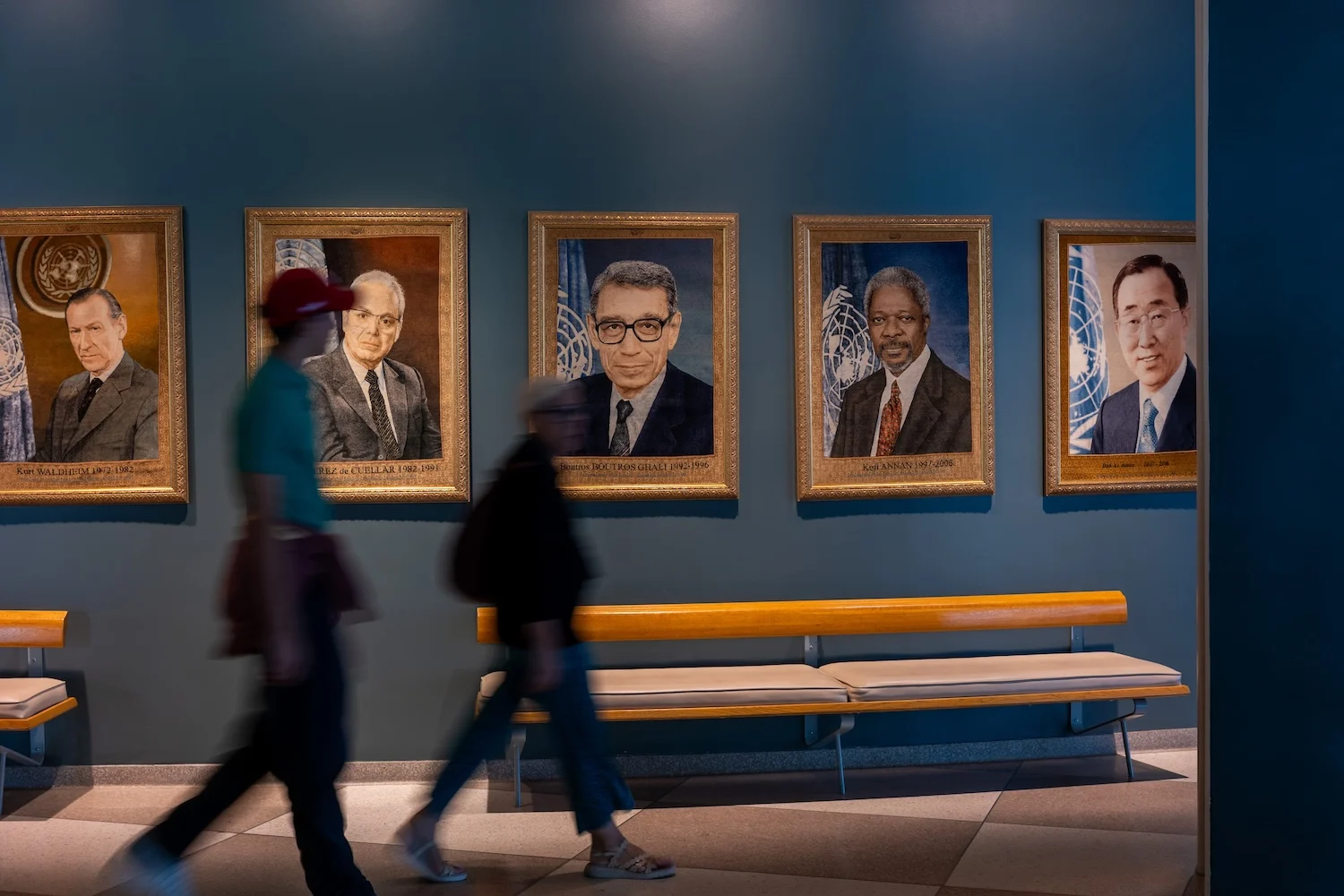
For a world mired in conflict and desperate for an unbiased interlocutor, the election of the next United Nations secretary-general couldn’t have come at a better time. The U.N.’s top boss is expected to be the peacemaker-in-chief, at least in theory, and perhaps more importantly, the guardian of a collective moral compass, regardless of national affiliations. Are any of the eight candidates up to the task?
As the race heats up, a former U.N. diplomat, who spoke with Foreign Policy on condition of anonymity, quipped that the key question is whether the P5—the permanent five Security Council members, which each hold a veto—want a secretary or a general.
A general might take a hands-on approach to the various conflicts engulfing the world and try to revive an institution struggling to remain relevant as regional actors offer mediation services while the U.N. itself is bogged down by its own bureaucracy and undermined by the United States, its biggest sponsor.
But the powerful countries that have the most say in the ultimate decision seem to prefer a secretary—someone who can manage the clashing interests of global powers without grabbing attention.
The sitting U.N. chief, António Guterres, has had a tough ride under U.S. President Donald Trump, who has made no secret of his contempt for everything that the United Nations stands for: respect for due process, human rights, international law, and equal status for all in the family of nations. Guterres’s successor can expect to navigate a minefield, as the United States openly links its funding to further national interests as Trump sees fit.
However, Trump’s lack of faith and transactional approach won’t be the only problem.
China is the second-biggest contributor, rising from contributing 1 percent of the costs in 2000 to 20 percent this year—comparable to the United States’ 22 percent. China is also assessed to contribute more than 23 percent of the budget that goes toward the organization’s peacekeeping forces, a little under the United States’ 26 percent.
Insiders say that Beijing is clamoring for a bigger say. Meanwhile, Russia intends to continue exploiting its position on the U.N. Security Council (UNSC) to gain leverage in other theaters. The United Kingdom and France also hold a veto, but their geopolitical weight is less of a factor and isn’t expected to sway the election.
The selection process has begun, with two rounds of straw or informal votes having already been held by the 15 members of the Security Council—a process undertaken to determine whether any of the five permanent members appears likely to block a candidate.
Based on those straw-poll votes, and also the geographic turn-taking that the United Nations often adheres to, most believe the next leader will be from Latin America. Specifically, the race is largely believed to be between four Latin Americans, three of whom are women.
Former Costa Rican Vice President Rebeca Grynspan is among the top candidates. She was the front-runner in the first straw poll conducted by the UNSC, which includes 10 temporary members in addition to the five permanent ones. The poll is split into three categories: encourage, discourage, and no opinion, and nine “encourage” votes—as well as no vetoes from the permanent members—are needed to win. Ten nations “encouraged” Grynspan’s nomination in the first round, while only one expressed apprehension.
If she is the final choice, she would be the first woman and the first Jew to hold the top U.N. position at a time when Israel’s relationship with the organization has hit rock bottom.
Trump shares Israel’s mistrust of some of the U.N.’s bodies that are active in the Middle East, such as the U.N. Relief and Works Agency which is mandated to look after Palestinian refugees displaced from their homes as a result of the 1948 Arab-Israeli War, and the U.N. Interim Force in Lebanon (UNIFIL), the peacekeepers in Lebanon. The United States’ refusal to renew UNIFIL’s mandate has killed the organization; its mandate expires at the end of the year.
There is no established link between Grynspan and the Israeli establishment and no insinuation she would take a sympathetic view of Israeli policy. Instead, she has been critical both of Hamas and the “continued bombardment of the IDF hitting civilians, hospitals, shelters, schools and UN facilities in Gaza.”
Israel’s view of Grynspan remains unclear, but she might have earned American ire when she warned against the negative impacts of U.S. tariffs on developing countries while serving as the head of the U.N. Conference on Trade and Development (UNCTAD).
Grynspan worked closely with China on development projects as UNCTAD chief . She is among four of the eight candidates who visited Beijing in recent months to discuss her plans for the U.N. and, according to the Chinese mission to the organization, expressed her commitment to “the one-China principle”—a veiled reference to support for China’s position on Taiwan.
Russia may decide based on its experience working with her on the Black Sea grain deal, which temporarily allowed for continued export of grain following outbreak of the Russia-Ukraine war. In the second round of polling, however, Grynspan fell down a few notches in the estimation of the Security Council—to seven “encourage” votes while four discouraged her candidacy.
Argentina’s Rafael Grossi, the head of the U.N. nuclear watchdog, the International Atomic Energy Agency, is a more well-known name in the contest. Grossi is perhaps the United States’ most-favored candidate owing to his experience with the Iran file, according to the former U.N. diplomat who spoke to Foreign Policy. Any resolution to the crisis with Iran and its nuclear program will almost certainly involve U.N. inspections, and Grossi could offer valuable expertise.
“If there is anything that sets me apart from the other candidates, it is that I am addressing very sensitive and delicate issues with all of them today, right now. What is happening in Iran, in Syria, in Ukraine,” Grossi said, referencing collaboration with the P5. “So, I believe that this working methodology that I have managed to establish with all of them allows me to think that it can be replicated at the United Nations, but with great prudence.”
However, Russia has already expressed its objection. In his current role, Grossi is also keeping an eye on the Russian-occupied Zaporizhzhia nuclear plant in Ukraine and has apparently irked Moscow. In August, the Russian government criticized him for canceling a trip to the plant over security concerns, implying a lapse in Russian security arrangements at the key installation, and blamed Ukraine instead for refusing to assure his security.
Russian Foreign Ministry spokesperson Maria Zakharova also criticized Grossi’s handling of the Russia-Ukraine war and dismissed his description of the U.N. “dying slowly” as a bid to earn “extra points” ahead of the elections. China may not back Grossi either, either on behalf of Iran or to appease Russia, Beijing’s “no-limits” partner. Rumor has it that even the U.K. is ill-disposed toward Grossi owing to the ongoing sovereignty dispute with Argentina over the Falkland Islands, or Las Malvinas.
Grossi has maintained seven votes in favor in both polls, but his “discourage” votes have risen from two to six. And he is not the only one who appears to be backed by the United States while still failing to make the cut.
Ecuadorian diplomat Ivonne A-Baki threw her hat in the ring after the first round of voting, following a meeting with the U.S. president. If that meeting was meant to suggest that she had U.S. blessings, it didn’t work. Her performance in the second and the only poll that she contested was dismal—not a single UNSC member voted in favor. Some experts said that was a sign that ties with Trump alone can’t boost numbers.
“Traditionally, candidates who come in at later stages do not do well in the voting. The Security Council needs some time to get familiar with the candidates,” said the former U.N. diplomat.
Then there are candidates who are likely opposed by both the United States and China.
Michelle Bachelet, Chile’s first woman president, fell sharply from the first to the second vote—from six votes in favor in July to two in August. Bachelet might get a Russian nod but may find it hard to secure U.S. approval; she is a socialist and a former U.N. human rights chief.
The force blocking Bachelet might, however, be China. In 2022, under her charge, the U.N. human rights office released a damning report about alleged abuses of the Uyghur community in Xinjiang, alleging torture, sexual abuse, and possible crimes against humanity.
“China will never forget that,” said the former U.N. diplomat. At the time, China reportedly even tried to bury the report.
That leaves two African candidates and two more Latin Americans.
Uganda’s Olara Otunnu and former Senegalese President Macky Sall, who is also a former chair of the African Union, are in the running but hold precarious middle positions in the polls. Sall maintained his tally in both votes, but with nearly half the UNSC—seven out of 15—discouraging him.
“At this stage, discourages are more important. If you have seven discouraging votes, that means the chance[s] of a veto-holding power having an objection are high,” said Syed Akbaruddin, a former Indian U.N. ambassador.
Former Guyanese Foreign Minister Carolyn Rodrigues-Birkett and former Ecuadorian Foreign Minister María Fernanda Espinosa are both top contenders in addition to Grynspan. The Guyanese candidate led the second poll. Espinosa, despite securing fewer “encourage” votes, was also tied for the least-discouraged candidate in that round—on par with Rodrigues-Birkett.
In the U.N.’s 80-year history, there has never been a woman in the top job, and only once has a Latin American held the role. A Latin American U.N. chief might prove to be useful for Trump, especially since the Washington’s latest National Security Strategy document emphasizes the Western Hemisphere.
The competition appears to be between the Latin Americans. However, there is no consensus candidate so far, and more could enter the fray even in the final months. According to the New York Post, Trump himself has backed Gianni Infantino, the head of world soccer federation FIFA, while some reporting suggests that the United States was considering Nickolay Mladenov, the head of Trump’s Board of Peace for Gaza.
There is some concern that Trump may field a real estate agent or a family member, but fears of the United States walking out of the U.N. and threatening its survival are exaggerated, Akbaruddin said. “Even in the past, the U.S. has called for budgetary discipline; I remember the Reagan era,” he said. “And fears that any of the P5, who gain the most from the UNSC, will want to kill the organization are inflated.”
The United States needs the U.N. to do the “dirty jobs,” said the former U.N. diplomat who spoke on the condition of anonymity. “If you don’t want to send American boots to resolve a problem but want to impose your solution, who do you ask? The U.N. put together a Haiti gang-suppression force; the U.N. sends peacekeepers; and the U.N. approved Trump’s Board for Peace for Gaza. The U.S. then pays 25 percent of the costs, not the total, because the rest is borne by others.”
The United Nations needs the United States, but the United States also needs the legitimacy and heft of the only universal organization—or the “parliament of nations,” as it is often called. The next secretary-general, like all others before, will have to navigate the clashing interests of global powers, particularly the P5 countries. But the U.N. still has a role in dealmaking and peacemaking and doesn’t have to relegate that job to the G-20, G-7, or G-2; instead, it should build cooperative frameworks with regional mediators.
Despite its many flaws, the United Nations is still perceived as the most impartial institution, and that is its biggest asset. A U.N. secretary-general still has credibility that few global leaders can boast of.
The biggest challenge for the new boss will be to find a way to be both a secretary and a general.
