


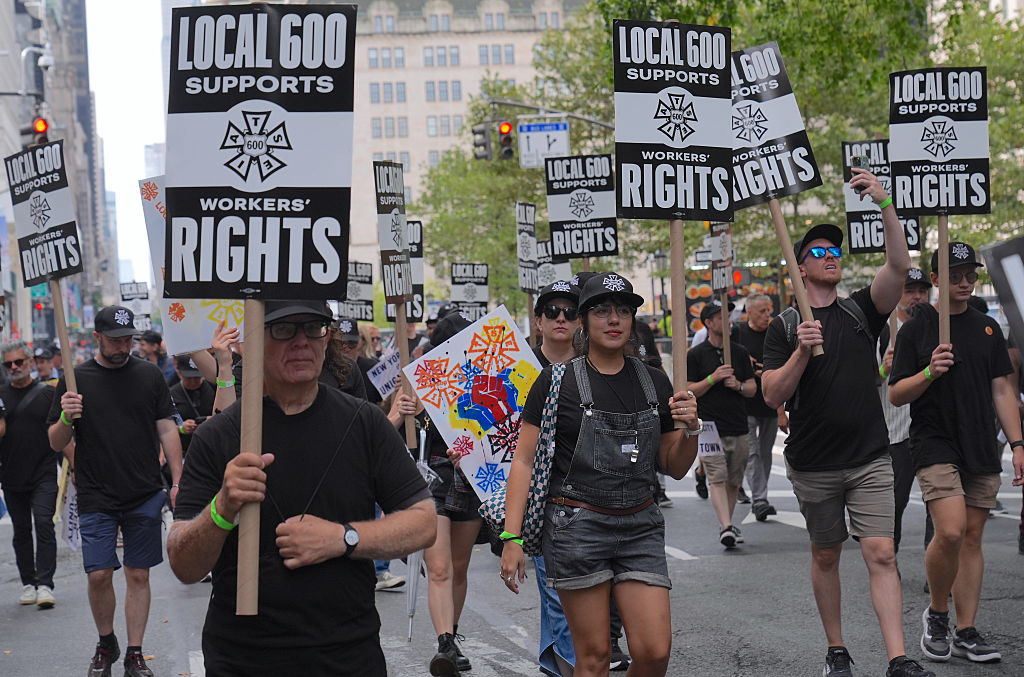
Members of more than 200 unions and other organizations marched the 2025 New York City Labor Day parade. (Selcuk Acar/Anadol/Getty Images)
Americans will mark Labor Day on Sept. 7. But organized labor’s political impact is felt every day in Washington.
OpenSecrets data shows that organized labor set a record for lobbying expenditures last year – spending $58 million trying to influence the federal government – after doling out $288 million in election-related spending in 2023-24.
“It’s expensive to play in American politics right now, and if you want to be at that table, you’re going to have to put out resources and more resources than ever,” said Christopher Borick, a political science professor at Lehigh University. “Organized labor is not immune to that reality. If you want to keep your place at the table, which they do, that means raising historic amounts of money.”
For decades, most of unions’ political support has gone to Democratic candidates and committees. In 2024, 87% of campaign spending benefitted Democrats, down slightly from 88% in the two previous cycles.
“They remain a crucial player in Democratic politics,” Borick said. “People have often questioned if, over time, that role has waned, and certainly we’ve seen shifts in union workers’ connection to the Democratic Party, but in terms of the actual organized labor entities, they are an absolute central aspect of Democratic politics.”
Such support also helps the party make its case to the working class.
“The union spending is incredibly helpful to Democrats, because it has a twofold effect,” said J.J. Balaban, a Democratic consultant in Pennsylvania. “One of the most competitive and fluid sectors of the electorate are working-class voters. Having support from unions is a validation of having working-class support.”
In addition, union money flowing to Democrats provides a little balance to the financial support Republicans receive from corporations and billionaires, Balaban said.
Unions are also benefitting from a growth in support. In last year’s Gallup poll taken before Labor Day, 68% of U.S. adults approved of unions. That’s the fifth straight year that at least two-thirds of Americans backed unions, after the share dipped to 48% in August 2009 and didn’t climb up to 65% until July 2020.
But Republicans have made some inroads into organized labor. Donald Trump won 45% of the votes of union households in 2024, according to network exit polls reported by CNN. President George W. Bush received 40% in 2004.
“In terms of voting patterns, clearly you’ve seen some erosion, particularly in relation to presidential elections,” Balaban said. “But unions are far from monolithic, so you have a long tradition of unions being supportive of Republicans on Long Island. Unions are much more disproportionately voting left on the West Coast.”
The Teamsters Union in 2024 did not endorse Democratic presidential nominee Kamala Harris even after President Joe Biden and congressional Democrats – over unanimous Republican opposition – provided more than $1 billion to fund pension plans for the Teamsters and other unions that had cut benefits or faced insolvency.
“Trump’s appeal to working-class voters, particularly white, working-class voters, really eroded the stranglehold that Democrats had for quite some time on that group,” Borick said. “Certainly during the Trump years and his populist appeals, rank-and-file union voters have not been as much of a guarantee for Democratic candidates as they once were. They realize this remains an essential part of their coalition, and they have to do more than ever, I think, to make sure that relationship is tight.”
Adding to the cost of playing politics is organized labor’s need to reach out to Republicans who are inclined to support the bloc’s positions, Borick said.
“That’s going to take resources, and all the campaigns are more expensive than ever so if you’re going to jump in and be engaged in that realm, the price tag has gone up,” he said.
Another trend: In recent years, labor money has migrated to super PACs, which received $213 million in the 2024 election cycle – nearly three-quarters of the sector’s political contributions. Four years earlier, a little more than two-thirds went to super PACs.
“Over time, as court cases have freed up avenues for campaign finance, labor unions, like corporations, have expanded their efforts through the different channels they could operate in,” Borick said. “They have more ways perhaps than ever to engage in soft money contributions.”
Jonathan D. Salant has covered money and politics out of Washington for almost 40 years. He is a former president of the National Press Club and a member of the Society of Professional Journalists D.C. chapter’s Journalism Hall of Fame.
