


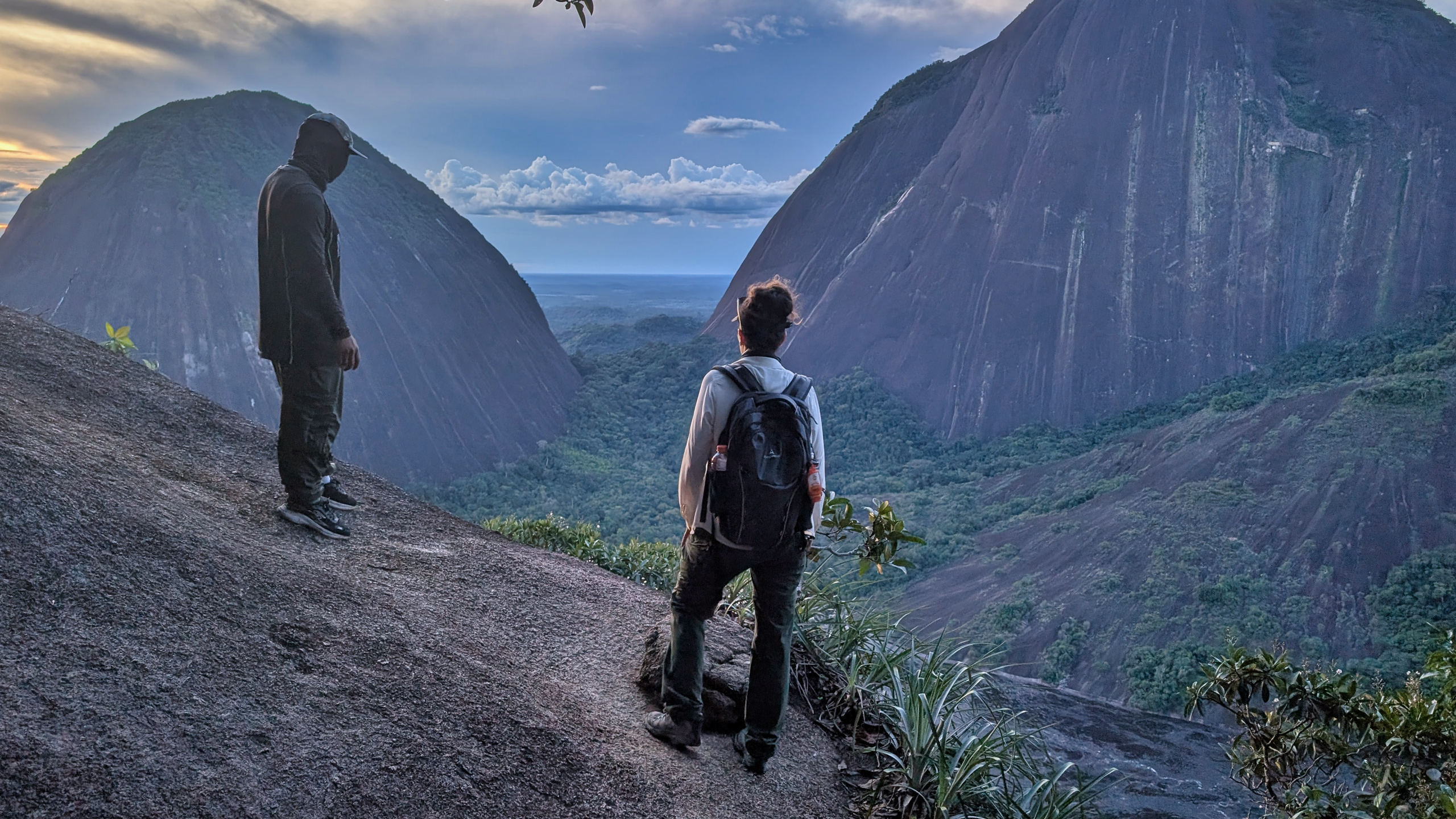
- Daniela Quintero is a Colombian journalist and sociologist who develops and edits cross-border investigations as investigations editor at Mongabay Latam.
- Her work combines field reporting with official records, environmental databases, satellite imagery, scientific literature, and legal documents.
- Quintero has reported on glass-eel fishing in the Dominican Republic and the smuggling and laundering of illegally mined Amazonian gold through Venezuela.
- Quintero spoke with Mongabay founder and CEO Rhett Ayers Butler in the Colombian Amazon in July 2026 about her career, investigative methods, and interest in environmental journalism.
High gold prices have fueled illegal mining across the Amazon. As Brazil tightened controls on the trade, criminal groups found another route through Venezuela, where it could be laundered and then exported overseas, according to a Mongabay investigation published last year.
Documenting the trade required journalists in three countries to work together—an approach Daniela Quintero considers essential because environmental crimes rarely respect national borders.
As investigations editor at Mongabay Latam, Bogotá-based Quintero develops projects that combine field reporting with official records, satellite imagery, scientific papers, and legal documents. She also coordinates Mongabay’s Nature Crimes Fellowship, working with journalists from Colombia, Ecuador, and Peru on investigations in the Amazon and the Pacific.
Quintero previously covered environmental issues and worked in the investigative unit at El Espectador before joining Mongabay in early 2025. Her reporting has ranged from glass-eel fisheries in the Dominican Republic to the gold smuggling story.
Ahead of Mongabay Latam’s PUMA FEST in July, I traveled with Quintero to Colombia’s Guainía department, where I interviewed her about her work and her path into environmental journalism.

An interview with Daniela Quintero
Mongabay: Can you introduce yourself?
Daniela Quintero: I’m a Colombian journalist and sociologist based in Bogotá. I’m an investigations editor at Mongabay Latam, where I develop and edit cross-border investigations into nature crimes and environmental issues across Latin America.
Mongabay: What does a normal day at Mongabay look like for you?
Daniela Quintero: I’m mostly in charge of developing pre-investigations for big projects. Most of my time goes into investigating new topics that we want to cover or that align with our coverage, finding stories in different countries, and locating sources we can speak with. I identify lines of investigation, determine the different voices we need, and construct the structure for the future investigations we are developing.
I also spend a lot of time reviewing official records, analyzing environmental databases, satellite imagery, scientific literature, and legal documents to understand how environmental crimes operate and where there may be an important story.
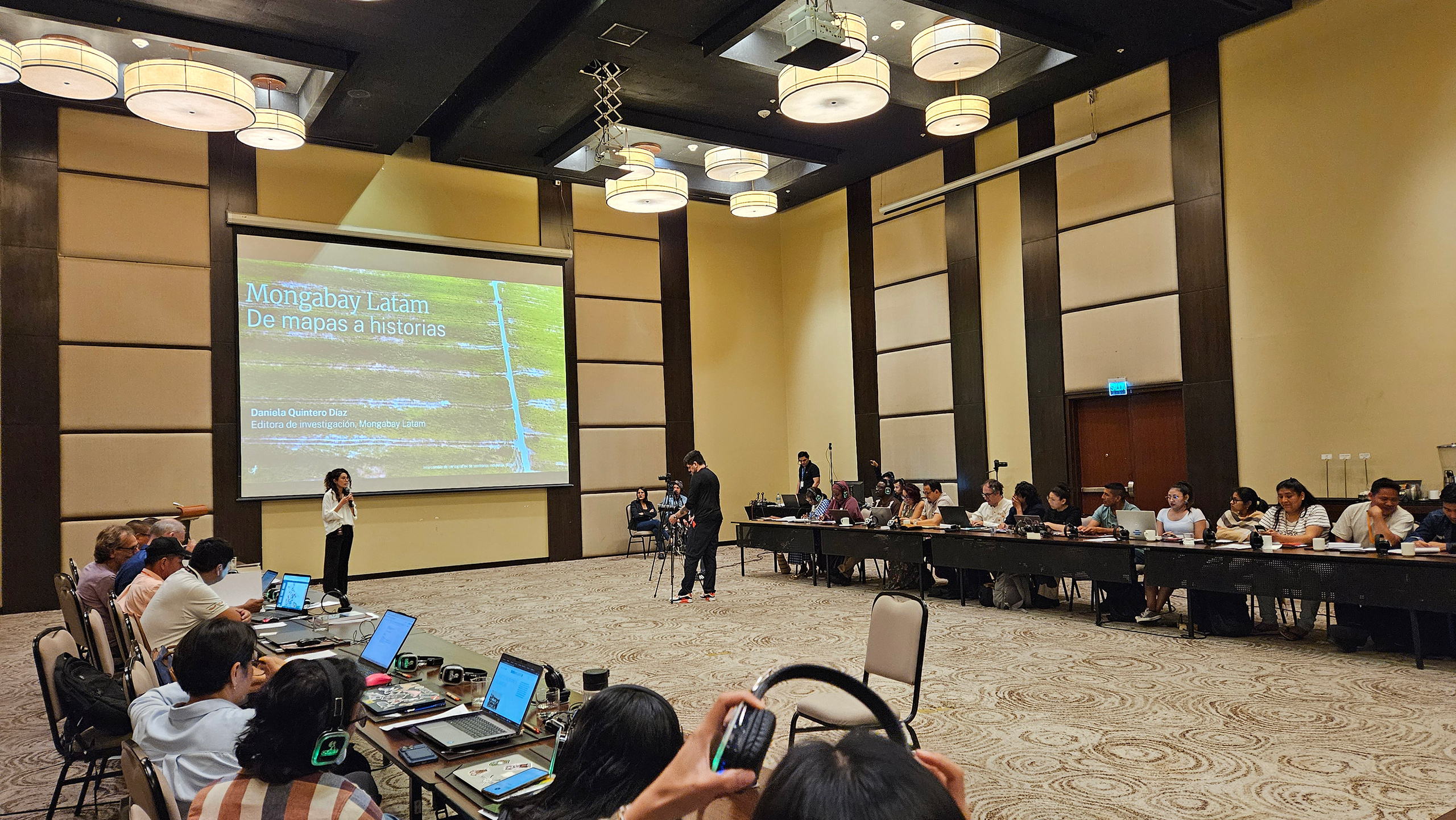
Another big part of my job is coordinating the Nature Crimes Fellowship program, which involves five journalists from Peru, Ecuador, and Colombia. For almost a year, they have been producing different investigations, especially related to nature crimes in oceans and in the Amazon. It has been a really interesting few months because we have learned a lot. It is the first time in Latin America that we are running this kind of project with senior journalists who want to develop their investigative skills. So, there has been a lot of training and providing them with tools to develop in-depth investigations about Latin America.
Once projects move forward, I also have editing tasks, and I write pieces sometimes as well.
Mongabay: What did you do before you came to Mongabay Latam?
Daniela Quintero: I have been a journalist for more than eight years. Before I arrived at Mongabay, I was at El Espectador. El Espectador is one of the main outlets in Colombia and the oldest newspaper in the country. I was there first as an environmental journalist, and then I was part of the investigative unit, where I developed in-depth investigations, especially related to environmental issues.
Mongabay: Why did you go into journalism?
Daniela Quintero: When I was 17, I didn’t really know what I wanted to do in life, but I knew I wanted to write and share stories.
I grew up in a mid-sized city in Colombia where most people aspire to become doctors, lawyers, or engineers. Journalism wasn’t really something people around me considered as a career and no one in my family had anything to do with it, so it wasn’t a path I was naturally exposed to. But I have always liked writing.
What I like most about journalism is that it lets me learn new things every day and explore topics outside my immediate reality. I’m naturally curious, and I feel really passionate about understanding and writing about those topics. Also, I’m kind of shy, so I found writing to be a way to express myself and share what I was learning.
Becoming a journalist wasn’t something I had planned very much—I just felt that it was what I should do when I was younger, but now I think it’s what I want to keep doing for the rest of my life.

Mongabay: Why are the topics you cover at Mongabay of interest to you?
Daniela Quintero: Environmental journalism wasn’t that popular some years ago, especially when I started. But the place where I worked is considered one of the main schools of environmental journalism in the country, and those journalists were among the first to start covering the environment in Colombia in a rigorous, structured way, back when nobody else was paying attention to it.
For me, it was very inspiring to see people with the same interests and to see how passionate they were about covering things that usually didn’t get much prominence in a national outlet in a country like Colombia. Here, media is usually very focused on political issues, economic issues, or the conflict. But seeing this group of people working on environmental topics—covering conservation issues as well as socio-environmental conflicts in a complex, diverse way—introduced me to the field and sparked my interest.
After that, I also started covering oceans. I discovered that underwater topics weren’t being covered very much in Colombia, so I joined my two passions: journalism and diving. It was amazing because it allowed me to share underwater stories that weren’t being told in my country at that time.
Environmental stories are never just about nature. They’re also about power, inequality, corruption, Indigenous rights, organized crime, and the people trying to protect their territories. I think that’s what has kept me interested in this kind of journalism.

Mongabay: Why do you like diving?
Daniela Quintero: Because it’s like another world—it is so different from what we know on land. There are forms of life and biodiversity that are completely different from ours, and seeing those interactions and ecosystems is fascinating.
My brain is usually super noisy—always thinking and never stopping. But when I’m underwater, it completely relaxes me. Everything else shuts off, and all I hear are my bubbles when I’m breathing. It’s a kind of active meditation that helps me relax and enjoy the world in a different way.

Mongabay: Is there a story that you’re really proud of?
Daniela Quintero: I have two favorite stories. One was about eel fishers in the Dominican Republic about five years ago. At the time, it wasn’t widely known that in a small town in the Dominican Republic, there was a time of year when the whole town went to the coast at night to fish for glass eels [elvers].
I saw some pictures and didn’t understand what the activity was. It wasn’t in my country, and I was still working for a local newspaper at the time, so getting funding to report that story was a challenge. It was supported by a journalism network, but doing my job in a country where I didn’t have sources or contacts was tough, as I had never been to the Dominican Republic before. Spending 15 days there covering an unfamiliar issue was a challenge, but I was really happy with the result. It reflected how this market works and how these fisheries contributed to the collapse of different eel species in other parts of the world. Now that those species are almost gone elsewhere, traders are arriving in Latin America and the Caribbean to supply international demand.
The second story—which recently won an award—was with Mongabay. We worked with Mongabay Brasil and colleagues in Venezuela on how gold from the Brazilian Amazon was being laundered through Venezuela before moving to other parts of the world. Working across three countries also showed me how essential collaboration is in environmental investigations, because these crimes don’t stop at national borders. It was recognized by a national award in Venezuela because it was the first time it was documented that gold wasn’t just being taken from Venezuela, but was being brought in from regional parks and laundered there.

Mongabay: What is something you like about working at Mongabay Latam?
Daniela Quintero: I’m relatively new to Mongabay, though I have known its work for several years. It has been amazing to see how the women leaders on the Latam team inspire younger journalists and share their knowledge and tools. One thing I really value is that expertise is shared very openly. The first time I learned how to use certain satellite platforms was in a workshop organized by Alexa [Vélez] years ago. Now, working with them and using those tools is really inspiring. It shows how useful those spaces are for younger journalists who are learning and suddenly have a platform to share their work.
Mongabay: Is there anything you want an international audience to know about Colombia?
Daniela Quintero: People usually only hear about the bad things in Colombia. But Colombia is an amazing country with incredible biodiversity and many people working to conserve ecosystems that are currently threatened. Even though conflict persists, nature crimes exist, and armed groups are gaining force in some territories, there are also many local initiatives confronting these issues and trying to preserve what we have.
We have mountain ranges (cordilleras), oceans, oceanic islands, mangroves, savannas, the Amazon, and even a desert on the northern coast. It is an extremely diverse country with many different communities—Afro-descendants, Indigenous peoples, and rich cultural heritage. I would like people to know more about the part of our country that resists and continues to protect its environment.

Mongabay: What advice would you give to someone following in your footsteps who wants to become an environmental journalist?
Daniela Quintero: I would tell them to take every chance they get to learn: apply for fellowships, attend workshops, and learn how to use new tools. Also, to stay curious. The best investigations often come from the questions that others stop asking.
I would also suggest staying obsessed with the topics you cover. I always say that I’m obsessed with my topics, and I don’t think that’s a bad thing. It shows how passionate you are and helps you build a methodology to approach complex issues—especially in environmental reporting, where people often mistake journalists for activists or conservationists. Reflecting the full complexity of these topics is one of the best ways to approach environmental journalism.
Cite this article
Rhett Ayers Butler (2026). Environmental crimes don’t stop at borders. Neither can the reporting. Mongabay Conservation news. DOI: https://doi.org/10.66709/news-327670

