


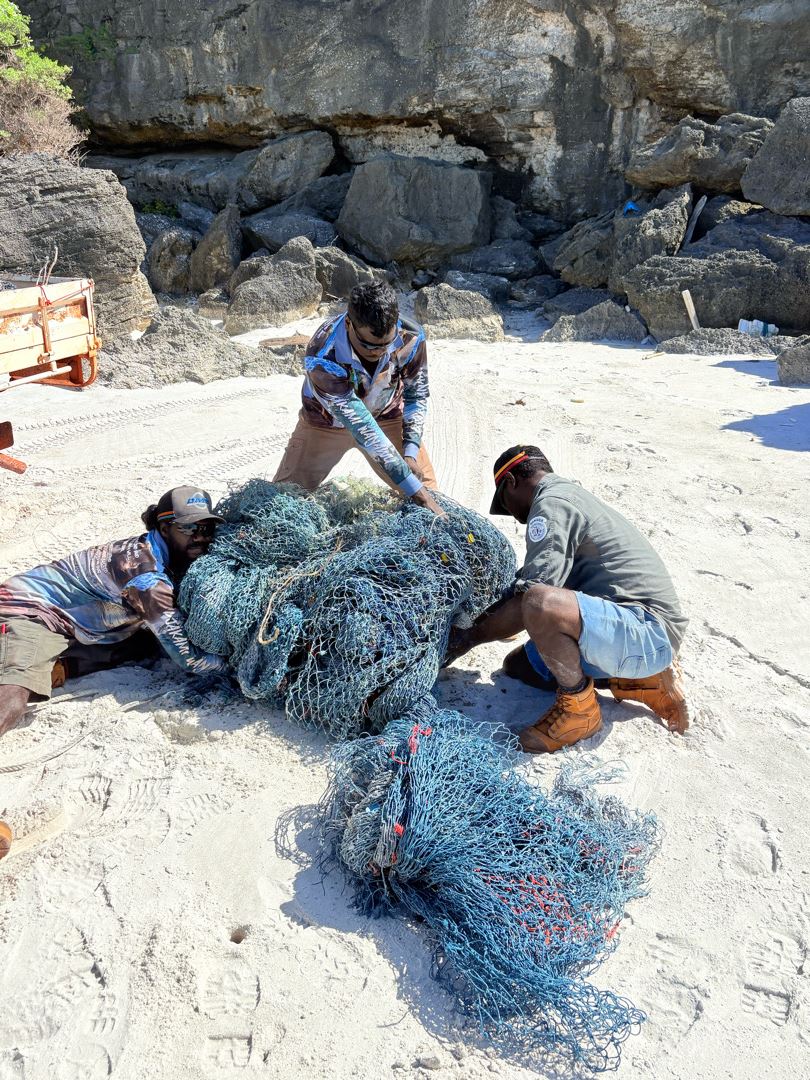
- Indigenous ranger groups across northern Australia are removing tons of ghost nets and other marine debris from some of the country’s most remote coastline, where abandoned fishing gear kills turtles, dugongs and sharks long after it is lost.
- The nets ride ocean currents into the Gulf of Carpentaria from Southeast Asia, and removing them is slow and dangerous work, though rangers are now using drones and AI to find nets faster than before.
- After funding for the patrols nearly lapsed, the Australian government committed AU$25 million ($18 million) over four years, most of it to continue the cleanups, and AU$4.5 million ($3.2 million) to stop nets from reaching the ocean in the first place.
- Rangers and advocates say the fix is not to blame any single country, but to address the problem at its source and keep supporting the Traditional Owners who care for this coastline.
On a remote beach on Groote Eylandt, a large island in Australia’s Gulf of Carpentaria, Kirsten Eden and her colleagues found a fishing net that someone had tried to make disappear. It had been burned and melted into a lump while at sea, and thrown overboard. It didn’t sink, but floated to shore as a wheel of hard plastic — once a net perhaps 60 meters (about 197 feet) long, now breaking into the microplastics that will outlast us all.
“So, the entire Groote Eylandt is Aboriginal freehold land,” Eden, who manages the Anindilyakwa Land and Sea rangers, told Mongabay. “It’s spoken for by Indigenous Australians. So, they’re not beaches that anyone can just go to. There’s so much cultural value to these beaches. There’s so much significance. There are songlines, there are art sites … And I guess that’s the drive to try and protect it and move this debris. And it’s such an eyesore.”
Aside from general cleanup, the team has its eyes on ghost nets: Discarded fishing nets that end up floating adrift, entangling sea life and gathering trash along their paths. Across northern Australia, Indigenous rangers are the working to retrieve the lost and abandoned fishing gear that keeps killing long after it is retired.
Getting a net off a beach is slow, physical work. Some have sat for years, buried deep or wound around driftwood and rock. One net can take hours, with rangers using shovels while a crane mounted on a four wheel drive vehicle takes the strain.
For beaches with no road, the team uses a custom-built barge that noses into the shallows and winches nets aboard. The water is dangerous, with too many crocodiles and hard currents to put divers in, Lawrence said.
Technology is starting to help. With researchers from Charles Darwin University, the Anindilyakwa rangers now fly drones that use artificial intelligence to spot nets from the air, and Traditional Owners have been trained to fly them. In one four-hour stretch earlier this year, the team found and pulled out 15 nets, Eden said. Before the drones, they rarely got more than three in a day.
Eden’s team of about 20 rangers patrols around 1,000 kilometers (621 miles) of coastline in Australia’s Northern Territory. A few of those beaches take 14 hours to reach along a single rough track.
The area “is quite huge, and the remoteness of some of those beaches is pretty hectic,” Eden said. “It’s very much an endless tide of pollution … [but] I love seeing that finished product, the beach just completely cleaned. That’s empowering.”
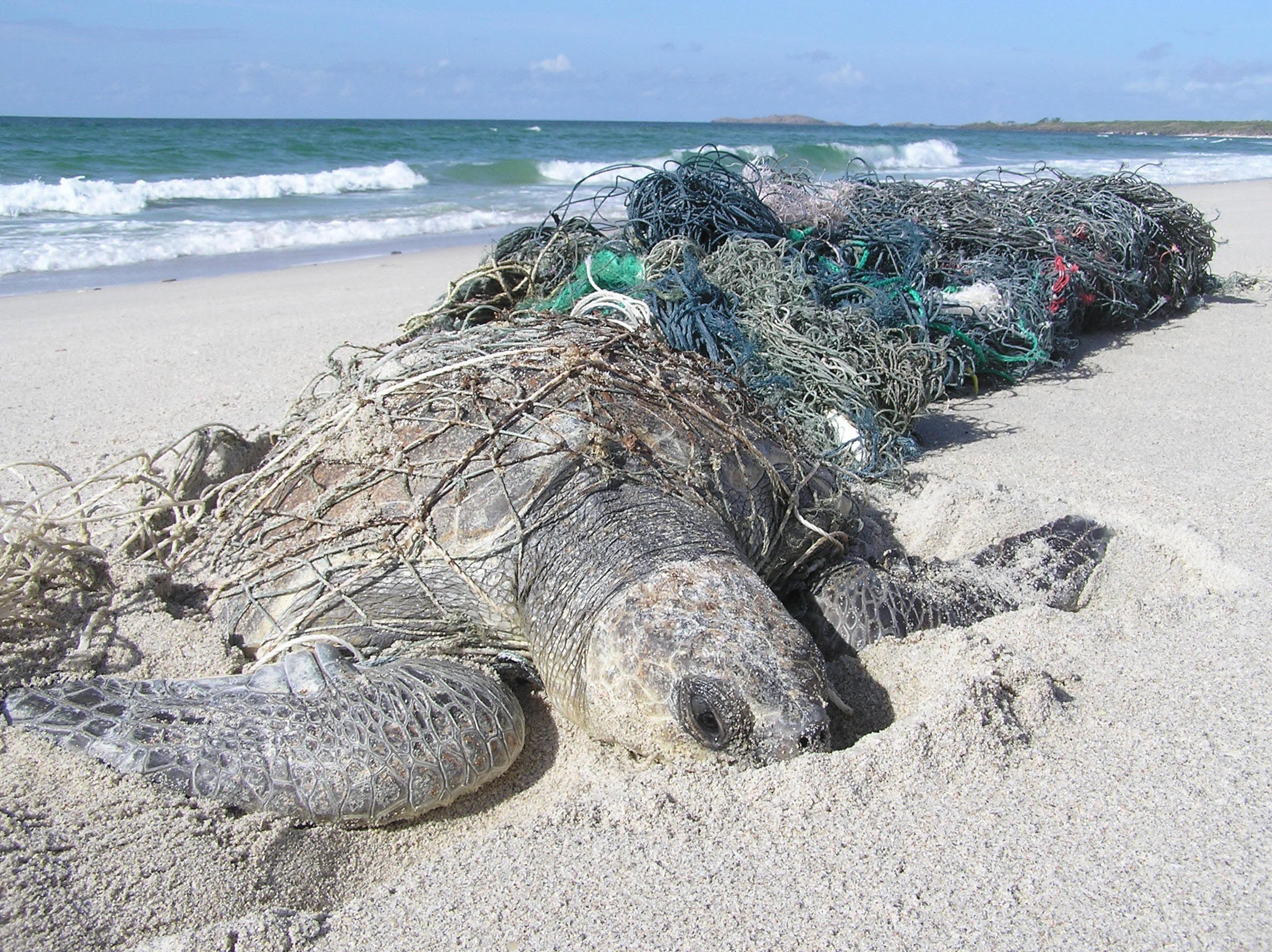
Once the nets are removed, the work is not over. Rangers comb through the nets to free any wildlife that is entangled but still alive. Research commissioned by the OceanEarth Foundation, an Australian-based NGO estimated the nets reaching these shores catch between 4,000 and 14,000 turtles a year, said managing director Anissa Lawrence. Many are endangered green (Chelonia mydas) and hawksbill turtles (Eretmochelys imbricata).
Anindilyakwa rangers are one team among many. More than 20 Indigenous ranger teams are now clearing debris across Western Australia, the Northern Territory and Queensland, Eden said, each looking after its own stretch of coast.
One of them is Dhimurru Aboriginal Corporation, a ranger group run by the Yolŋu people on the Gove Peninsula in northeast Arnhem Land, further north along the coast from Groote. Its four rangers look after about 550 km (342 mi) of shoreline. In 2025, they removed roughly 13 tons of marine debris, a heavy haul, said the corporation’s executive officer Stephina Salee, an Aboriginal and Torres Strait Islander who spoke with Mongabay. On the worst beaches, about 3 tons wash up per kilometer (0.6 mi), and it keeps coming no matter how often the rangers clear it.
“Ghost nets remain one of the most significant threats because they continue trapping turtles, dugongs, sharks and other marine life long after they’ve been lost,” Salee said.
The nets threaten species at the heart of Yolŋu culture, Salee said, so clearing them is never only about the animals. For Traditional Custodians, the link is direct, OceanEarth Foundation’s Lawrence said: When the country is sick, they are sick, and healing it heals the people.
Most of the nets drift from Southeast Asian fisheries on ocean currents, Lawrence said, washing into the Gulf of Carpentaria, which acts like a funnel. The monsoon brings the debris down, then the dry-season winds push it onto southeast-facing beaches in the gulf — the hardest ones to reach and, in Groote’s case, its turtle-nesting beaches.
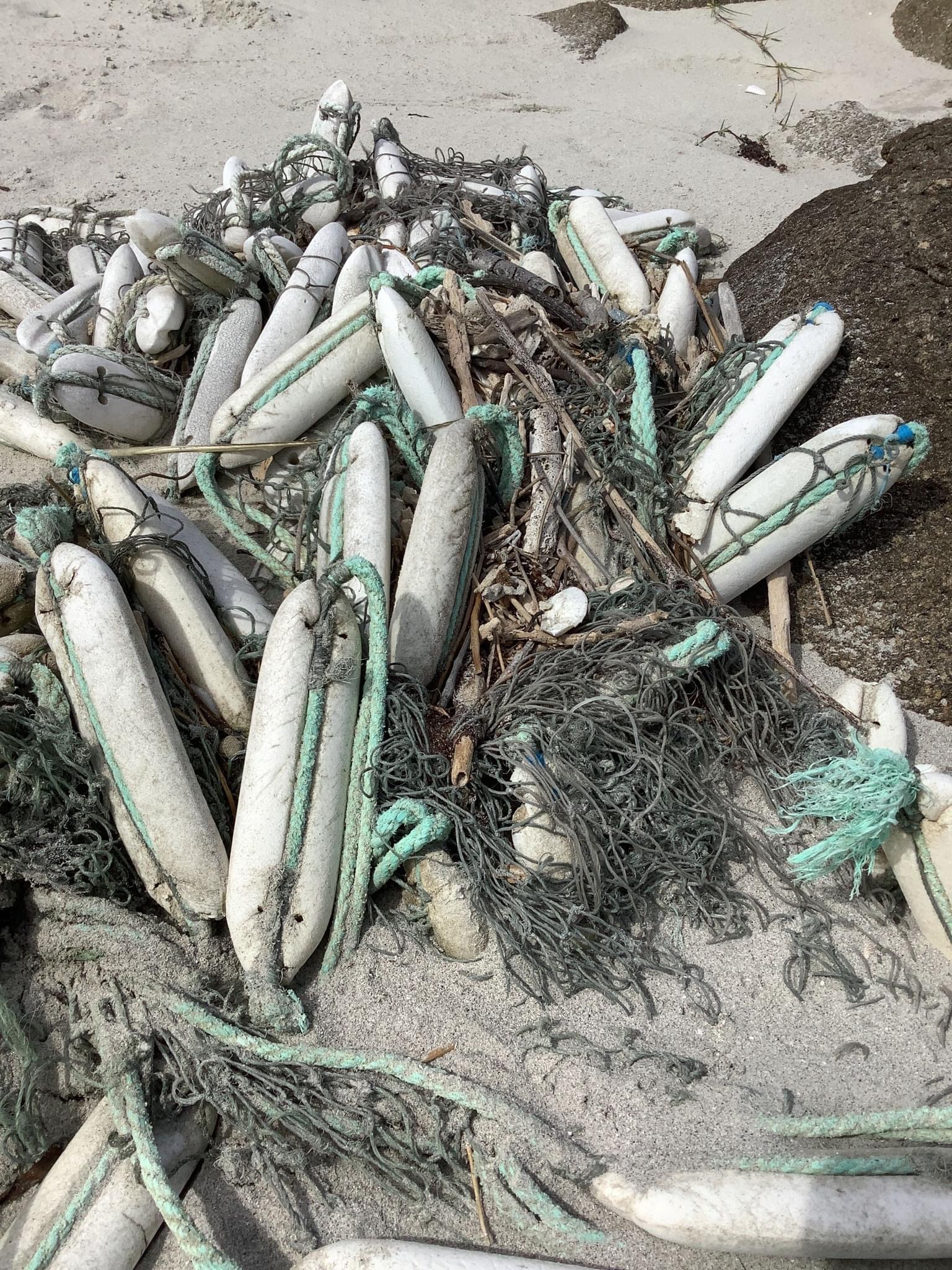
Rangers can tell a lot from a net: the mesh, the knots, the kind of fishing it was built for. What they usually can’t tell anymore is the country of origin. A handful of manufacturers now supply nets worldwide, so the same gear turns up under many flags. A net lost in one country can travel thousands of kilometers before it lands on someone else’s beach.
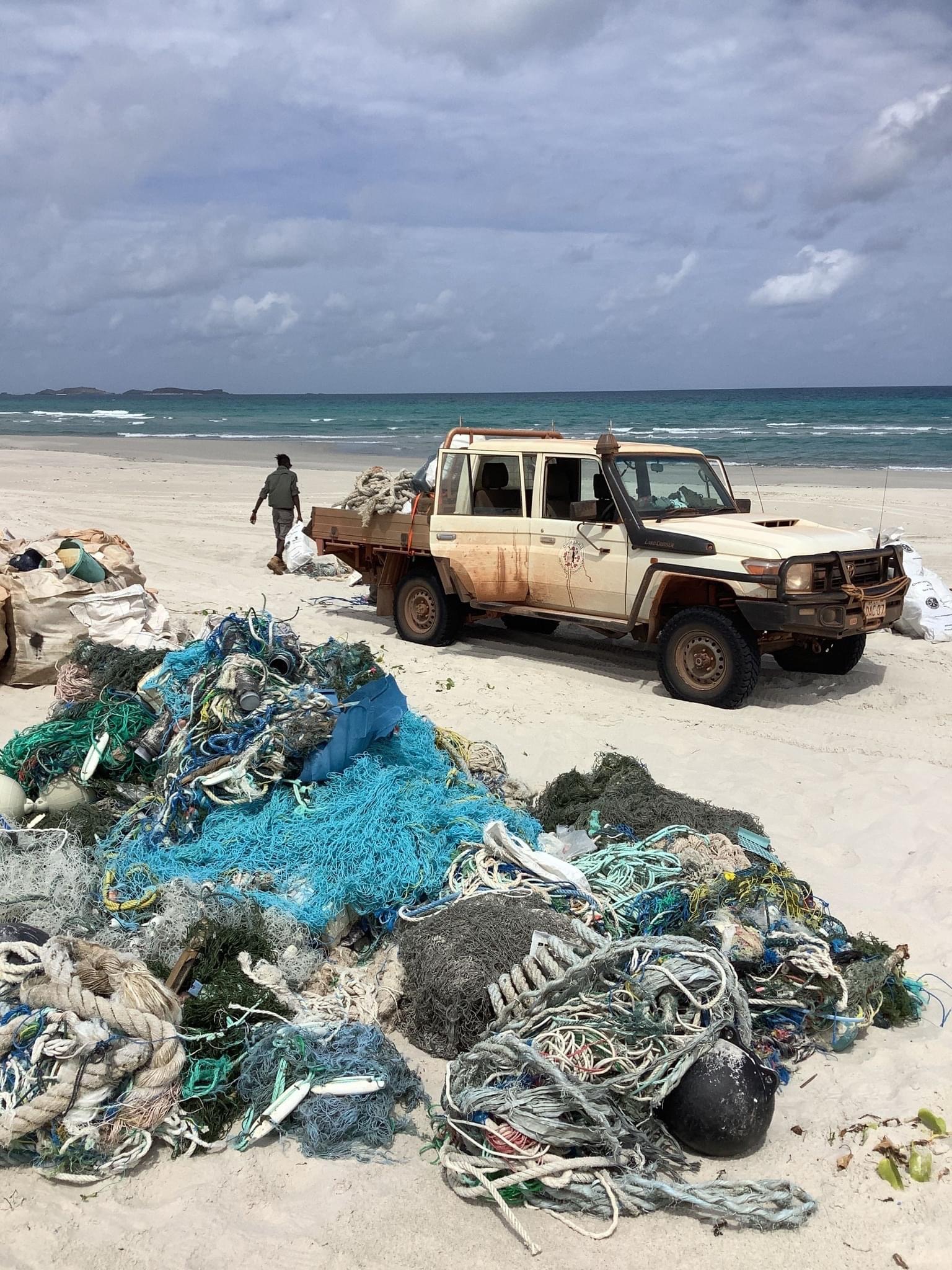
Then comes the problem no one has solved: what to do with all the collected nets. Eden has been stockpiling nets at the ranger base for three years and is running out of room, she said. The region’s landfills are small and often full, Lawrence added, and some refuse nets that may contain lead. That can leave burning as the only option — fumes and all.
Ghost-net weaving has become a celebrated form of Indigenous art and the best nets go to artists, but the volume removed from the beaches dwarfs what art can use, Salee said. Eden has applied for a grant to buy shredders that could turn the plastic into something salable. For now, it sits in a pile.
In December 2025, the Australian government committed AU$25.1 million (approximately $18 million) over four years toward the effort. About AU$20 million ($14 million) keeps the ranger cleanups running and expands them to more groups.
The other AU$4.5 million ($3.2 million) goes to prevention, or what Lawrence calls turning off the tap, through a partnership among Australia, Indonesia, Papua New Guinea and Timor-Leste. The idea is to set up monitoring in those countries and, as rangers track what lands in Australia, find where gear is lost before it drifts. Alongside that, the effort aims to give fishers somewhere on shore to hand in nets that are torn or worn out, instead of losing them at sea. The goal is no ghost gear from international sources or recreational fishing on northern Australian beaches by 2030.
“Success won’t be measured by how many ghost nets we remove,” the Dhimurru Aboriginal Corporation’s Salee said. “It will be measured by how many never enter the ocean in the first place.”
Ghost gear is a problem no single fleet or country created, Lawrence said, and she credits the countries now moving on the issue. Indonesia, she noted, has begun tackling ghost gear in its waters, work she said is significant given the scale. “It’s a system issue. It needs a system [solution],” she added.
“Marine debris keeps coming back with the tides, but our Rangers keep coming back too. They don’t give up on Country,” Douglas Munyarryun a Yolŋu Traditional Owner told Mongabay. “They are out there cleaning our beaches, protecting our sea life and looking after the places our old people have cared for forever.”
Banner image of Dhimurru Aboriginal Corporation, a ranger group run by the Yolŋu people on the Gove Peninsula removing a ghost net.
Dolphin mother and calf observed using shells to catch fish in Australia
Liz Kimbrough is a staff writer for Mongabay and holds a Ph.D. in ecology and evolutionary biology from Tulane University, where she studied the microbiomes of trees. View more of her reporting here.
FEEDBACK: Use this form to send a message directly to the author of this post. If you want to post a public comment, you can do that at the bottom of the page.
Cite this article
Liz Kimbrough (2026). Indigenous rangers pull killer ‘ghost nets’ from Australia’s northern coast. Mongabay Conservation news. DOI: https://doi.org/10.66709/news-328070

