


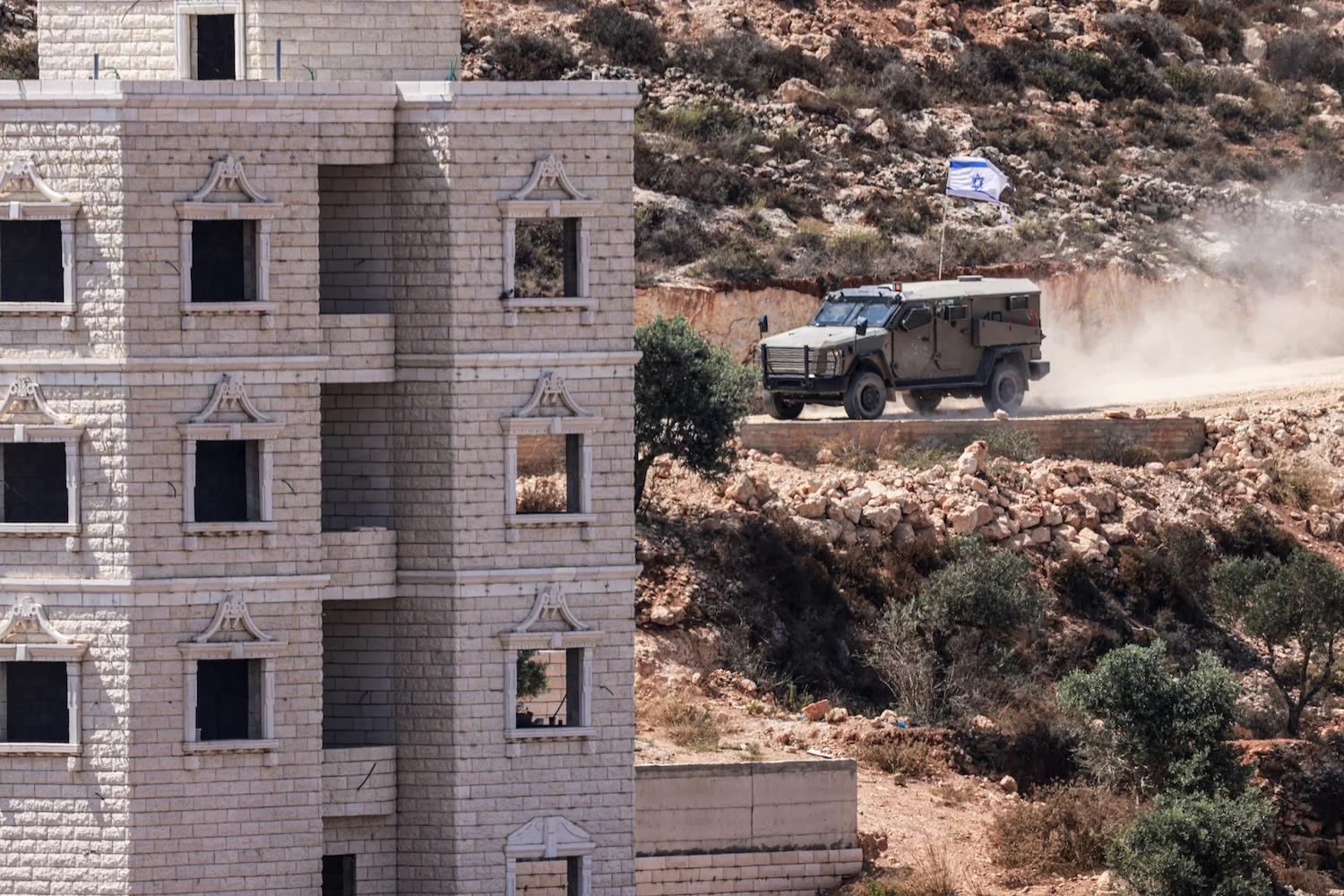
Nearly 300 Iranian missiles and drones have bombarded Jordan during the Iran war, mostly targeting U.S. bases in a small Arab state that never wanted conflict with Tehran. After a July strike killed three American soldiers, a controversial petition from more than 100 Jordanian activists demanded that U.S. forces leave the country. On cue, Western angst erupted over the country’s survival. Fretful commentaries worried whether popular unrest would weaken a ruling monarchy that has long been one of Washington’s closest strategic partners in the Middle East.
Yet my recent conversations with Jordanian officials, journalists, and commentators reveal a strikingly different concern. Their frustration about the Iran war is real, but it pales in comparison to their sense of existential dread about Israel’s accelerating drive to annex the West Bank.
Jordanians assume that if Israel claimed full or partial sovereignty over the territory, many Palestinians would be forced to relocate to Jordan. This would put unprecedented pressure on the country’s demographic and political fault lines, potentially destroying the very stability that makes it a vital U.S. ally. Jordanians describe this as the al-watan al-badil, or alternative homeland scenario, a reference to the Israeli claim that Jordan should be a Palestinian homeland.
If Israel moves ahead with annexation, its approach will determine the impact on Jordan. The Oslo Accords divide the West Bank into three administrative zones. Most of the West Bank’s 3 million Palestinians reside in Areas A and B, which contain major cities and remain under varying degrees of Palestinian Authority (PA) control. The larger Area C comprises nearly two-thirds of the territory and encompasses around 250,000 Palestinians. It rests under Israel’s control and currently draws its largest settlement projects.
The most extreme annexation scheme involves Israel absorbing Areas A, B, and C simultaneously, which would instantly dissolve the PA and orchestrate a large-scale population transfer into Jordan. The mildest proposal entails annexing just Area C and the hotly contested East Jerusalem. This might preserve the PA as a rump administration. But it would enable future Israeli encroachments into cities such as Hebron and Nablus in Areas A and B, pushing Palestinians into increasingly overcrowded, unlivable enclaves. From there, many would face pressure to leave for Jordan.
The precise number of Palestinian refugees dislodged eastward thus depends upon which West Bank areas are annexed, living conditions in Palestinian enclaves, and the degree of military force used. But as one Jordanian strategist told me, even the “best-case” scenario of annexing Area C is anticipated to produce up to 500,000 Palestinian newcomers to the kingdom. A full-spectrum plan could send many more.
Since the 2000s, Jordan has weathered jihadi terrorism and refugee influxes from the Iraq War and Syrian civil war. The Arab Spring commenced a decade of protests over unemployment and corruption. Coup-mongering palace intrigue five years ago targeted King Abdullah II. Border insecurity with Syria, intensified by drug-smuggling violence, has worsened since the fall of Assad.
Still, Jordan endures. Backed by robust military and security forces, the royal leadership deftly manages public tensions by balancing moderate repression with perpetual reforms promising more democracy and prosperity. This makes the kingdom an ideal bulwark for U.S. interests. Jordan hosts U.S. forces at a dozen bases, making it a key logistical hub for U.S. Central Command. No other Middle Eastern country save Israel receives as much U.S. foreign aid, with Amman slated to reap more than $2 billion in economic and security assistance this year.
Jordan and Israel inked a U.S.-backed peace treaty in 1994. Today, however, the Gaza war and newer Israeli advances into Lebanon and Syria have ratcheted fears of annexation. Bilateral relations have reached their lowest point since before the treaty. Military cooperation persists under U.S. guidance, and Jordan helped intercept Israel-bound Iranian missiles over its airspace in April 2024 and June 2025. But the two countries have withdrawn ambassadors and canceled energy and water deals. King Abdullah, who has ruled since 1999, has declared annexation as Jordan’s red line. Jordanian planners have openly suggested that Amman would respond by abrogating the peace deal and taking other “drastic measures.”
Behind Amman’s concern is the fraught history of intercommunal relations between Palestinian Jordanians and Jordanians of tribal heritage, or Transjordanians. The 1970 Black September civil conflict, in which the Jordanian army trounced the Palestine Liberation Organization after a bloody insurrection, seeded deep distrust. Since then, an uneasy but durable ethnocracy has held: Transjordanian tribes staff the state and military as stewards of the crown, while Palestinian Jordanians propel the economy but have little political voice.
This leaves fundamental questions of national identity unanswered, including who belongs in Jordan. Transjordanian chauvinists often see Palestinian Jordanians as disloyal guests, and some have infamously accused Queen Rania—herself of Palestinian origin—of corruption. Conversely, many Palestinian Jordanians complain of discrimination, such as how the electoral system for parliament favors rural tribal areas over Palestinian-dominated cities such as Amman.
For generations, the Hashemite monarchy advocated Palestinian statehood because it was a safety valve that relieved these internal strains. Transjordanian nationalists believed that a future Palestinian state would encourage Palestinian Jordanians to return. For Palestinian Jordanians, the cause of Palestinian self-determination provided a locus of solidarity that substituted for their political marginalization in Jordan. Efforts to resist Israel thus bridged a precarious social divide with a common foe. Indeed, Jordan saw some of the largest anti-Israel protests of any Arab country during the Gaza war.
Annexation by Israel and the formal demise of Palestinian statehood would thus amplify Transjordanian xenophobia, driven by angst over declining tribal patronage and political privileges. It would fuel Palestinian demands for political representation, since newly arrived Palestinians, unlike Iraqi and Syrian refugees, would expect Jordanian citizenship, as they have nowhere else to go. But in an authoritarian system that bans major opposition such as the Muslim Brotherhood, calls for representation could instigate ugly cycles of repression, protest, and volatility.
Jordanian politics would be upended in other ways as well. Absorbing the newcomers would greatly stress a moribund economy already struggling with nearly 83 percent public debt, 24 percent poverty, and 45 percent youth unemployment. The monarchy would also lose custodianship over the Islamic and Christian sites of East Jerusalem, something that helps bolster its legitimacy. On top of all this, Jordan would face other political fallout, from popular demonstrations on the streets to militant groups plotting attacks against Israel.
In essence, Israeli annexation of the West Bank would do what the Iran war, Syrian border insecurity, and jihadi terrorism did not: batter the demographic, political, and financial pillars of Jordanian stability. The kingdom still might not collapse, but the prolonged instability and social conflict that ensues would make for many lost years, if not decades.
What accentuates worries within Amman’s political salons and diplomatic circles is that the kingdom alone cannot physically prevent a population transfer.
Its leadership does have a well-rehearsed security response to West Bank annexation. Jordan would nullify the 1994 peace treaty; sever all formal ties with Israel; close land crossings such as the King Hussein Bridge; activate its military along the border to prevent mass incursions; and beseech the United States to intervene, most likely by threatening to revoke its basing privileges.
However, this would not be enough to mitigate the fallout. For one thing, Jordan would have difficulty making good on its threats to close U.S. bases at the very moment that it needed massive assistance from Washington to deal with an influx of refugees. Border security measures would likely fall short as well. Egypt has prevented the threatened displacement of Palestinians from neighboring Gaza because its eight-mile shared border is flat and securitized. Further insulating Cairo from that border is the 130-mile-wide Sinai Peninsula desert.
Jordan, by contrast, shares a 60-mile rugged frontier of valleys, hills, and riverbed with the West Bank that its much smaller military cannot hermetically seal. Just 20 miles separate that border with the outskirts of Amman, where nearly half of the national populace resides. Once Palestinians—many already with kin in the kingdom—seek refuge in Jordan, the monarchy would be hard-pressed to reject them, having already sheltered hundreds of thousands of Iraqi and Syrian refugees from recent conflicts alone.
Until recently, Jordan’s leadership assumed that Israel would not annex the West Bank because of the political and strategic costs. Now, however, many Jordanians believe that those constraints are fading.
First, the strategic need for Jordanian stability that once framed Israeli national security doctrine has waned. The kingdom traditionally served as Israel’s buffer state, which under a common U.S. security umbrella insulated Israel’s longest land border from the rest of the Middle East. Indeed, even before the 1994 peace treaty, the two countries regularly coordinated on security issues. A stable eastern flank enabled Israel to confront bigger regional threats.
Yet those threats have vanished. Hamas is a shadow of its former self. The Israeli military decapitated Hezbollah and now wages total war in southern Lebanon. In Syria, the Assad regime is gone, and Israel bombs targets with impunity. Iraq is consumed by sectarianism. Iran remains mired in unwinnable conflict with the United States and still has no nuclear weapons. The 2020 Abraham Accords normalized Israeli ties with four Arab states, and optimists believe that an elusive Saudi Arabia peace deal remains possible.
In a new regional order defined by Israeli coercive dominance, Jordanian stability carries less strategic weight. Israel’s military establishment has long argued that the kingdom’s collapse would be costly. But those leaders’ civilian counterparts have suggested that Israel could secure itself with comprehensive defensive measures, such as militarizing the border and preemptively occupying the shared Jordan Valley. For Israeli annexationists, reclaiming biblical Judea and Samaria, a messianic dream anchored in divine covenant rather than geopolitical calculus, justifies sacrificing Jordan.
Second, inside Israeli politics, calls for annexation have radically shifted from the fringe, far-right Zionism espoused by West Bank settlers to the political mainstream. Israeli public opinion has long moved past the two-state solution. Now, like the right-wing government of Prime Minister Benjamin Netanyahu, most other parties—including some projected to win the October general elections—endorse some form of annexation.
Indeed, Jordanians have watched nervously as other levers of Israeli state power have accelerated momentum for annexation. Last year, the Knesset overwhelmingly passed a symbolic motion to impose Israeli sovereignty over the West Bank. Key officials, from the national security minister to the chief rabbi, call for ethnically cleansing Gaza and turning Israel’s attention eastward. In the West Bank this year, violent Palestinian expulsions and illegal settlement construction in Areas B and C have increased, backed by the unprecedented imposition of Israeli civil and land laws to facilitate local land grabs.
What particularly stokes Jordanian alarm is the perceived impunity of Israeli expansionism against outside pressure. The international community largely sees annexation as blatantly illegal. However, many states felt the same way about Israel’s conduct in its war with Hamas in Gaza, and this had little impact on the course of the war.
To Jordanians’ alarm, this leaves Washington as the only actor capable of preventing annexation. Amman has not forgotten that the Biden administration helped underwrite the Gaza war. Last year, U.S. President Donald Trump explicitly pushed King Abdullah to accept Palestinian refugees from Gaza. In a positive sign, Trump now publicly opposes Israeli annexation of the West Bank. But Jordanians worry that if forced to choose, Washington will side with Israel over the Hashemite Kingdom.
All this put Jordan on war-footing long before American soldiers were killed by Iranian strikes. As one Jordanian journalist acerbically told to me in Amman, “Ask the Gazans how hoping for Israeli restraint worked out,” then “ask the rest of the world how Trump keeping his promises is working out.”
U.S. commentators championing Jordan as an oasis of stability or warning about the threat that it faces from Iran would do well to also acknowledge the threat that Jordanians themselves are focused on.
