


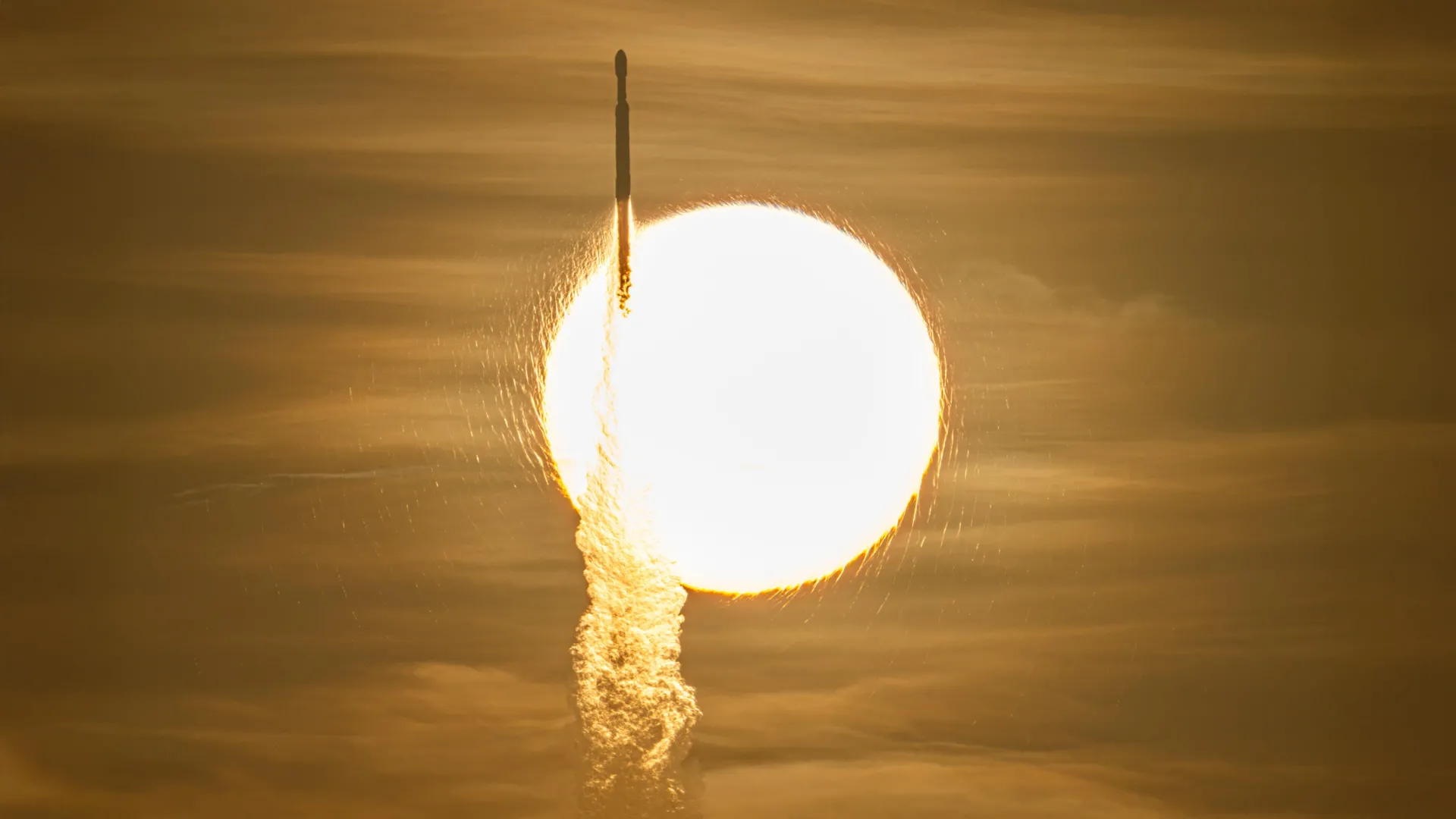
NASA’s Nancy Grace Roman Space Telescope has begun a three-month journey covering roughly one million miles as it travels toward its final orbit. The observatory lifted off at 7:26 a.m. EDT Sunday aboard a SpaceX Falcon Heavy rocket from Launch Complex 39A at NASA’s Kennedy Space Center in Florida.
Once operational, Roman will combine sharp infrared vision with an unusually wide view of the sky. That combination will allow astronomers to examine enormous regions of space while also looking far back into cosmic history. Among its primary goals are studying dark matter, dark energy, and worlds outside of our solar system, known as exoplanets. Its sweeping observations are also expected to support many discoveries beyond those central objectives.
“Roman is exactly the kind of success story we want to see across NASA,” said NASA Administrator Jared Isaacman. “Delivered ahead of schedule and on budget, this mission reflects more than a decade of dedication from the NASA workforce and our industry partners. Now, Roman will give us a new atlas of the universe, push the boundaries of discovery, and demonstrate what is possible when America’s space program pairs bold ambition with disciplined execution.”
Roman Begins Its Journey Into Deep Space
Controllers at NASA’s Goddard Space Flight Center in Greenbelt, Maryland, started receiving telemetry from Roman just seven minutes after launch. Falcon Heavy operated as planned and separated from the observatory 31 minutes after liftoff. After detaching from the rocket’s center core, the two boosters returned safely to the launch site, where they can be refurbished.
“Roman will be a discovery machine that will bring us closer than ever before to answering humanity’s most profound questions about our cosmic history,” said Nicky Fox, associate administrator for the Science Mission Directorate at NASA Headquarters in Washington. “With its large field of view and fast survey speeds, Roman will usher us into a new era of discovery and make the invisible visible, setting the foundation for humanity’s search for life beyond our solar system.”
During the first part of the mission, Roman communicates with controllers using the Near Space Network, a system of ground stations and relay satellites that handles tracking, telemetry, and commands. Roughly 70 minutes after launch, communications shift to NASA’s Deep Space Network, which will help guide the observatory toward the second Sun-Earth Lagrange point, or L2, about one million miles from Earth.
L2 is a region where the gravitational influences of the Sun and Earth allow spacecraft to maintain a relatively stable position with limited fuel use. Roman will first communicate through the Canberra Deep Space Communication Complex in Australia. Approximately six hours later, communications will transfer to the Madrid Deep Space Communication Complex in Spain and then to the Goldstone Deep Space Communication Complex in California. Together, these facilities will help maintain continuous contact with the spacecraft during its journey.
Key Systems Deploy After Launch
One hour and 23 minutes after launch, the Roman team confirmed that the observatory’s solar panels and lower instrument sun shade had deployed successfully.
Over the next several days, Roman’s high-gain antenna and visor-like deployable aperture cover will also deploy. Mission controllers will carry out the first of two course corrections, and Roman’s Coronagraph Instrument will be switched on.
The Coronagraph Instrument will demonstrate technology that could eventually be used by future missions such as NASA’s Habitable Worlds Observatory concept to directly photograph planets resembling Earth. Directly imaging such planets is extraordinarily difficult because a host star can be billions of times brighter than the planet orbiting it. A coronagraph helps by blocking much of the star’s light so that nearby planets become easier to detect. Roman will move that technology forward by capturing images of planets similar in size to Jupiter.
A 300 Megapixel View of the Cosmos
A few weeks into the journey, Roman’s main scientific instrument, the Wide Field Instrument, will be activated.
The instrument is a 300 megapixel infrared camera equipped with 18 4K detectors, each roughly the size of a saltine cracker. Those detectors will gather photons from distant astronomical objects and turn them into detailed panoramas of the cosmos.
Roman was designed to remain optically stable while rapidly moving from one observation to another. That means it can cover huge portions of the sky without lengthy pauses between observations. NASA says the telescope is designed to survey the universe about 1,000 times faster than the Hubble Space Telescope.
This speed is one of Roman’s defining advantages. Hubble can capture extremely detailed images of relatively small areas of the sky, while Roman is designed to combine similarly sharp views with a much larger field of view. That should allow astronomers to study enormous numbers of galaxies, stars, and planets in a fraction of the time previously required.
First Roman Images Expected in Early 2027
For the remainder of its three-month commissioning period, scientists and engineers will carefully test and calibrate Roman’s instruments. These procedures are designed to make sure the observatory is operating precisely before its full science program begins.
NASA expects to release Roman’s first images in early 2027.
Once science operations are underway, Roman will transmit about 1.4 terabytes of data to Earth every day. That is the highest daily data rate yet for a NASA astrophysics mission. The enormous volume of information will require more than traditional analysis alone.
Machine learning, artificial intelligence, and citizen scientists will help researchers search through Roman’s observations and identify potentially important discoveries. Astronomers can then investigate the most promising findings in greater detail.
“We’ve never been able to view the universe with eyes like Roman’s before,” said Julie McEnery, Roman’s senior project scientist at NASA Goddard. “There’s no telling what more we’ll know and have seen by this time next year.”
A Major New NASA Astrophysics Mission
Roman is the fourth primary NASA mission to launch aboard a Falcon Heavy rocket. Earlier this year, NASA’s Launch Services Program worked with SpaceX to move the launch date forward after the telescope was completed earlier than expected.
NASA Goddard manages the Roman mission, with participation from the agency’s Jet Propulsion Laboratory in Southern California; Caltech/IPAC in Pasadena, California; the Space Telescope Science Institute in Baltimore; and scientists from a range of research institutions.
The mission’s main industrial partners are BAE Systems Inc., L3Harris Technologies, and Teledyne Scientific & Imaging. International contributions also come from ESA, JAXA, the French space agency CNES (Centre National d’Études Spatiales), and the Max Planck Institute for Astronomy in Germany.
