


Welcome back to Foreign Policy’s Latin America Brief.
The highlights this week: Left-wing lawmakers from across the hemisphere hold a strategy session in Uruguay, Mexico reacts to the U.S.-Canada trade war, and the race for the next United Nations secretary-general moves forward.
For years, right-wing politicians from across Latin America have gathered at the U.S. Conservative Political Action Conference (CPAC) and spinoff events in the region. This visibility helped elevate the far right across the Western Hemisphere. Once-fringe CPAC speakers have become national leaders, including Argentina’s Javier Milei and Chile’s José Antonio Kast.
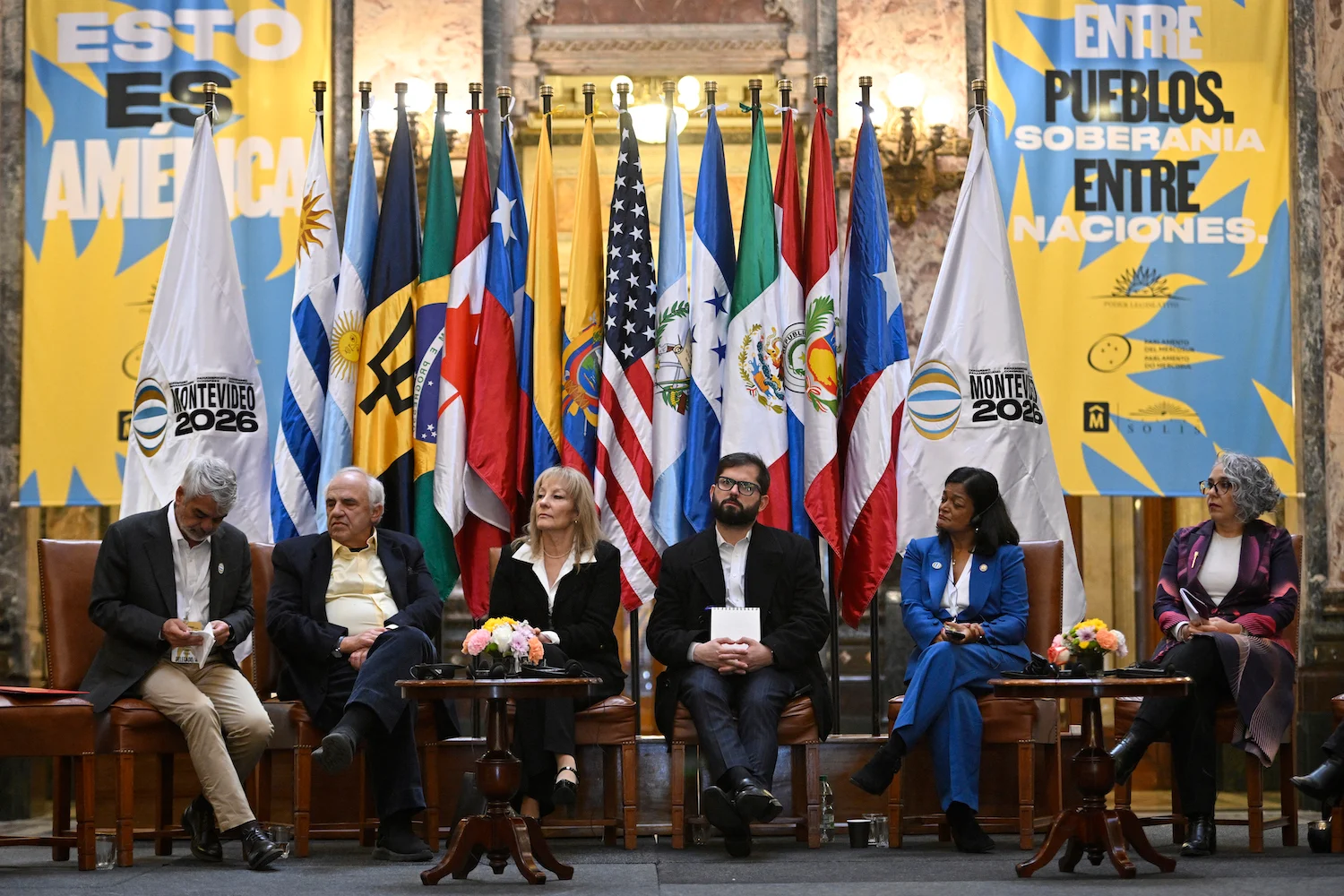
While right-wing leaders currently dominate democratic politics in the Americas, a different set of gatherings is trying to boost the hemisphere’s left. Last weekend, the Panamerican Congress held its third annual meeting in Montevideo, Uruguay. The event featured politicians from Canada to Chile and showcased mounting pushback to U.S. President Donald Trump’s interventionist doctrine for the region.
Aside from Canadian Prime Minister Mark Carney, the region’s left-leaning leaders have generally tempered their criticism of Trump. Brazilian President Luiz Inácio Lula da Silva and Mexican President Claudia Sheinbaum have spoken up for national sovereignty, but they have been open to dialogue to try to remove U.S. tariffs—and to preempt U.S. military action on their territories.
Further from the international spotlight, however, progressive lawmakers are resisting what Trump has termed the “Donroe Doctrine.”
U.S. lawmakers have held hearings to question the Trump administration’s boat strikes. Argentine lawmakers have staged inquiries into the opaque terms of Milei’s recent economic agreements with Trump. And in Ecuador, campaigning from opposition lawmakers helped public opinion coalesce against a proposal that would have allowed U.S. military bases in the country. The prospect was defeated in a national referendum last November.
In countries with right-wing leaders, “the progressive opposition’s main tools are their national legislatures,” said Chilean lawmaker Gonzalo Winter, who attended the Panamerican Congress. He argued that the gathering was important “in order to build a more familiar relationship between lawmakers of different countries.”
CPAC Latin America events have platformed issues such as financial deregulation, hard-line security policies, and skepticism toward climate change. The Panamerican Congress, meanwhile, focused on topics including green industrial policies, smarter regulation of Big Tech companies, and strengthening democratic institutions.
Participants floated the idea of a regional rapid-alert network in cases where countries’ sovereignty comes under threat, according to a draft summary of the event’s closed discussions seen by Foreign Policy.
Left-wing politicians have held regular gatherings in the region in previous decades. Perhaps most notable was a group called the São Paulo Forum, which was founded by Lula and Cuban leader Fidel Castro in the 1990s. However, it defended the autocratic Cuban, Nicaraguan, and Venezuelan political models and was also male-dominated.
The Panamerican Congress has a different flavor. In addition to emphasizing the importance of democracy, it featured women as prominent organizers of the event. This year’s iteration devoted significant energy to debating policies such as establishing government-backed care work programs that are designed to lower costs for working women.
The gathering also featured self-critique among the Latin American left, according to lawmaker Alfonso Ramírez Cuéllar of Mexico’s ruling Morena party. “The fight against corruption and the fight for security at times remains an unresolved issue in both Latin America and Mexico,” he said. “Sometimes the right takes ownership of those issues from us, and we cannot allow that.”
For now, the participants at the Panamerican Congress are largely shut out of executive power. But with the region’s quickly changing political winds, their ideas could become future policy.
Sunday, Sept. 6: Jamaican officials visit the United Kingdom to lodge a complaint calling for reparations for slavery.
Monday, Sept. 7, to Thursday, Sept. 10: The International Court of Justice holds hearings in a Nicaragua-lodged case against Germany over its support for Israel’s war in Gaza.
Colombia’s deportation drive. Just weeks into his presidency, Colombian President Abelardo de la Espriella is leaning hard into Trump’s immigration agenda, announcing a deportation drive against undocumented migrants. De la Espriella’s moves have alarmed migrant rights advocates.
Recent government numbers suggest that hundreds of thousands of Venezuelans who have fled amid economic and political crisis in recent years are residing in Colombia with “irregular” status, Colombian media have reported. Until now, they were able to try to build new lives in the country without having to worry about immigration raids.
Colombia is also set to become a testing ground for a new U.S. migration policy. The United States plans to fund filmmakers to produce videos seeking to persuade Colombians in the United States to return and to discourage others from migrating northward, according to a public call for grant applicants. The videos will be distributed through U.S. embassy platforms and Colombian media outlets, it said.
Ambassador Carolyn Rodrigues-Birkett, the permanent representative of Guyana to the United Nations, speaks during a U.N. Security Council meeting on threats to international peace and security at the U.N. headquarters in New York on June 13, 2025. Michael M. Santiago/Getty Images
U.N. secretary-general race. The U.N. Security Council held a second straw poll last week in the race for the organization’s next secretary-general. Former Costa Rican Vice President Rebeca Grynspan led the first straw poll in July, but this one was topped by former Guyanese Foreign Minister Carolyn Rodrigues-Birkett, multiple outlets reported, with Grynspan in second.
Argentina’s Rafael Grossi was seen as an early front-runner in the race. In last week’s straw poll, he was tied for the second-most votes in favor of his candidacy among eight contenders—but also for the third-most votes against it.
A woman has never led the United Nations. Longtime U.N.-watcher Richard Gowan told Foreign Policy that the conventional wisdom prior to Trump’s election was that this year would change that—but when Trump returned to the presidency, “the conventional wisdom flipped overnight” because it “seems that the U.S. will insist it’s going to be a man.”
China has publicly said it supports the idea of a woman as secretary-general, however, a view that the polling suggests is widespread.
Meetup of the moment. The latest youth trend in Latin America is taking outdoor plazas and social media by storm. From holding dance battles to recreating viral memes, young people are chasing reputational clout in what’s called “aura farming.” In the slang of Generation Z, improving one’s “aura” refers to gaining a reputation for being cool.
The term is global, but these outdoor meetups have spread particularly quickly in Latin America.
Aura farming is an outgrowth of gamer culture. In many instances, two people face off and take turns performing strings of repetitive moves, a nod to the fact that players in some online games can rack up points by doing the same movement in quick succession. While the gestures may look quirky to the uninitiated, participants say they enjoy the fact that the battles get them out of the house and into public spaces.
The phenomenon is big enough that it showed up in former Chilean President Gabriel Boric’s speech at the Panamerican Congress over the weekend. “This is sometimes hard to understand for we who are older,” he said of aura farming, “but we should ask and listen to what the young people in our countries are thinking about.”
When was the last Latin American U.N. secretary-general elected?
1961
1971
1981
1991
It was Peru’s Javier Pérez de Cuellar, whose term began on Jan. 1, 1982.

Mexican President Claudia Sheinbaum and Canadian Prime Minister Mark Carney speak during the awards ceremony after the FIFA Men’s World Cup 2026 Final match between Spain and Argentina at New York New Jersey Stadium in East Rutherford, New Jersey, on July 19.Andrew Harnik/Getty Images
Mexican officials followed along with intense interest as an anticipated trade deal between Canada and the United States collapsed over the weekend. Washington and Ottawa have now moved into a trade war, with each country announcing new 50 percent tariffs on certain goods.
Though the total amount of goods covered by the new tariffs is relatively small—an estimated 5 percent of each country’s exports to the other—Carney suggested that the blow-up revealed a stark difference in principles. The Trump administration was choosing its moves as part of a “power play,” he told Canadian television on Saturday.
One of the U.S. demands that Canada would not accept, Carney said, was limits on its ability to reach economic deals with third partners. That’s worrying for Mexico, too, said former Mexican trade negotiator Orlando Pérez: “If the United States is asking us to raise tariffs on partners who we already have trade deals with, it would be a very complicated situation.”
Pérez added that the U.S.-Canada trade war constitutes yet another step away from the standards of the U.S.-Mexico-Canada Agreement, which was designed “to be able to manage this type of disagreement through dialogue channels and administrative committees” rather than allow it to escalate into tariffs.
Sheinbaum said on Monday that she was still “optimistic” that separate U.S.-Mexico trade talks would yield a bilateral deal.
Publicly, Sheinbaum’s stance is about “not letting Canada’s crisis become hers,” former Mexican Ambassador to the United States Arturo Sarukhán wrote on X. But the events of the past few days nevertheless show that with the United States, there should be no “assumption that treaty membership provides automatic protection.”
