


In July, China underscored its expanding strategic reach across the Pacific by sending a submarine-launched ballistic missile (SLBM) from the South China Sea into the Pacific Ocean. Likely flying over the Philippines and passing just south of Guam, the missile splashed down within the South Pacific Nuclear Free Zone. This aggressive act, which came with little forewarning just hours after Australia signed a treaty with Fiji, drew condemnation across the Pacific, with regional leaders decrying the provocation and accusing Beijing of deliberately escalating tensions. But this was far from an isolated incident. Instead, it underscores a fundamental geopolitical reality: The Pacific islands are now a central arena of great-power competition, where any gap in proactive U.S. strategy invites external disruption.
The trajectory of Chinese power in the South Pacific became apparent in April 2022, when news broke of a wide-ranging, secretly negotiated security agreement between China and the Solomon Islands—a small island nation of approximately 850,000 people that is in the South Pacific. The news was alarming not just because of its sudden and secret nature but because of what it portended: a potential strategic Chinese foothold in the Pacific, the possibility of a military and police presence to follow, and the prospect of a hostile power placed between the United States and its closest allies.
For decades, U.S. strategy toward the Pacific islands has suffered from institutional neglect and competing geopolitical priorities. Yet, as the SLBM launches in spring 2022 and last month illustrate, maintaining unhindered access, trusted partnerships, and strategic influence across Oceania is the foundational prerequisite for the United States’ security posture across the entire Indo-Pacific. To safeguard these shared interests, Washington must move beyond high-level visits and episodic engagement. The United States requires a comprehensive, consistent, and fully resourced Pacific strategy—one that grounds diplomatic, economic, and security commitments in sustainable, long-term partnerships. Beijing’s maneuvering demonstrates an accelerating race for influence. And reactive outreach will be insufficient to preserve regional equilibrium against an adversary pursuing a deliberate, long-term footprint.
Washington’s appreciation for the Pacific has grown in recent years, with overwhelming bipartisan support for efforts under both the first Trump and Biden administrations to deepen overall U.S.-Pacific engagement. In 2019, U.S. President Donald Trump relaunched the Compacts of Free Association (COFA) negotiations with Palau, Micronesia, and the Marshall Islands, in which economic benefits to those countries are conferred in exchange for U.S. military access across the North Pacific. He also invited the leaders of all three countries to the White House. U.S. President Joe Biden built on that momentum and, due largely to the 2022 agreement with the Solmon Islands, quickly expanded engagement across the entire Pacific islands region, which encompasses 14 countries and several territories. Under Biden, the United States published the first U.S.-Pacific strategy and welcomed all Pacific leaders to the White House not once but twice for leader-level summits, in addition to rolling out hundreds of millions in targeted development and security assistance.
Today, however, that trajectory faces renewed uncertainty. Under the second Trump administration, the United States has radically reshaped its foreign policy, dismantling development mechanisms such as U.S. Agency for International Development, using tariffs as a tool of first resort for both ally and foe, and withdrawing from or reducing its presence in international institutions that it initially helped to create. While not specifically aimed at the Pacific region, these measures have had an outsized effect on these small democratic nations, which are dependent on external development assistance and possess narrow economies that are highly vulnerable to external shocks.
As U.S. foreign policy finds its new shape driven largely by an “America First” outlook, there are signs that the Pacific remains a significant priority for U.S. national security professionals. Two agreements seen as a ground-floor signal of U.S. commitment to the region, the COFA and the Tuna Treaty, were funded with broad bipartisan support. U.S. Deputy Secretary of State Christopher Landau, a top U.S. diplomat, has visited the region twice, including a well-received trip to Papua New Guinea for the country’s 50th anniversary of independence and diplomatic relations with the United States. In May, the Quad foreign ministers announced that the grouping plans to build out a new port in Fiji, one highlight among several Pacific-related announcements.
The Trump administration has also recognized the importance of bolstering key relationships across the region. In July, the newly elected Solomon Islands Prime Minister Matthew Wale visited Washington. That visit, on the heels of a similar one to Canberra and Wellington, was a clear demonstration of Wale’s commitment to returning to traditional partnerships with Australia, New Zealand, and the United States after several years of pro-Beijing leadership in Honiara. During the visit, Wale met with Landau and other senior U.S. officials, and the two countries announced several significant deliverables, including the intended return of the Peace Corps to the Solomon Islands and $6 million in new funding for unexploded ordnance removal, which is still a persistent and deadly issue for the region.
And yet despite these signs of life, U.S. programming for the region remains largely on hold, and there is still no U.S. ambassador resident in any of the 14 Pacific island countries. In response to both Beijing’s ambitions and Washington’s drawdown, Australia has drastically ramped up its engagement in recent years, crafting various bilateral agreements that incorporate a protective security component, such as the Falepili Union with Tuvalu, which allows some of Tuvaluans to emigrate to Australia in exchange for essentially giving Australia veto power over Tuvalu’s external security arrangements. Australia has also signed two mutual defense treaties over the past year, one with Papua New Guinea and another with Fiji. Yet as China’s SLBM launch in July demonstrated, Beijing remains determined to assert its presence and influence across what it considers a highly strategic region.
The Pacific has thus entered the fore as a central arena of great-power competition, and ensuring the region remains open and free from a permanent Chinese presence requires a group effort, including from the United States. Ensuring that the United States retains the ability to depend on its access to and through the Pacific—including to allies such as Australia, Japan, and the Philippines—will require steps beyond what the region has seen thus far from Washington.
In the Pacific, showing up, engaging, and listening is a critical first step. Through senior-level engagements in the region and Hawaii, the United States has met that mark. But it is time to move beyond showing up and listening. The United States must also demonstrate that it has listened and work to flesh out what has become an increasingly anemic relationship. As Beijing pursues vectors of engagement across the full range of diplomatic, economic, security, and informational instruments of power, so, too, must the United States.
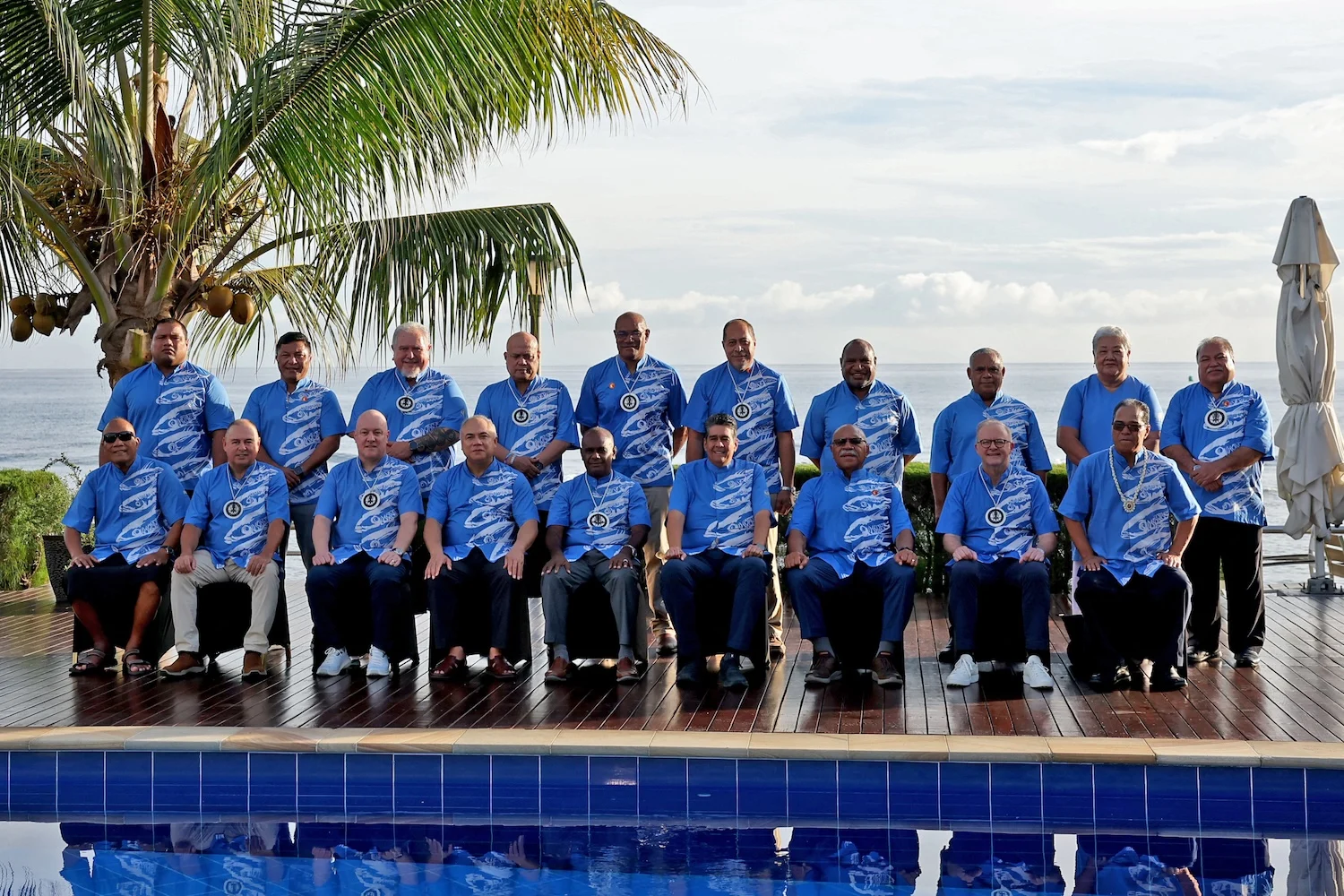
From Aug. 30 to Sept. 4, the annual Pacific Islands Forum Leaders Meeting (PIFLM) will take place in Palau. The United States, as a dialogue partner, has been invited to attend, and Deputy Secretary of State Landau is leading the delegation. As one of Taiwan’s three remaining allies in the Pacific and a close and consistent U.S. partner through the COFA, Palau as host presents a prime opportunity for the United States to showcase its commitment both to Palau as a strategic ally and to the Pacific region as a whole.
As part of Landau’s visit, or following this PIFLM, the following recommendations have the ability to build upon the groundwork that has been laid thus far, shaping a far more comprehensive and enduring approach to an often overlooked, but strategically vital region.
First, the United States must stop being egregiously outmatched by China’s diplomatic ground game in the Pacific. Getting ambassadors to the region will not rectify this imbalance, but it is an essential first step. Similarly, the United States should deploy a dedicated ambassador to the Pacific Islands Forum—as it does with the Association of Southeast Asian Nations, another regional body—in recognition of the important and influential role that the forum plays in the Pacific and beyond.
The United States must be more agile in capitalizing on key strategic opportunities. While the initial announcements out of Wale’s visit to Washington were positive, it is critical that Washington commits to doubling down on one of the most critical countries in the Pacific, ideally with much-needed health and port infrastructure, as well as bolstering real investments into the Solomon Islands.
Existing U.S. work in the maritime domain, including U.S. Coast Guard deployments and critical ship-rider agreements, is welcome but remains insufficient. In conjunction with partners like New Zealand, Japan, and Australia, the United States should conduct regular overflights of far-reaching maritime zones using assets out of Guam, Hawaii, and—ideally—Australia, and it must ensure that authorities are in place to allow Pacific officials to use the evidence collected to prosecute violators of maritime law. Lastly, Coast Guard deployments—often cited as one of the most important contributors to regional security—should be expanded, including potentially home porting a Coast Guard cutter in Australia.
Partnering with the Pacific to counter the growing Pacific transnational and organized crime threat is directly in the United States’ national interest. Starting with the COFA states in the North Pacific, the United States should deploy regular FBI, Drug Enforcement Administration, and legal experts to work alongside host-nation officials on a consistent basis to provide the full spectrum of U.S. national power toward a challenge that threatens all nations.
As the Pacific becomes more connected across an increasingly complex network of digital infrastructure, it is imperative to protect and secure these vital digital assets from malign incursion and intentional or accidental disruption. The United States should take the lead in presenting global norms around protection and sustainment of digital infrastructure.
Pacific nations, which spend around 5 to 15 percent of GDP on fuel and gas, have found themselves at the whip end of the global fuel crisis. The United States should work with other regional partners, such as Australia and New Zealand, to craft meaningful financing solutions, such as through the World Bank, to provide critical debt relief to Pacific partners.
Education and training programs allow the United States to forge lasting ties with future Pacific leaders—a noncorrupt form of “elite capture,” in a sense. The United States should expand the scope of its Young Pacific Leaders fellowships to sectors such as law enforcement, health, and disaster preparedness to broaden the reach and connectivity between Washington and its Pacific partners. Additionally, it should urge the Quad to announce a fellowship for the Pacific to promote education opportunities for Pacific Islanders in Quad countries. This could be launched at the next major Quad ministerial or leaders’ summit.
In line with a renewed U.S. focus on commercial diplomacy, a full-time, dedicated PIF Trade Office in Washington would better foster U.S.-Pacific business relationships.
Ultimately, the United States cannot afford to rest on a baseline level of effort in a region where the strategic stakes are escalating so rapidly. China’s assertive military maneuvers and sustained diplomatic push have made it clear that mere presence is no longer a substitute for strategy. Fortunately, the cost of securing Washington’s posture in the Pacific is remarkably modest relative to its yield; small, targeted investments in diplomatic footprint, maritime security, and economic resilience offer an outsized return, delivering maximum strategic impact for minimal financial outlay.
By moving beyond symbolic visits and institutionalizing low-cost, high-gain partnerships that address the concrete needs of Pacific island states, Washington can reinforce a vital arena of its Indo-Pacific strategy. Failing to execute this high-leverage approach will leave the United States perpetually on the defensive, slowly losing ground in a region that is essential to its long-term national security.
