


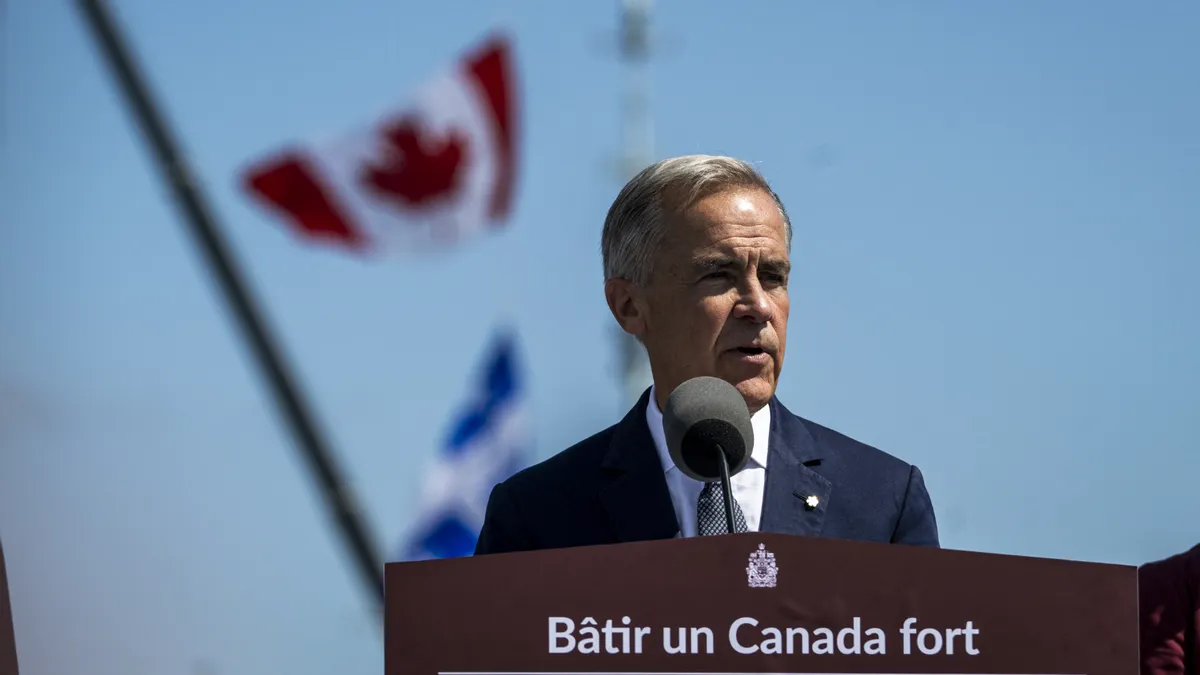
- The claim that Canada walked away from trade negotiations with the U.S. because President Donald Trump demanded changes to the country’s French language rules is still under investigation.
- The rumor stems from declarations by
Canada P rime Minister Mark Carney. In two separate speeches, Carney said that “at the last minute,” U.S. trade negotiators demanded that Canada bend rules designed to protect one of the country’s two official languages, French. - Carney said the rules specifically relate to Canadian and French-language content on online streaming platforms and
translation requirements for unregistered trademarks that are not in French . This was consistent with a 2025 report by the Office of the U.S. Trade Representative, which outlined these two rules as “trade barriers.” - U.S. Trade Representative Jamieson Greer said on Aug. 24, 2026, that the story was “fake” and Trump called Carney’s assertion a “lie.” The White House declined to comment further on the matter and Carney’s office referred us to his press conferences.
- On Aug. 26, 2026, Greer told Canada’s public broadcaster CBC that the U.S. negotiators “highlighted” rules about discoverability of Canadian French-language content for online streamers, but that these were “the farthest thing from a red line.” Instead, he said the U.S. was focused on the requirement for U.S. streamers to pay 5% of revenue to help develop and promote Canadian content.
- The next day, Dominic LeBlanc, Canada’s U.S.-Canada trade minister, said on X that the country “welcomes that the U.S. is now withdrawing its positions on discoverability and labeling and is confirming that measures to promote French language and Canadian culture will not be subject to future U.S. trade actions.”
The White House declined to comment on LeBlanc’s Aug. 27 statement. Snopes will update this report if or when additional information surfaces. We have reached out to Greer’s office and await a response.
In August 2026, a rumor spread online that Canada walked away from trade negotiations with the U.S. because President Donald Trump demanded changes to the country’s French language rules.
French and English are Canada’s two official languages. French is also the sole official language of Québec, the country’s second-largest province by area and by population.
The claim spread on social media, including Facebook and X. One X post said, “President Trump demands Canada change its French language, Quebec culture and Canadian identity as a condition for reversing tariffs” (archived):
The post included a video of
Meanwhile, Snopes readers emailed and searched the website seeking to confirm the rumor.
Carney and U.S. officials provided two different versions of the story, neither of which we could independently confirm without access to recordings or transcripts of their conversations. For this reason, we left the claim unrated.
In an email to Snopes, White House spokesperson Kush Desai declined to comment on whether the Trump administration asked Canada to change its French language rules. Instead, Desai claimed Canada rejected the deal to “demand continued one-sided access to the American market with no reciprocity.” In a Truth Social post, Trump also called Carney’s claim “a lie.”
On Aug. 24, 2026, U.S. Trade Representative Jamieson Greer referred to Carney’s claim as a “funny fake story.” Two days later, he told Canada’s public broadcaster CBC that U.S. negotiators had “highlighted” rules about discoverability of Canadian French-language content for online streaming services, but they we
We reached out to U.S. Trade Representative Jamieson Greer’s office for further comment and await a response.
Canada and U.S. trade accusations
In March 2025, the
The same report also mentioned a new rule in Canada regarding online streamers (Page 52 of the PDF document).
On Aug. 22, 2026, Carney said in a speech that one of the reasons Canada walked away from trade negotiations with the U.S. was
“We were not prepared to compromise on our sovereignty, the protection of the French language and our culture,” Carney said in French at the 13:17 mark in the video. “For our American colleagues, let’s be clear. These questions were never on the table, even if the U.S. tried until the last minute.”
“They asked too much and offered too little,” Carney said later in English.
Following Carney’s statement, U.S. Trade Representative Jamieson Greer said on CNBC that Carney’s claim was a “funny fake story,” adding that he he and his children speak French (at the 8:47 mark):
“I understand why the Québecois want to have French-language content and all of that,” Greer said, adding that the United States’ position was that a 5% contribution from U.S. online streamers was not acceptable.
Two days later, on Aug. 24, Carney spoke in Lévis, Québec, to announce a CAD$11 billion (approximately $8 billion) investment to build six specialized ships called icebreakers. A reporter asked him in French for details of the sticking points in trade negotiations with the U.S., wondering if the collapse was related to streaming service requirements or French language rules for products. In response, Carney said, in French (at the 01:08:27 mark):
First of all, it’s a fact, but it’s not funny. For the Americans, the questions of the French language, Québecois culture, francophone culture, Canadian culture, are “irritants.” [Carney gestured to make air quotes.]
No. Here in Québec, here in Canada, these are rights. Fundamental rights. Not irritants, rights. There is a huge gap between U.S. perspectives and Canadian perspectives.
Carney then went on to assert that the sticking
“The Canadian government says, each time, no, no, no, no, no,” Carney said in French. “The joke is over. It is not funny.”
In response, Trump posted on Truth Social on Aug. 25 that he “would never interfere with Canadians speaking French,” calling Carney’s assertion “a lie” (archived):
Desai also provided the following statement on behalf of the White House via email:
Canada was offered the most generous trade deal of any of America’s trading partners despite being overwhelmingly reliant on access to the American economy, which is over 12-times larger than Canada’s economy. Canada rejected that deal to demand continued one-sided access to the American market with no reciprocity.
An apparent concession
On Aug. 26, 2026, Greer told Canada’s public broadcaster CBC that the U.S. negotiators “highlighted” rules about discoverability of Canadian French-language content for online streaming services, but that these were “the farthest thing from a red line.” Instead, he said the U.S. was focused on the requirement for U.S. streamers to pay 5% of revenue to help develop and promote Canadian content. (The exchanged happened at the 8:27 mark.) Greer did not say anything about labeling.
The next day, Dominic LeBlanc, Canada’s U.S.-Canada trade minister, said on X the country “welcomes that the U.S. is now withdrawing its positions on discoverability and labelling and is confirming that measures to promote French language and Canadian culture will not be subject to future U.S. trade actions” (archived):
Québec’s separatist party, which led the polls in a provincial election scheduled for October 2026, ruled out a referendum on Québec independence before Trump leaves office.
For further reading, Snopes has covered several rumors related to U.S.-Canada relations since the beginning of Trump’s second term, including Trump’s proposal to rename Lake Ontario “Lake America.“
