


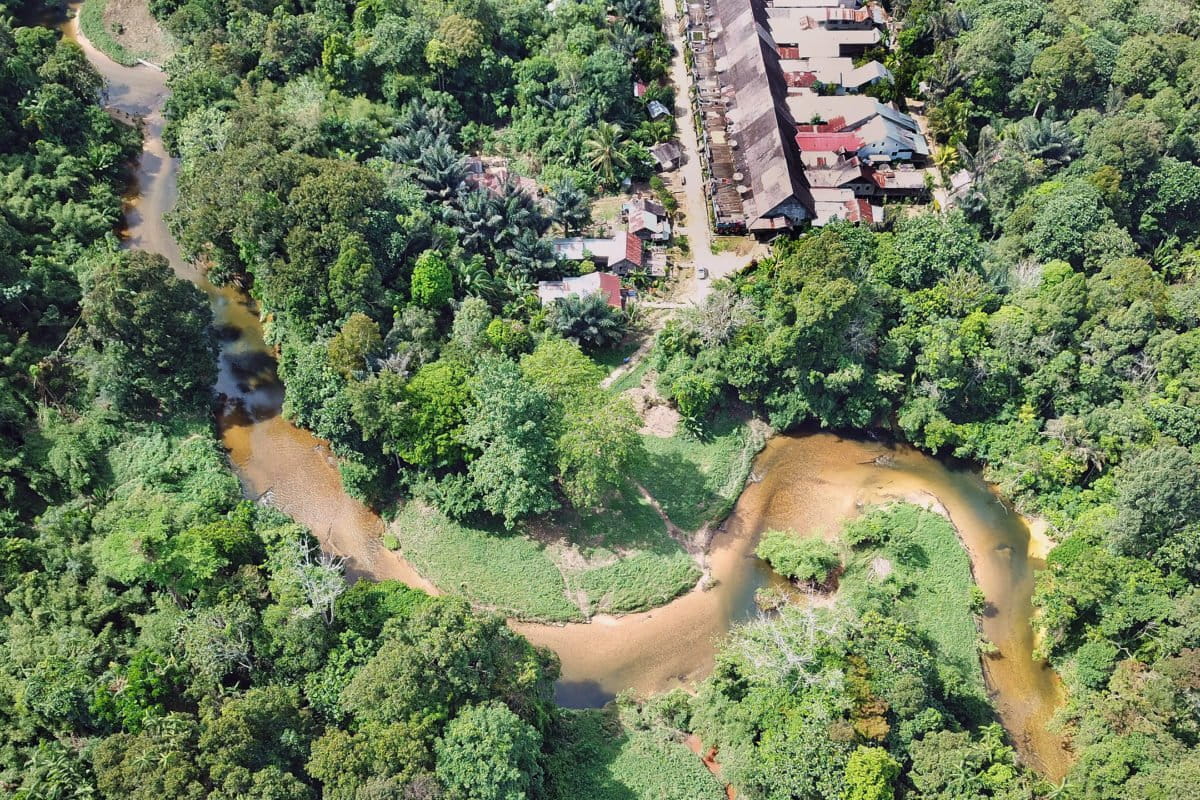
- As climate and economic shocks put pressure on tropical forests, a new study suggests support for rural communities could help protect forests while strengthening their ability to withstand crises.
- Forest loss in protected areas of West Kalimantan on the Indonesian part of Borneo fell during the COVID-19 pandemic, with a larger decline in villages receiving health and livelihood support, the study finds.
- The findings point to health care, alternative livelihoods and other social support as potential tools for easing pressure on forests and helping forest-dependent communities adapt to future economic and environmental shocks — although the study does not establish a direct cause-and-effect relationship.
Villages in Indonesia’s West Kalimantan saw less forest loss during the COVID-19 pandemic when conservation groups provided health and livelihood support, a new study has found, suggesting social safety nets can help protect forests during economic crises.
The peer-reviewed study, published last month in Lancet Planetary Health, suggests forest loss in West Kalimantan province on the Indonesian part of Borneo fell sharply during the pandemic, as weak timber demand and travel restrictions made logging less profitable and harder to carry out. At the same time, villages with access to alternative livelihoods and other support were less reliant on forests for income, the paper adds.
The researchers say their study is among the first to combine household surveys with detailed satellite data to examine how the pandemic affected rural livelihoods and forest loss in the same communities, offering a closer look at how economic shocks and social support can influence pressure on tropical forests.
“As the pandemic started, we expected economic hardships to cause illegal logging to increase again,” Skylar Hopkins, an assistant professor at North Carolina State University and the lead author for the new study, said in a statement.
Mapping deforestation trends
Before the pandemic, average forest loss was 52% lower in NGO-affiliated villages than in unaffiliated villages, the study finds. Indonesia has the world’s third-largest tropical forest area, a major store of biodiversity and carbon, long threatened by logging, agricultural expansion and fires.
The researchers surveyed 10 villages in West Kalimantan in late 2021: six communities supported by the health and livelihood NGOs Alam Sehat Lestari (ASRI) and Yayasan Planet Indonesia (YPI) and four nearby communities without such programs. They combined household surveys with satellite data and machine-learning models to track weekly forest loss and compare deforestation trends in 28 NGO-affiliated villages with those in other villages across the region, while accounting for differences in forest area and other factors that could influence forest loss.
Forest loss across three types of protected areas in the province was 39% lower during the pandemic than before March 2020, the study finds. Researchers compared forest loss from Jan. 1, 2018, to March 9, 2020, with the period from March 16, 2020, to Nov. 22, 2021. The decline in average forest loss was particularly pronounced in villages linked to health and livelihood programs, where it was 68% lower than in other villages during the pandemic, compared with a 52% difference before the pandemic.
The paper’s authors note that their findings suggest the programs may have helped communities reduce their reliance on forests as the pandemic disrupted incomes and access to markets. The study also finds that villages receiving support had more access to alternative livelihoods and outside assistance, which may have reduced pressure on forests.
Logging was reported by 7% of surveyed households, but the researchers say the figure may be understated because logging is illegal in protected areas. Where households had stopped logging, the authors found the main reasons were that it was prohibited, risky or less profitable than other work.
“COVID-19 is just one example of local and global disruptions creating challenges for health and conservation,” Giulio De Leo, a professor from Stanford University and co-author of the paper, says in the statement. “Our research shows that investing in health and livelihood solutions designed by communities can build resilience for both people and ecosystems.”

Reviewing the study’s findings
The study offers a useful contribution by showing through data how falling logging profitability, mobility restrictions and natural conditions helped reduce forest loss during the pandemic, while NGO support appeared to strengthen communities’ access to lower-impact livelihoods, says Gita Syahrani, founder and executive director of sustainability-focused nonprofit BLESS Indonesia, who was not involved in the research but reviewed it after a request by Mongabay.
She says the findings reinforce the link between human well-being and forest health, but adds that the study’s conclusions should be examined carefully to determine whether they indeed establish cause and effect.
According to Gita, similar approaches have been used elsewhere in Indonesia, including efforts to develop snakehead fish and pineapple in Siak in Riau province in Sumatra, products from tengkawang trees and nuts in Sintang in West Kalimantan in Borneo, and community conservation and carbon schemes in Jambi province in Sumatra.
The study could further consider the role of local individuals who drive change, the need for clear divisions of responsibility across value chains to ensure livelihoods remain viable, and the long-term trust and relationships needed to change community behavior, she adds.
Transition to sustainable alternative economies would require action at the right scale, says Gita, who notes that villages cannot protect forests alone when provincial and district policies, investment and budgets still favor resource extraction.
She says viable business models, along with market access, financing, technology, skills and policy support, are needed to make alternative livelihoods sustainable, while individuals driving change also need support to navigate uncertainty, competing interests and pressure.
“A transition to sustainable alternative economies therefore needs to be viewed holistically, including its relationship with health considerations and the urgency of disaster prevention,” Gita tells Mongabay in an email.
West Kalimantan is home to extensive tropical forests and peatlands that support millions of people, store large amounts of carbon and provide habitat for endangered wildlife including Bornean orangutans (Pongo pygmaeus). The province faces continuing pressure from forest clearing for agriculture and plantations, logging, mining and fires.
Recent fires have burned tens of thousands of hectares in the province, threatening forests and orangutan habitat, while land clearing for oil palm has also damaged areas being restored for wildlife. Conservation efforts have increasingly combined forest monitoring, habitat restoration, fire prevention and community involvement to address these pressures.

Basten Gokkon is a senior staff writer for Indonesia at Mongabay.
See related story:
Illegal loggers use pandemic as cover to ramp up activity in Sulawesi
Citations:
Hopkins, S. R., Hazel, A., Pourtois, J. D., Chamberlin, A. J., Gajewski, Z., Harryman, I., … De Leo, G. A. (2026). Pandemic impacts on protected rainforests and rural communities with variable health and livelihood support in West Kalimantan, Indonesia: A mixed-methods approach combining household surveys and remote sensing. The Lancet Planetary Health, 10(6), 101455. doi:10.1016/j.lanplh.2026.101455
FEEDBACK: Use this form to send a message to the author of this post. If you want to post a public comment, you can do that at the bottom of the page.

