


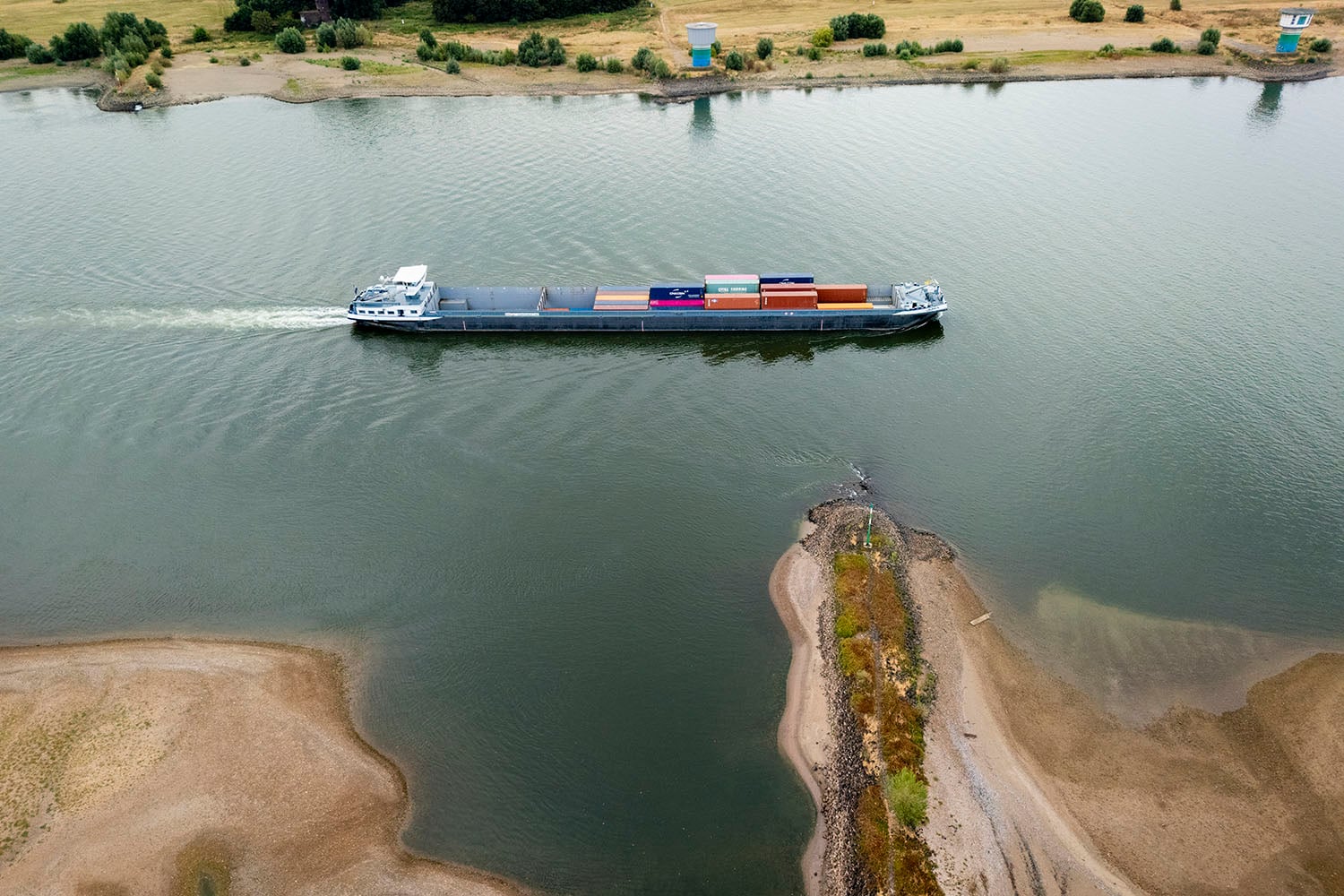
The Rhine River recently reached a depth of only 21 centimeters in the German town of Kaub—the lowest reading since Germany started keeping records at that gauge in 1880. The significance of those low water levels is vast. Culturally, the Rhine has long been central to German national identity—the border that has been fought over for centuries and memorialized in famous poetry and operas. Economically, the Rhine is connected to the planet’s largest chemical complexes. These days, the barges that go down the Rhine are moving at just a fifth of their full capacity.
Why is the Rhine administered by one of the world’s oldest international organizations? Is the Rhine drought of global economic significance? And what aspects of human history are being revealed by the Rhine’s receding waters?
Those are just a few of the questions that came up in my recent conversation with FP economics columnist Adam Tooze on the podcast we co-host, Ones and Tooze. What follows is an excerpt, edited for length and clarity. For the full conversation, look for Ones and Tooze wherever you get your podcasts. And check out Adam’s Substack newsletter.
Cameron Abadi: The Mannheim Act of 1868 first internationalized the navigation of the Rhine; it also established the Central Commission for the Navigation of the Rhine, which is the organization still responsible for governing shipping today on the river today. Is this the oldest continuously operating international organization in the world?
Adam Tooze: Some people claim that it is. It certainly goes back a long way. It was a product of the Congress of Vienna of 1815. That’s what set this in motion. This was the great peace conference after the Napoleonic Wars, perhaps the classic demonstration of the kind of logic, not to say wisdom, of post-revolutionary conservative geopolitics: the idea that you could organize the world in a concerted way, a kind of concert of powers that would manage the world, the dream of Henry Kissinger and everyone that came afterward in the 20th century. This had a technological side. And that was—in this case, before the advent of railways—the management of waterways. And out of that came a convention signed at Mainz in 1831 that began to remove those river tolls that were so pesky and that Kaub was all about.
And it’s out of that that the Mannheim Act was signed in 1868. The timing is not altogether accidental. The mid-19th century is the moment of the emergence of modern internationalism. I mean, I immediately thought, “Well, what about the international Red Cross, which is also a product of that same moment?” It comes into existence in 1863. The first big scientific congresses began to meet internationally in the 1850s. The great exhibition of 1851 was the biggest trade fair in history. So, this mid-19th century moment is precisely where you would expect this kind of institution to emerge from.
I think you would say it’s a powerful confirmation of the basic logic of what in international relations theory is called functionalism. In other words, that there is great-power politics, which produces the tragedy of international politics, which is the security dilemma. My security is your insecurity, and the more security I search, the more insecure you become. And so, there is this problem, this tragedy of international relations. But there is another liberal functionalist view that says, “Hold your horses, that’s all very well. Yes, states do conflict, but we also have all these common interests.” And so, it’s not surprising that we see institutions and innovations emerging to take care of those common interests along functional lines. This was a theory that really took off in the early 20th century and is commonly invoked to explain things like European integration. Because in the end, on this same border bisected by the Rhine, there are Germans, French, Belgians, and Dutch. And it all turns out that they actually all have profoundly similar and identical economic interests, which lead to things like the coal and steel community and the European common market in the 1950s.
And this, a hundred years earlier, would be the kind of seed of that logic, which is, “Hey, we may fight wars, but in the end, this is a waterway and we’ve got to figure out how to manage it, and so let’s do some internationalism.’ And then there’s only so many times you can sit down with your counterparts from the other side of the Rhine and agree on technical management logics without constituting some kind of community that transcends pure national interest and security logic. And so, I think you could invoke this as a rather striking example of that kind of functionalist logic in international relations.
CA: There has been a lot of discussion in Germany about the economic impact of the drought in the Rhine. But is this drought also of global significance?
AT: Well, I mean, I think we probably shouldn’t overrate it. Only about 5 percent of German logistical traffic goes on waterways at all, and 80 percent of that is the Rhine. But when the Rhine is disrupted, it does have a big impact. So, when there were the big floods in 2018, the flooding took, I think, 0.3 to 0.4 percent off German GDP, which is roughly what Germany is expected to grow at this time.
So, I mean, part of the attraction of this story at the current moment is that the German economy’s pulse rate is so goddamn low that anything that disrupts it threatens to upheave, obstruct .and violate any further prospect of economic growth. And then there’s the other thing about this, which is that it sits at the nexus of one of the most symbolic elements of German capitalism, which is the chemicals industry. And BASF, which sits in Ludwigshafen and is a Rhine-based heavy chemicals business. And if you think of the three big, iconic names of German industrialism in the 20th century, one would probably be Krupp making steel, and another one might be Mercedes-Benz making cars. And the one in the middle is Rhenish chemical capitalism. And that’s IG Farben. And IG Farben’s core component, the heavy chemicals component of IG Farben, the people that won the Nobel prize for the Fritz Haber-Carl Bosch process is BSF in Ludwigshafen, their business is centered on this axis.
They also were the driving force in the huge debate in 2022 during the early phase of the war in Ukraine over the question of whether Germany could do without Russian gas. Again, in the end, it was BASF that was at the core of that conversation, because they take a lot of Russian gas as their feedstock. So here, when we start tweaking these elements of the German system, we see not just really huge pieces of GDP so much as highly symbolic elements of the German industrial and economic system showing their vulnerabilities. BASF is a rich company; they’ll find ways of accessing the raw materials they need. But to find themselves at the mercy of weather, heat, temperature, and rock formations in the Rhine and medieval castles just makes for a kind of configuration of history that is that is truly, truly peculiar.
And it’s one, I think, that we have to start getting used to. And when you look at the numbers, it’s kind of bonkers. When you especially look at the Kaub bottleneck, there’s a rock formation there that costs a couple of million euros, probably, to shave off. And they just haven’t gotten around to doing it. And all of a sudden, you’ve got a fraction of 1 percent of GDP on the line that might be disrupted here. And the ecologists will say, ‘Well, just digging the ditch deeper, the channel deeper won’t add water to the Rhine.’ That is absolutely true, it won’t fundamentally change the ecological challenge here. But Germany right now is like an aged, arthritic economic system that is facing a series of combined pressures on it. And so, I think it just does rather vindicate that kind of story that this notionally highly sophisticated powerhouse industrial economy could find itself at the mercy of the question of whether the water level is one or two inches too high or too low. It’s extraordinary.
CA: As the water recedes, World War II munitions and sunken vessels are being revealed, and so are hunger stones, carved warning markers from other historic droughts. What is the significance of this archeology of human history that we’re now encountering?
AT: The hunger stones are these extraordinary objects that literally have on them the inscription, “If you see this line, weep.” In other words, you’re going to have a terrible harvest and there’s going to be famine. It’s quite the message.
Yes, this is part of the story of these places, which takes us right back to your wonderful question at the opening: What do these rivers do? Because they’re both channels of communication and zones of conflict. And right now, it’s not just the Rhine that’s affected by very low water, but the entire European river system. And this has been most dramatic in the Danube, where there’s extremely low water levels, as well. And what’s come to the surface is an entire fleet of, I think, 200 vessels that the Wehrmacht, the retreating German army, sunk deliberately into the Danube River to block presumably Soviet maritime forces coming up from the Black Sea, I guess. And so, then Serbia and other countries are having to sort out how they deal with this detritus that’s emerged from the late war stage.
And so, this is another one of these extraordinary effects of what we used to call the anthropocene, this collective massive transformation of the ecological system that we are sited within it. All of a sudden, the effects of the ensuing crisis are that they expose things that we thought were buried forever and that were out of reach. And no, they’re coming back now. Skeletons of forgotten battles are coming back to view.
