


Welcome back to Foreign Policy’s Situation Report.
Here’s what’s on tap for the day: Rising settler violence in the West Bank, the CIA director’s visit to Moscow, and North Korea’s disinterest in meeting with Trump.
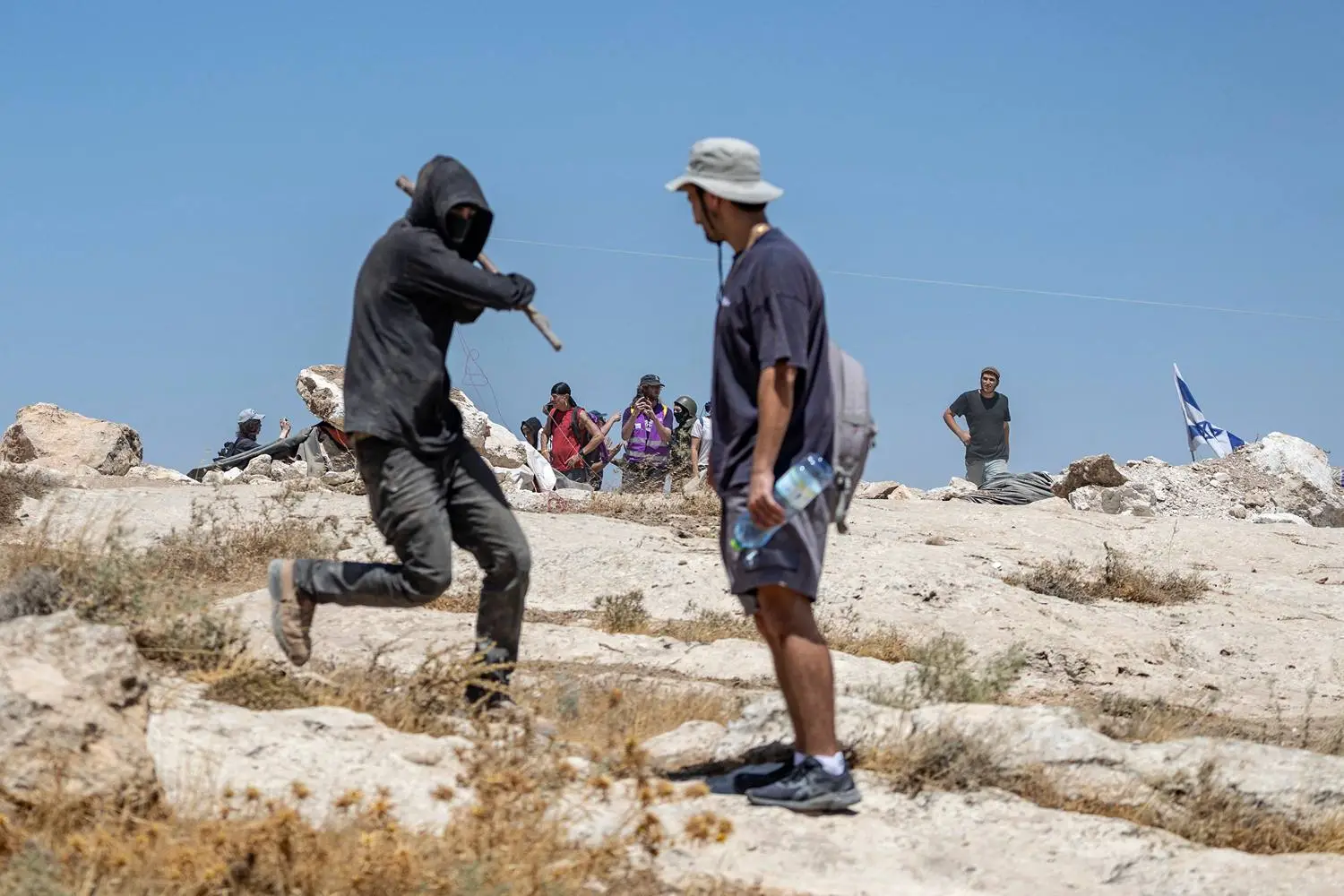
Violence by Israeli settlers against Palestinians in the occupied West Bank is spiraling out of control, and the Israeli government is facing growing global criticism—including allegations that it has poured fuel on the fire by embracing far-right policies and ignoring the problem. Settlers have clashed with Israeli forces in some instances, but the military has also been accused of standing by during attacks on Palestinians. Top rights groups have characterized settler violence in the West Bank as state-sanctioned ethnic cleansing.
Israeli Prime Minister Benjamin Netanyahu’s government has given unprecedented support for the expansion of West Bank settlements, which are illegal under international law. The push for more settlements has been driven by far-right Israeli politicians such as National Security Minister Itamar Ben-Gvir and Finance Minister Bezalel Smotrich, who have been sanctioned by governments including the United Kingdom, Australia, Norway, Canada, and New Zealand for “their repeated incitement of violence against Palestinian civilians.”
Though settler violence has been an issue for years, the problem has reached a fever pitch in 2026. Since the beginning of the year, there’s been an average of 6.6 settler-related incidents per day in the West Bank that resulted in casualties, property damage, or both, according to a recent report from the United Nations Office for the Coordination of Humanitarian Affairs (OCHA). The United Nations has warned that this year has seen the highest rate of settler violence on record.
Political considerations. The surge in violence comes ahead of Israel’s highly anticipated elections in October. Netanyahu’s critics have contended that his weak response to the violence is driven in part by his desire to avoid antagonizing the extremist politicians propping up his shaky coalition government.
This week alone saw two high-profile incidents: One in which a far-right Israeli lawmaker smashed a Palestinian monument in the West Bank under the observation of Israeli soldiers (the Israeli military said soldiers stopped the demolition “within minutes”), and one where settlers (including children) threw stones at AFP journalists and left-wing activists. At least five people were injured in the latter incident, which reportedly saw an Israeli soldier temporarily confiscate the camera of one of the journalists. (It’s worth noting that Israeli soldiers in the past have fatally shot Palestinian children for allegedly throwing stones at civilian vehicles.)
In July, Netanyahu said that settler attacks were not reflective of the broader settlement community and perpetrated by “150 or so, what you call, juvenile delinquents.” In response to the recent vandalism of a Palestinian monument by the Israeli lawmaker, Netanyahu said that public officials shouldn’t “take the law into their own hands.”
Under pressure. As the situation worsens, Netanyahu is facing growing international pressure to take stronger action—including from the United States. Even U.S. Ambassador to Israel Mike Huckabee, a longtime supporter of settlements, has spoken out, decrying violent settlers as “Israeli terrorists.” (John recently wrote about this.) But the Trump administration more broadly has largely avoided sharp or direct criticism of the Israeli government on the matter, even as the situation has impacted Palestinian Americans.
“We are in regular dialogue with partners about improving stability and security in the West Bank,” a State Department spokesperson said on background earlier this week, adding, “We condemn criminal violence by any party in the West Bank.”
But Democratic senators—including a number with strong pro-Israel records—are urging Netanyahu to step up his response.
“We urge you to take measures to prevent and intercede in this violence, establish a credible mechanism to investigate violations of law, and to make clear that the Government of Israel will not tolerate violence by its people, just as it does not tolerate violence against its people,” dozens of Democrats led by Sens. Adam Schiff, Chuck Schumer, and Cory Booker said in a letter to Netanyahu.
On Monday, the most senior Israel Defense Forces (IDF) officer in the West Bank reportedly warned Netanyahu that rising settler violence in the West Bank could “ignite” a wider escalation and was making it harder to thwart “Palestinian terrorism.” IDF Chief of Staff Lt. Gen. Eyal Zamir on Thursday announced that he’s ordering a significant increase of troops in the West Bank amid the tensions in the Palestinian territory.
The U.S. Department of Defense last week fired the publisher, editor in chief, and a reporter from the military newspaper Stars and Stripes because of alleged “insubordination,” intensifying the Pentagon’s crackdown against media coverage it doesn’t like. Stars and Stripes is partially funded by taxpayer dollars but has traditionally been editorially independent. Ousted editor in chief Erik Slavin told CBS News in an interview on Monday that he hoped the newspaper would “remain independent in some way,” describing his firing as a “real shock.”
What should be high on your radar, if it isn’t already.
Ratcliffe’s Russian roulette. CIA director John Ratcliffe’s sudden trip to Moscow earlier this week was meant to warn Russia against attacking NATO countries, the Wall Street Journal reported, citing people briefed on the visit. The trip, during which Ratcliffe reportedly did not meet Russian President Vladimir Putin, came after new U.S. intelligence assessments indicated that Putin could seek to launch a limited attack on a member of the trans-Atlantic alliance in the coming years.
On Thursday, Russia’s foreign ministry warned that the country’s military could strike U.K. military targets inside and outside Ukraine in retaliation for Britain continuing to provide Kyiv with long-range missiles used to attack Russia.
Cyber crisis. It’s been a bad few weeks for cybersecurity, and it’s only getting worse. Multiple U.S. agencies including the FBI and the National Security Agency revealed on Wednesday that a China-linked hacking group has spent years targeting several U.S. government systems including at the Department of Energy, NASA, the Federal Reserve, and the U.S. Senate.
The group, dubbed QTFY, has been active since 2018, the agencies said in an advisory. While many of the attempted intrusions were unsuccessful, the advisory indicates that the group managed to gain access to some networks. Separately, a cyberattack on a company that runs three U.K. airports reportedly compromised the data of 8.7 million customers. The incidents follow a series of cyberattacks against local water systems across the United States in the past month, believed to be the work of Iran.
Humanoid robots fall after hitting the crash barrier in the finish area of the 100-meter final in the small robot category at the 2nd World Humanoid Robot Games in Beijing on Aug. 26.
U.S. President Donald Trump has been pushing for a meeting with North Korean leader Kim Jong Un, but Pyongyang doesn’t seem interested. For insights on why North Korea is giving Trump the cold shoulder, John spoke with Sydney Seiler, a former national intelligence officer for North Korea at the U.S. National Intelligence Council. The gist: Kim is done talking about denuclearization.
“Kim’s longer-term diplomatic strategy is to just wait out countries until they come to the realization that we have to live with a nuclear North Korea,” Seiler said. “Any type of engagement with the United States at this time that doesn’t look like a near-total capitulation by the United States to that logic is actually detrimental to North Korea’s interests.”
FP Insiders can read the full interview here. (If you’re not an FP Insider yet, you can subscribe here for VIP access to exclusive content, ad-free web browsing, and more perks.)
Monday, Aug. 31: U.S. Treasury Secretary Scott Bessent hosts a meeting of G-20 finance ministers and central bank governors.
Kyrgyzstan hosts the Shanghai Cooperation Organization summit.
Wednesday, Sept. 2: Estonia holds a presidential election.
Thursday, Sept. 3: Spanish Prime Minister Pedro Sánchez is set to address the country’s parliament on the enclave of Ceuta, over which Spain is currently locked in a dispute with Morocco.
“I have a lot of real estate on my ass, so he has a lot of room to kiss my ass.”
—Ontario Premier Doug Ford, referring to Trump. Amid the escalating U.S.-Canada trade war, the two men have been fighting a war of words complete with name-calling and personal insults.
Talk about a diplomatic downgrade. Several foreign ambassadors in Washington received VIP invites to Trump’s “Freedom 250” IndyCar race last weekend—only for those invites to be rescinded the night before and replaced with general admission tickets via Ticketmaster, the New York Times reported. A State Department official told the Times that the sudden cancellations were “due to a change imposed by private event organizers.”
