


A group of environmental organizations announced their intent to sue the United States National Marine Fisheries Services (NMFS) for failing to consider protections for Eastern Pacific gray whales under the Endangered Species Act (ESA).
Gray whales (Eschrichtius robustus) are experiencing a potentially catastrophic population decline, a sharp reversal from what had been considered a conservation success. In 2019, there were roughly 20,500 gray whales; by 2023, the population had declined to just 14,526 individuals, “nearly 30% of the entire population” gone in four years, according to nonprofit Public Employees for Environmental Responsibility (PEER).
Like many whale species, gray whales are being killed by ship strikes and entanglements, but scientists attribute most of the recent mortality to climate change and disruptions to the Arctic food web on which the gray whales depend. They “seem to be starving” to death, PEER said.
The whale’s population was greatly reduced by a century of whaling, but in 1973, ESA protections helped the species recover and they were delisted in 1994. Given the recent population collapse, environmental groups petitioned NMFS in 2025 to relist the whales, which would afford them additional protections. The agency should have published a 12-month finding by Aug. 24, 2026. They didn’t, so the group has sent a notice of intent to sue for violations of the ESA.
“The Trump administration has once again broken one of the nation’s bedrock environmental laws — the ESA — by failing to respond to our August 2025 petition to list gray whales under the Act,” Rick Steiner, founder of Oasis Earth, said in a news release, referring to U.S. President Donald Trump. “NOAA’s own science shows the gray whale population to be in grave danger due to Arctic climate change and other threats, and the government is now required to afford the whales all additional protections provided by the ESA.”
Mongabay requested a statement from the National Oceanic and Atmospheric Administration, which oversees NMFS, on the delay. In an email spokesperson Michael Milstein said, “Our policy is not to comment on litigation matters.”
“The sudden collapse of the gray whale population has come as a shock,” said Mark J. Palmer, associate director of the International Marine Mammal Project in the release. “This catastrophic decline may result in the loss of the entire population in as soon as 10 years if current conditions continue. Listing the species is an important step in marshalling support for the grays.”
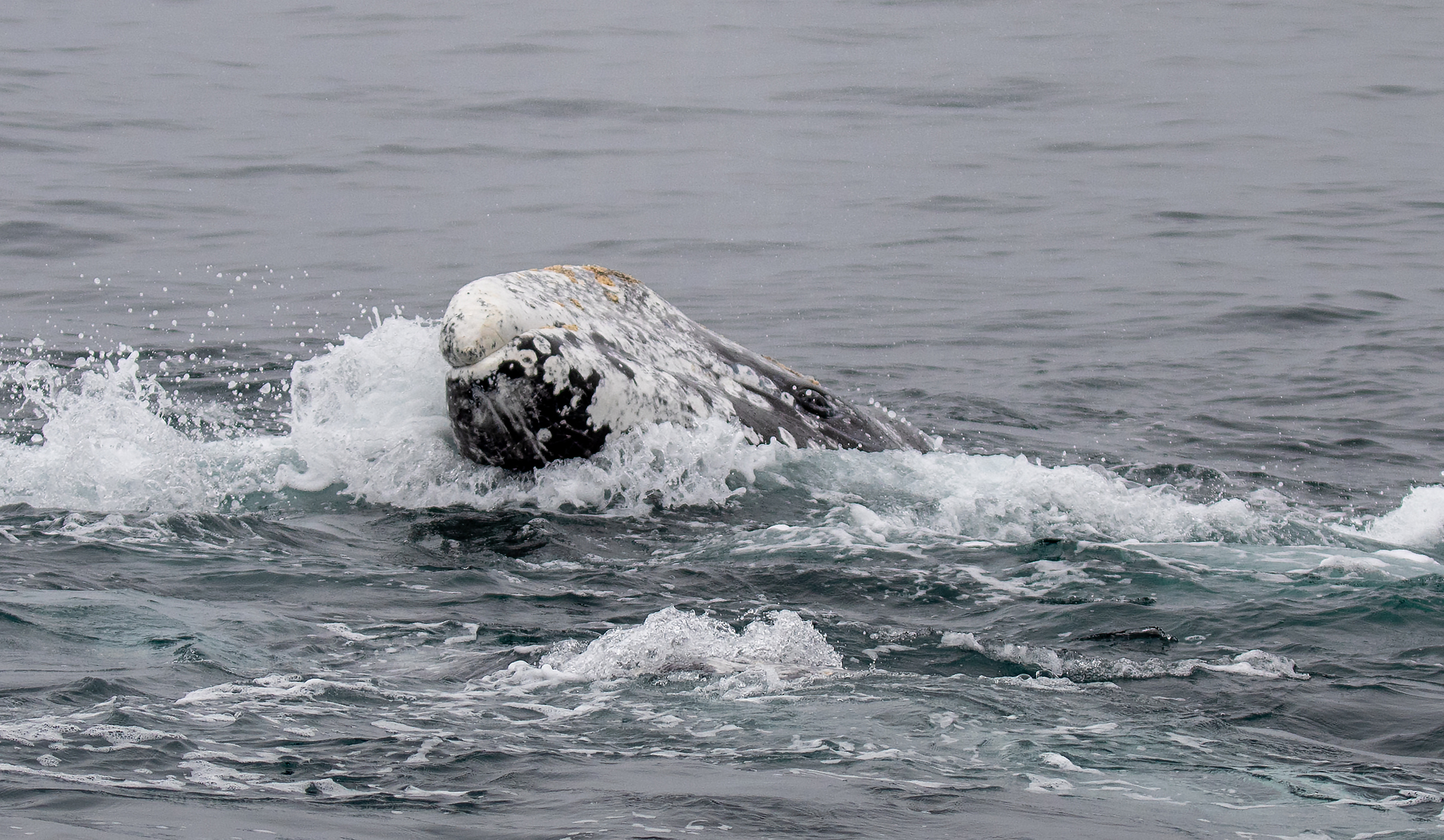
Banner image: Of a gray whale. Image courtesy of Robin Gwen Agarwal via iNaturalist (CC BY NC 4.0).
