


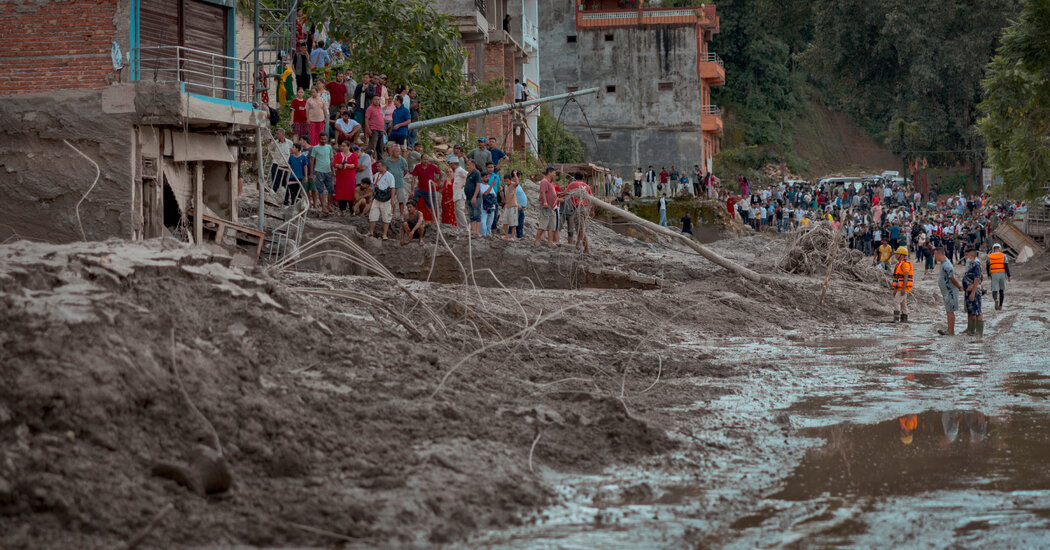
Nepal’s early flood warning system relied on a conventional network of river gauges that was ill-equipped to sufficiently alert locals of the deadly wall of water that swept through the country’s valleys on Wednesday, according to scientists and disaster response researchers.
Geologists believe that the catalyzing event for the flash floods in Nepal and Tibet was a dual high-altitude landslide and glacial avalanche that unleashed huge volumes of water. Experts in disaster response say that the speed of the cascade, coupled with its extremely remote origin in the Himalayan mountains, made it nearly impossible for Nepal’s warning system to alert residents in time to move to safer ground.
According to those experts, Nepal deploys a system of gauges in rivers and lakes that is designed to detect the slower rising water levels that typically precede a monsoon-driven flood or glacial lake outburst flood, which occurs when a pool of glacial meltwater bursts its banks.
By the time Nepal’s system of river gauges would have detected the fast-moving flash flood on Wednesday, it was almost certainly too late, the experts said. The torrent engulfed villages, killed hundreds of people, and left more than 1,000 others missing.
“We didn’t have the right information at the right time, so we couldn’t save more people,” said Basanta Raj Adhikari, director of Tribhuvan University’s Centre for Disaster Studies in Nepal. “The Nepalese government is very good on monsoon floods and perennial floods, but we were not prepared for this fast-moving flash flood,” he said.
“The flood developed so rapidly that people simply did not have enough time to get to safety, even though the system was functioning,” said Shushil Kumar Shrestha, senior divisional engineer at the National Disaster Risk Reduction and Management Authority. He added, “The challenge this time case was the extremely short window between the onset of the event and the arrival of the flood.”
Kristen Cook, a geomorphologist at the Université Grenoble Alpes in France, said the network of river gauges installed by Nepal’s Department of Hydrology and Meteorology was extensive but ill-equipped to detect cascades of water displaced at such volume and speed. “The challenge for events like this is that the gauges just get destroyed,” she said.
By the time the water has arrived at the river gauge, which is typically installed on a bridge or somewhere that’s inhabited, it would be too late, Dr. Cook said.
Another practical challenge was the remoteness of the initial landslide on Wednesday, said Austin Lord, an anthropologist and senior fellow at the Stimson Center in Washington who has studied natural disasters in Nepal. Dr. Lord said the landslide was in a “blind spot” on the northern side of Nepal’s Langtang mountain range, an area that he said was scarcely populated and barely monitored by geologists.
“These types of large-scale slope failures, if you’re not looking at this area and detecting deformations in the landscape, it would be very hard to know when all of a sudden it breaks loose,” he said.
“In terms of early warning, it’s really hard for events like this,” said Stuart Dunning, a professor of geomorphology at Newcastle University. “This is not a glacial lake where you know exactly where the source of the flood water is going to be coming from.”
One solution for detecting flash floods initiated by sudden landslides, suggested Dr. Cook, would be to install early warning systems that spot unusual levels of seismic activity, rather than monitor water levels.
These could have alerted downstream communities of a sudden landslide like the one that unfolded on Wednesday, she said, which was so powerful that the U.S. Geological Survey registered it as a magnitude 5.2 seismic event.
Another option would be to improve satellite-based systems that remotely sense changes in the environment that could hint at an impending landslide or avalanche, said Dr. Lord.
“But there’s no single network that can be optimized for all hazards,” he added. “You have to set up a series of different systems that can detect a different mix of hazards until they’re overlapping.”
Warming temperatures caused by climate change underscore the need to set up those systems, he said. “Earthquakes, landslides, slope failures all could happen even without climate change,” he said. “It’s just that climate change is this additional factor that increases the likelihood, scale, frequency and intensity of these events.”
