


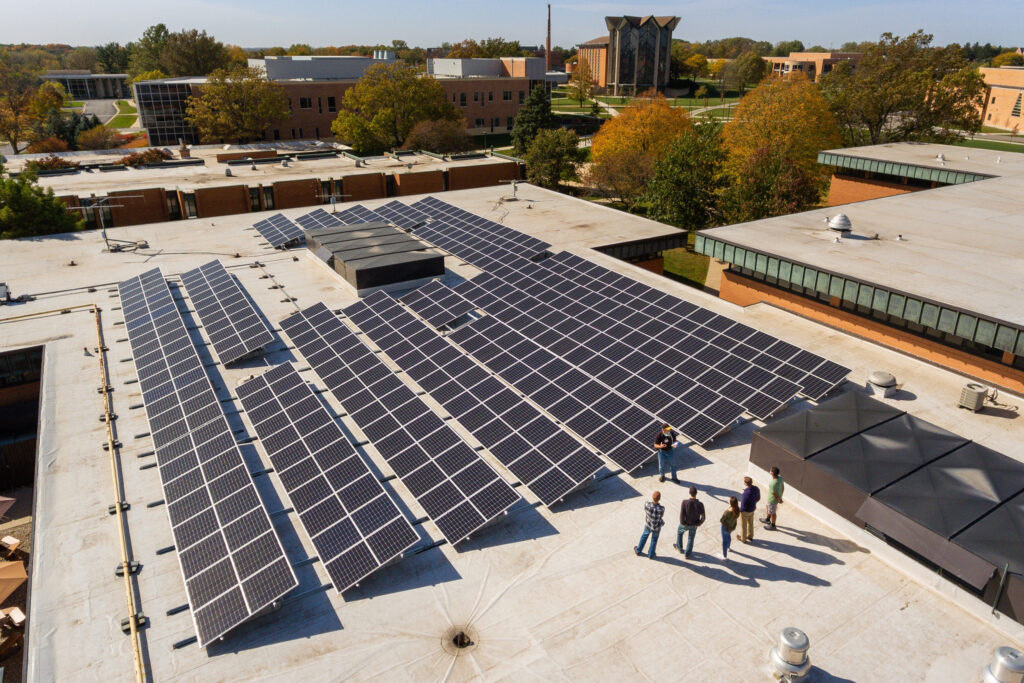
Rooftop solar installers feel like a dog that’s been repeatedly kicked.
President Donald Trump has made solar more expensive—or at least slowed the long-term decline in costs—by imposing tariffs on imported photovoltaic panels and other parts. Trump also signed a measure last year that phased out the main federal tax credit for rooftop solar.
The policy shifts have led to significant decreases in sales for installers, based on my conversations this week.
Wood Mackenzie, a research firm, projects that new residential solar generating capacity will fall 21 percent this year compared to 2025. That’s enough to put many U.S. solar companies out of business and to force those that remain to slash costs.
“It’s been a chaotic year,” said Cindy Rohaly, co-owner of GAI Energy, a designer and installer of solar and energy storage systems in Flora, Indiana, northwest of the Indianapolis metro area.
The company has been in business since 2008, initially named Green Alternatives Inc. That’s long enough to be used to the “solar coaster,” the term that people in the industry use to describe ups and downs often related to changes in government policy.
This downturn is unusually challenging, Rohaly said, and it’s made worse by the suddenness of the policy shifts, such as the escalating tariffs with Canada that took effect in the last week.
She runs the business with her husband, Chris Rohaly, and they have about 10 employees.

“It’s been a madhouse,” Chris Rohaly said, adding that there is “a lot of mistrust in the industry and in the market right now.”
When Trump signed the bill phasing out solar tax credits last year, buyers of residential rooftop solar had until the end of the year to get projects installed and still qualify for the 30 percent credit. Buyers rushed to place their orders and installers enjoyed a busy few months.
Customers who want solar installed at businesses—which are typically larger than the systems on residential rooftops—have more time under current law, with projects needing to have begun construction by July 4, 2026, and be complete by 2030. If a project didn’t start by July 4, then it has to be complete by the end of 2027.
Most of the current work at GAI Energy is for commercial and industrial businesses, largely due to the availability of tax credits.
Roger Horowitz, vice president for Go Solar programs at Solar United Neighbors, said he has been pleased that his nonprofit continues to see strong interest in its solar-buying cooperatives despite the broader challenges. The process of setting up cooperatives across the country gives him insight into what’s happening in the industry.
“The companies that are going out of business that I see [are] the really small ones and the really big ones,” he said.
The reasons vary, but often come down to large companies struggling to keep up with debt from expansion, and small companies being unable to book enough projects to cover the cost of operation.
The largest casualty has been Freedom Forever of California, which was active in about 30 states. It filed for bankruptcy in April and is now selling off assets. The fall of Freedom Forever has rippled across the industry because the company often did installations on behalf of other rooftop solar businesses, such as Sunrun.
I don’t have a reliable estimate of the number of U.S. rooftop solar businesses or how many have closed.
Data from the latest Solar Jobs Census from the Interstate Renewable Energy Council show that solar installation companies employed about 178,713 people in 2024. Of that total, about 45 percent install residential systems, which is more than any other segment, followed by 33 percent who install utility-scale systems.
The rise of regional and national solar installers has helped change an industry that sprouted from highly localized small businesses. Sunrun, based in California, is the largest in the country based on market share.
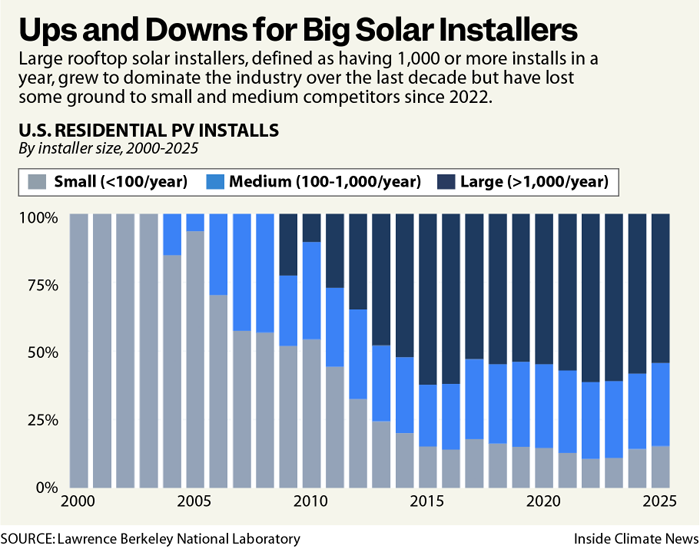
The shift toward larger businesses can be seen in newly released data from Lawrence Berkeley National Laboratory, which shows that large installers, doing more than 1,000 projects annually, had 54 percent of the market in 2025. Installers of this size didn’t exist until 2009 and have had at least 50 percent of the market since 2014.
Small installers with 100 or fewer projects per year had 15 percent of the market. This category includes GAI Energy in Indiana.
The Lawrence Berkeley figures are part of an annual report that analyzes the changes in rooftop solar. One of the crucial long-term variables is that the median installed price has fallen substantially, due to production efficiency and other factors, from $15.72 per watt in 2001 (adjusted for inflation to 2025 dollars) to $3.62 per watt in 2025. This translates to a cost of about $22,000 for a 6-kilowatt system.
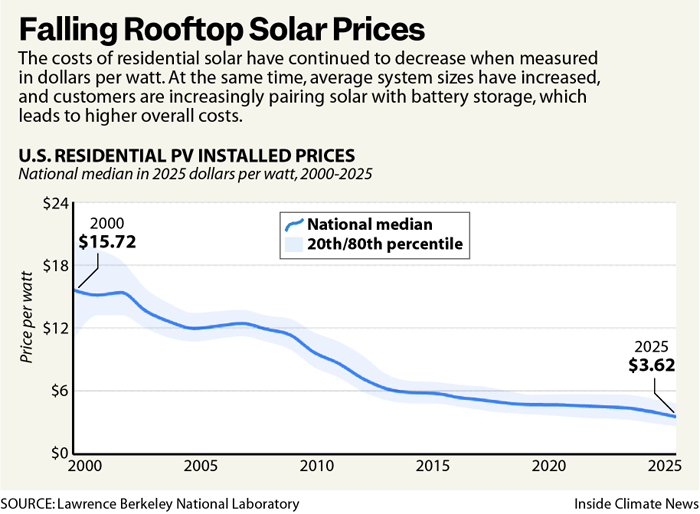
But other variables are contributing to an increase in the total cost of projects, such as growth in the size of the average system and the popularity of purchasing battery energy storage to work alongside solar.
Looking ahead, Wood Mackenzie projects small increases in residential rooftop solar installations every year through 2031. Even so, the estimated new installations in each of those years would be much less than the all-time high in 2023, the year after President Joe Biden signed the Inflation Reduction Act, a measure designed to encourage growth in solar power.
Max Issokson, a Wood Mackenzie analyst, said there is reason for solar installers to be optimistic despite the challenges. The main reason is that utilities keep increasing electricity prices, which stokes demand for customer-owned solar.
“A lot of installers are continuing to bet on rising electricity prices, and there’s a lot more consumer interest in solar and storage due to the amount of coverage that data centers in AI are getting in the news, and sort of how that relates to future power prices,” he said.
This story is funded by readers like you.
Our nonprofit newsroom provides award-winning climate coverage free of charge and advertising. We rely on donations from readers like you to keep going. Please donate now to support our work.
But installers will need to adapt to changes, Issokson said. For example, customers are likely to look to installers to do more maintenance as systems age. As some companies have gone out of business, installers will need to learn how to service systems that were sold by others.
Another trend is the growth of virtual power plants, which are networks of solar and batteries that support the grid. Virtual power plants hold the promise of additional income for solar companies and consumers, but they bring additional complexity, Issokson said.
Back at GAI Energy, the co-owners said stability will depend on having more predictable policies, and they don’t know when that might happen.
“This year, every change has served to confuse not only the industry but customers,” said Cindy Rohaly. “That’s really been the hardest thing to get at.”
Other stories about the energy transition to take note of this week:
Global Renewable Energy Investment Falls: Global spending on renewable energy fell to $327.5 billion in the first half of this year, a slight decrease from the second half of 2025, and also down from the first half of 2025, according to BloombergNEF. Investment was down 21 percent compared to the peak in the second half of 2024. One area of growth was projects that combine utility-scale solar and battery energy storage. U.S. spending increased as developers sought to qualify for expiring tax credits and initiated projects to help meet electricity demand from data centers.
Trump Seems to Like Batteries, Which Is Rare for an Energy Transition Technology: When the Trump administration canceled tax credits for energy technologies, batteries were notable for keeping their tax incentives. Now, the administration is devoting billions of dollars to help develop batteries, as Brad Plumer reports for The New York Times. But Trump’s opposition to consumer tax credits for EVs is undermining the idea of battery dominance, since EVs are one of the main end uses for advanced batteries.
Vehicle-to-Home Charging Expands in California: The utility Pacific Gas & Electric said this week that it is expanding a program to allow customers to use their electric vehicles to provide power to their houses and other uses, adding models from Nissan, Volvo, Polestar and Kia, among others, as Suvrat Kothari reports for InsideEVs.com. Customers can receive incentives to help cover the costs of setting up a charging system, enabling the two-way flow of electricity between the vehicle and the home.
Tesla Has Stopped Selling Solar Roof Tiles and Is Refocusing on Solar Panels: At one time, Tesla touted its solar roof tiles as a groundbreaking product, but sales were disappointing and the company has talked little about them in recent years. So it’s no surprise that Tesla has now discontinued the tiles and will focus on selling solar panels. Dan McCarthy and Julian Spector of Canary Media look at the history of Tesla’s tiles and what may be ahead as the company has said it wants to build a solar cell factory in Texas and has high expectations for solar panel sales in the near future.
Here’s How Pennsylvania Could Catch Up on Solar Development: Pennsylvania was a pioneer in using government incentives to encourage residents to install solar panels, but that was a long time ago, and most of the country has been more successful in recent years. PennFuture, an environmental advocacy group, has issued a report with recommendations on how Pennsylvania lawmakers can jump-start development, as my colleague Jon Hurdle reports. One of the main suggestions is to allow community solar, which are subscription-based systems that let people in apartments and others to benefit from solar without having panels installed where they live.
Inside Clean Energy is ICN’s weekly bulletin of news and analysis about the energy transition. Send news tips and questions to [email protected].
About This Story
Perhaps you noticed: This story, like all the news we publish, is free to read. That’s because Inside Climate News is a 501c3 nonprofit organization. We do not charge a subscription fee, lock our news behind a paywall, or clutter our website with ads. We make our news on climate and the environment freely available to you and anyone who wants it.
That’s not all. We also share our news for free with scores of other media organizations around the country. Many of them can’t afford to do environmental journalism of their own. We’ve built bureaus from coast to coast to report local stories, collaborate with local newsrooms and co-publish articles so that this vital work is shared as widely as possible.
Two of us launched ICN in 2007. Six years later we earned a Pulitzer Prize for National Reporting, and now we run the oldest and largest dedicated climate newsroom in the nation. We tell the story in all its complexity. We hold polluters accountable. We expose environmental injustice. We debunk misinformation. We scrutinize solutions and inspire action.
Donations from readers like you fund every aspect of what we do. If you don’t already, will you support our ongoing work, our reporting on the biggest crisis facing our planet, and help us reach even more readers in more places?
Please take a moment to make a tax-deductible donation. Every one of them makes a difference.
Thank you,

Reporter, Clean Energy
Dan Gearino covers the business and policy of renewable energy and utilities, often with an emphasis on the midwestern United States. He is the main author of ICN’s Inside Clean Energy newsletter. He came to ICN in 2018 after a nine-year tenure at The Columbus Dispatch, where he covered the business of energy. Before that, he covered politics and business in Iowa and in New Hampshire. He grew up in Warren County, Iowa, just south of Des Moines, and lives in Columbus, Ohio.
