


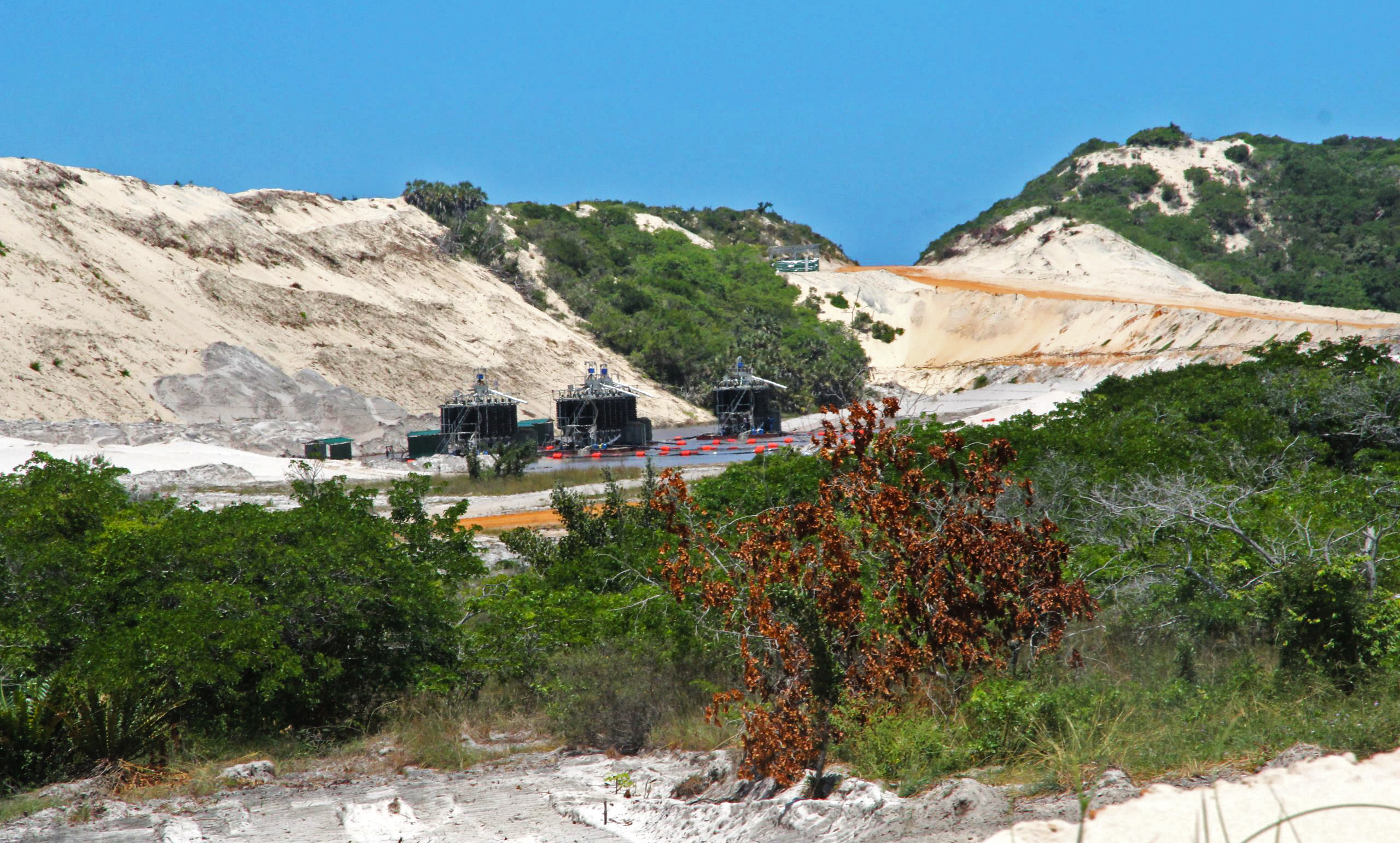
- Rapid loss of mangroves in Mozambique’s Zambezia Province is linked to the activities of Mozambique Heavy Sand Company VIII, which is part-owned by an influential Chinese mining group, Mongabay has found.
- The mangrove loss occurred inside a site considered “one of the most diverse and productive river delta systems in the world.”
- Satellite imagery suggests it was caused by what appears to be a blocked waterway where sand mining activities took place between 2022 and 2026.
- Increasingly, environmentalists are raising the alarm about the environmental impacts of heavy minerals prospecting and mining in vast sections along Mozambique’s coast.
A sand mining operation along the coast of central Mozambique’s Zambezia Province decimated hundreds of hectares of mangroves in just a few years, a Mongabay investigation has found.
The area is under the control of Mozambique Heavy Sand Company VIII, part-owned by the Jinan Yuxiao Group, an influential Chinese mining group claiming to hold more than 500,000 hectares (1.24 million acres) of land in mining concessions in Mozambique. That’s an area larger in size than 700,000 soccer fields. These concessions mostly target heavy mineral sands that primarily yield titanium ores that are used in the production of everything from paints to plastics and sunscreen.
Environmental activists are raising the alarm about the risks from heavy minerals mining along Mozambique’s coast and local media has documented the growing threat from it. “All of our coastal zones have these heavy mineral sands projects,” Fatima Mimbire, an advocate for transparency in Mozambique’s mining sector, told Mongabay, adding that. most mineral sand mining companies in Mozambique were Chinese. “These companies are destroying without concern for the environment, without concern for the people.”
Global Mangrove Watch (GMW), a platform built to track where mangroves are recovering and where they are in retreat, first signaled the losses in the Chinde district of Zambezia. Lammert Hilarides, an earth observation specialist at Wetlands International (WI), told Mongabay how he started noticing an uptick in mangrove deforestation alerts from the region in late 2023. WI is one of the organizations that designed and now helps run GMW.
In the years that followed, Hilarides, a senior technical officer at WI, tracked alerts from the area. By painstakingly analyzing the pattern of the alerts, he concluded that human activities were likely responsible for the losses.
Coastal riches
Mozambique, a country in southern Africa with a coastline of 2,700 kilometers (1,680 miles) along the Indian Ocean, boasts the greatest expanse of mangrove forests in East Africa, spread across 304,263 hectares (751,850 acres).
Mangrove trees and shrubs are able to survive salty and brackish water that would prove fatal to other vegetation. Salinity in the surrounding water sucks moisture from other plants, leaving behind poisonous residue. Mangrove species have evolved to filter the salt, which allows them to thrive along coastlines, in estuaries and in intertidal zones.
The country’s mangrove cover was in steady decline between 2015 and 2022, according to GMW data. Every year since Mozambique has seen net gains in mangrove cover, though it isn’t clear how much of that is the result of mangrove reforestation efforts. The country’s mangroves are being lost to both natural disasters and human activities.
These trees guard their seashore habitats, acting as a buffer against rising tides and the fury of cyclones that hit the coastal country with devastating frequency. Mangroves are also lost to these natural disasters. Haphazard sand mining along the Mozambican coast not only poses a growing threat to these marine and estuarine ecosystems but also erodes a vital defense against climatic disasters.
“This area in the Zambezi delta stood out because it is very atypical,” Hilarides said. “[Usually] we see a good number of alerts from this region but they are mostly from natural coastal erosion or storms.” This prompted GMW’s GIS (Geographic Information Systems) expert to review the satellite images from the time the alerts appeared. “The satellite images showed one of the estuaries being closed off by sand mining activity,” he said.

“Mozambique is a rich country when it comes to heavy sands, very rich in ilmenite,” said José Mendes, chairman of the Geological and Mining Association of Mozambique, a scientific organization representing geoscientists and mining sector professionals.
Deltas often have a higher concentration of heavy mineral sands because different river channels tend to deposit a lot of sediment, which is the case in the Zambezi delta, Mendes said. The minerals are found along riversides, sandy beaches and in sand dunes along the coast.
Extracting heavy minerals from sandy coasts tends to reshape coastlines and displace sediments. Satellite imagery seen by Mongabay suggests that between early 2022 and 2026, these activities blocked a waterway in the Zambezi delta, severing a connection between the estuary and sea.
Changing the hydrology of such systems, by cutting off the influx of seawater, for example, alters the chemistry of the waterlogged soils and can prove fatal to mangroves.
“What concerns me the most is the fact that some of these projects are implemented without having any environmental impact assessment,” said Mimbire, who is also a member of the steering committee for the Extractive Industries Transparency Initiative, a Norway-based group that works on improved natural resource governance. Mozambique became a member of EITI in 2009.
She described visiting sites where heavy mineral sands mining occurs and seeing first-hand the destruction of coasts, dunes and islands.

Foreign interests target Mozambique’s heavy mineral sands
Mozambique’s coastal regions have long been targeted for sand, mostly used in construction and extracted by local operators. But in the past two decades, its heavy mineral sands are increasingly drawing foreign interest because of the presence of critical mineral ores such as ilmenite, zircon and rutile. Zirconium is derived from zircon, which usually occurs alongside ilmenite. Rutile and ilmenite are raw materials for the production of titanium dioxide pigment. Mozambique is a leading supplier of titanium feedstock in global markets.
A review of mining licenses by Mongabay showed that the coast of Mozambique, especially in the provinces of Inhambane, Zambezia, Nampula and to some extent Cabo Delgado in the north, is pockmarked with concessions for exploration and mining activities. Most of these are for areas of heavy mineral sands, like the license held by the Mozambique Heavy Sand Co. VIII in Chinde.
The concession in Chinde where mangrove loss was detected by Hilarides is 3,281 hectares (8,108 acres) in size and sits within the larger Zambezi delta. The delta is a Ramsar site, or a wetland of global significance, because it is considered “one of the most diverse and productive river delta systems in the world.”
By stitching together satellite imagery, Hilarides documented the progressive loss of mangroves over four years. In that time, new roads opened up in the estuarine land and large vessels appeared in narrow waterways. By early 2026, all that was left of a stretch of once-lush mangroves was a water channel surrounded by parched bare land.
“It is a tragedy,” Hilarides said. “With a better thought-through plan it could have been prevented. The connection between the estuary and the sea could have been maintained and very likely the mangroves could be saved.”

The Mozambican Ministry of Mineral Resources and Energy did not respond to questions from Mongabay about the mangrove loss, nor to requests to share mining licenses data. The mining licenses data accessed by Mongabay originates from the ministry; however, the government does not permit using this information for litigation purposes.
Public records accessed by Mongabay show that Mozambique Heavy Sand Co. VIII is a wholly-owned subsidiary of Jinan Yuxiao Group. Jinan Yuxiao is the main investor in a constellation of companies that operate under the banner of Mozambique Heavy Sand. Several sister companies like Mozambique Heavy Sand V, Mozambique Heavy Sand VII, VIII and IX have sprouted up in the past decade. Together, these companies held at least six active licenses in early 2026, while four more were under review.
On its website, the Jinan Yuxiao group claims to be “the largest Chinese-funded mining enterprise in Mozambique.” Its mining concessions are estimated to have zirconium and titanium reserves of more than 100 million tons, according to the company.
The group has been operational in Zambezia Province since at least 2015, when Mozambique Heavy Sands obtained a license covering 8,613 hectares (21,283 acres) there. In 2022, it held two concessions covering at least 8,786 hectares (21,711 acres) in Chinde district alone. Official records from 2023 show Mozambique Heavy Sand Company was exporting thousands of tons of ilmenite ore from mines in Zambezia.
Mozambique Heavy Sand VIII applied for a mining license in 2022 for the area that subsequently suffered the mangrove loss. In this case, the mangrove die-off appeared to have happened during the exploratory phase in an area now under mining concession “11015”.
The other known companies linked to the Jinan Yuxiao Group in Mozambique include the Africa Great Wall Mining Development Company and Cronus Minerals. The group is continuously seeking to expand and currently holds more than “60 exploration rights”, according to its website.

Mitigating the damage
A disregard for environmental damage is a recurring concern in this sector, as highlighted by civil society organizations. In 2024, a report by Centro de Integridade Pública CIP, the Mozambique chapter of Transparency International, documented environmentally harmful practices by three companies: Dingsheng Minerals in Gaza Province, Haiyu (Mozambique) Mining Co. Lda in Nampula province, and Jinan Yuxiao’s Africa Great Wall Mining Development Company in Zambezia.
“The data obtained in the field shows that the companies have caused adverse environmental and social impacts, which include the destruction of sensitive habitats, environmental pollution, inappropriate resettlement and/or unfair compensation in the resettlement process,” the report said.
“Each project, according to the quantities of sand being removed, and where it is coming from, requires some sort of mitigation,” Mendes from the Geological and Mining Association said. “It is the responsibility of the concessionaire.”
Mozambique Heavy Sand Company VIII and the Jinan Yuxiao Group had not responded to Mongabay’s questions at the time of publication.
When processed, the minerals being extracted by these companies, such as titanium, have a market value 10 times greater than the value of the ore extracted, Mendes said. But much of the value addition happens abroad with little benefit to Mozambique. China is the leading buyer of titanium feedstock sourced from Mozambique.
“Currently Mozambique has neither the infrastructure or the energy supply for the transformation of the minerals to happen there,” he said. “Concessionaires take advantage of the situation in the country to take local materials and go process them outside.”
The Mozambican government recognizes it is being short-changed. This year it overhauled mining sector regulations, including restricting the export of unprocessed minerals.
However, the new law does not apply retroactively to existing mining licenses, like the one held by Mozambique Heavy Sand Co. Ltd VIII in Zambezia, according to Mimbire.
Hilarides told Mongabay that he was hopeful the Mozambican government would take note of his findings and take action to mitigate the damage while there’s still time. “Restoring the connection between the river and the sea would allow the mangroves to recover naturally,” he said. “It’s a relatively low effort, high reward [action].”
This hope is predicated on the resilience of these trees: If the right conditions in terms of salinity and sediments were restored, the surviving trees could still flourish and bring the mangrove back to life. The window to take action is closing, however, Hilarides said, “The longer you wait the more difficult it becomes.”
Banner image: A representative image of heavy sand mining site off the coast of Mozambique. Image courtesy of Estacio Valoi.
(José Jaco contributed reporting from Mozambique.)
‘The shape of the land will change:’ South African villages resist heavy sands mine

